China’s ‘Xiaokang’ Border Defence Villages along the LAC - International Relations | UPSC Learning
Topics
0 topics • 0 completed
🔍
No topics match your search
China’s ‘Xiaokang’ Border Defence Villages along the LAC
Medium⏱️ 8 min read
international relations
📖 Introduction
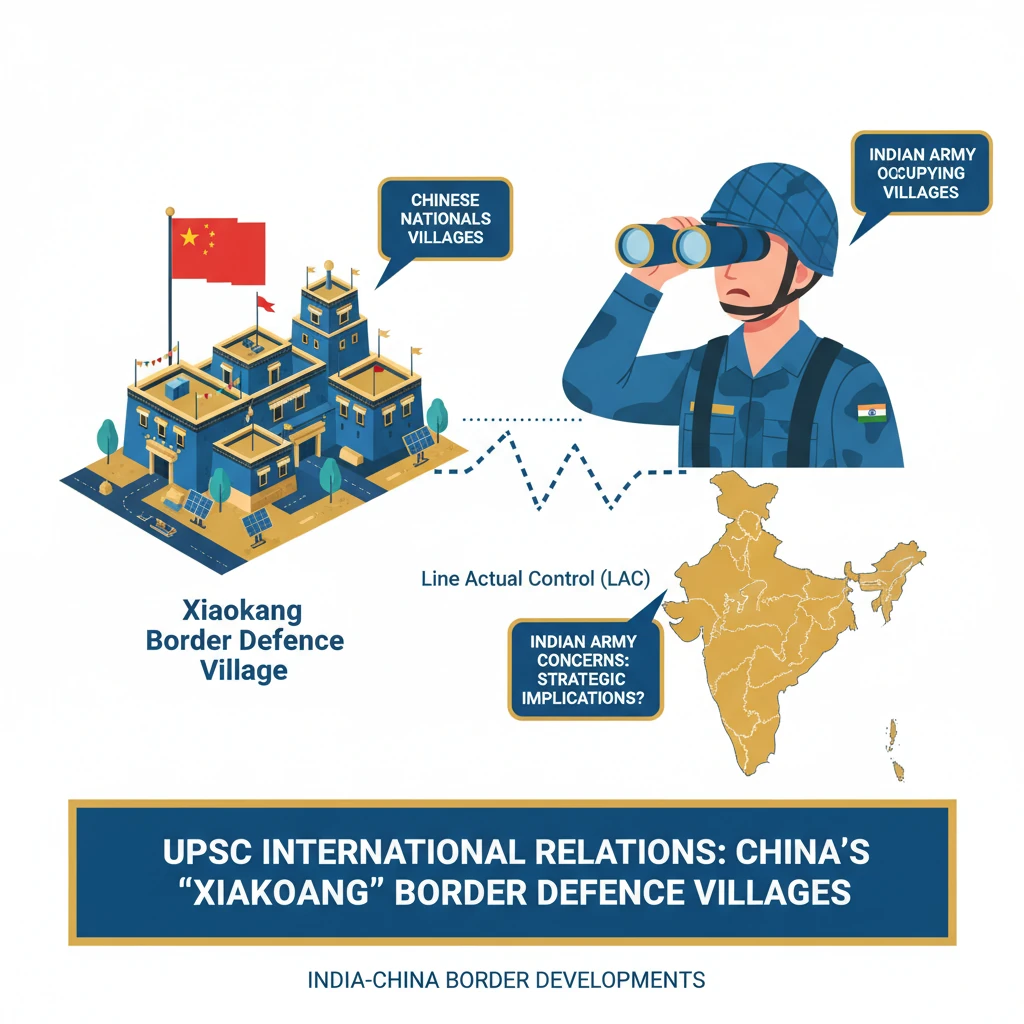
<h4>Context and Recent Developments</h4><p>In recent times, Chinese nationals have begun to occupy previously vacant <strong>“Xiaokang” border defence villages</strong> along the <strong>Line of Actual Control (LAC)</strong> between <strong>India</strong> and <strong>China</strong>. These developments have raised significant concerns for the <strong>Indian Army</strong>.</p><p>The primary worries revolve around the nature of the occupants and the broader strategic implications of these settlements.</p><div class='info-box'><p><strong>Key Event:</strong> Chinese nationals occupying <strong>Xiaokang villages</strong> along the <strong>LAC</strong>.</p><p><strong>Indian Concern:</strong> Nature of occupants and strategic implications.</p></div><h4>Understanding “Xiaokang” Border Defence Villages</h4><p>The <strong>Xiaokang</strong>, or <strong>“well-off villages”</strong>, are a crucial part of <strong>China’s strategic infrastructure development initiative</strong>. They are specifically located along its borders, particularly the <strong>LAC</strong> with <strong>India</strong>.</p><p>These villages are strategically built in regions where <strong>territorial claims are contested</strong> or where <strong>China</strong> perceives a need to reinforce its <strong>sovereignty</strong>.</p><div class='key-point-box'><p><strong>Notable Occupation Areas:</strong> Villages opposite <strong>Lohit Valley</strong> and the <strong>Tawang sector</strong> in <strong>Arunachal Pradesh</strong>.</p></div><h4>Dual-Use Infrastructure: A Strategic Design</h4><p>A defining characteristic of these villages is their <strong>dual-use infrastructure</strong>. This means they are designed to serve multiple purposes simultaneously.</p><p>They function both as <strong>civilian settlements</strong> and potentially as locations for <strong>military presence</strong>, allowing for flexible deployment and resource utilization.</p><div class='info-box'><p><strong>Dual-Use:</strong> Combines <strong>civilian settlement</strong> with potential <strong>military presence</strong>.</p></div><h4>Associated Concerns for India</h4><p>The establishment and occupation of these villages present several significant challenges and concerns for <strong>India</strong>.</p><ul><li><strong>Territorial Claims:</strong> <strong>China’s construction of 628 such villages</strong> along <strong>India’s borders</strong> with the <strong>Tibet Autonomous Region</strong> is seen as a concerted effort to assert and solidify <strong>territorial claims</strong> along the <strong>LAC</strong>. This necessitates heightened vigilance from <strong>Indian military strategists</strong>.</li><li><strong>Military Implications:</strong> The inherent <strong>dual-use nature</strong> of these villages raises serious concerns about increased <strong>militarisation</strong> along the already tense <strong>LAC</strong>. This could escalate border tensions.</li><li><strong>Uncertain Intentions:</strong> A lack of transparency from <strong>China</strong> regarding the specific purpose and the scale of the civilian population in these villages creates deep suspicion. This opacity significantly hinders any efforts towards <strong>trust-building</strong> between the two nations.</li></ul><div class='exam-tip-box'><p><strong>UPSC Insight:</strong> The <strong>Xiaokang villages</strong> are a classic example of <strong>grey-zone tactics</strong> used by states to alter ground realities without direct military confrontation. Understanding their dual-use nature is crucial for analyzing <strong>India-China border dynamics</strong>.</p></div><h4>India’s Counter Initiatives along the LAC</h4><p>In direct response to <strong>China’s infrastructure development</strong>, <strong>India</strong> has significantly intensified its own efforts to enhance <strong>border infrastructure since 2019</strong>.</p><ul><li><strong>Vibrant Villages Program:</strong> This program aims to modernise <strong>663 border villages</strong>. Specifically, <strong>17 villages</strong> have been selected for development along the <strong>China-India border</strong> in regions such as <strong>Ladakh</strong>, <strong>Himachal Pradesh</strong>, <strong>Uttarakhand</strong>, <strong>Sikkim</strong>, and <strong>Arunachal Pradesh</strong>.</li><li><strong>Border Roads Organization (BRO):</strong> The <strong>BRO</strong> has completed <strong>90 infrastructure projects</strong> along the <strong>India-China border</strong>, with a total value of <strong>Rs 2,941 crore</strong>. As of <strong>September 2023</strong>, <strong>36 projects</strong> are in <strong>Arunachal Pradesh</strong>, <strong>26</strong> in <strong>Ladakh</strong>, and <strong>11</strong> in <strong>Jammu and Kashmir</strong>.</li><li><strong>Major Highway Projects:</strong> The <strong>BRO</strong> is actively involved in constructing key highways, including the <strong>Trans-Arunachal Highway</strong>, <strong>Frontier Highway</strong>, and <strong>East-West Industrial Corridor Highway</strong>. These projects aim to improve connectivity, especially in eastern <strong>Arunachal Pradesh</strong> and the <strong>Tawang region</strong>.</li><li><strong>Border Area Development Programme (BADP):</strong> This is a <strong>centrally sponsored scheme</strong> designed to address the special developmental needs of people living in remote and inaccessible areas near the <strong>international border</strong>. Funds from <strong>BADP</strong> can be utilized for projects related to <strong>Infrastructure</strong>, <strong>Livelihood</strong>, <strong>Education</strong>, <strong>Health</strong>, <strong>Agriculture</strong>, and allied sectors.</li><li><strong>Railways:</strong> <strong>Indian Railways</strong> is constructing strategic rail lines in the <strong>Northeast region</strong>. The primary objective is to facilitate the swift mobilisation of the <strong>Indian Army</strong>, enhancing rapid response capabilities.</li></ul>
💡 Key Takeaways
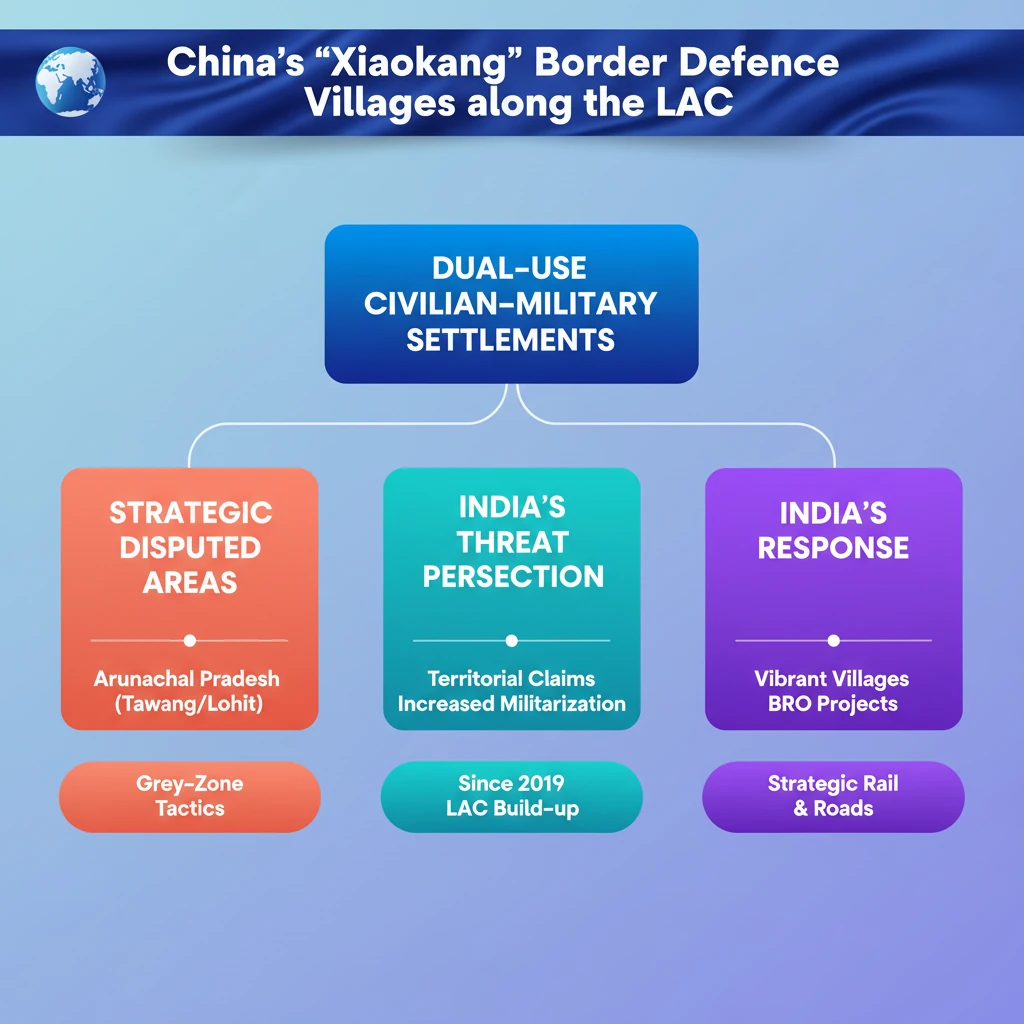
- •Xiaokang villages are China's 'well-off' border settlements with dual civilian-military use.
- •They are strategically built in disputed areas like Arunachal Pradesh (Lohit Valley, Tawang).
- •India views them as a threat, asserting territorial claims and increasing militarization.
- •India's response includes the Vibrant Villages Program, BRO projects, and strategic railway lines.
- •The issue highlights China's grey-zone tactics and India's intensified border infrastructure development since 2019.
🧠 Memory Techniques
95% Verified Content