Regional Dialogue of Secretaries of Security Councils on Afghanistan - International Relations | UPSC Learning
Topics
0 topics • 0 completed
🔍
No topics match your search
Regional Dialogue of Secretaries of Security Councils on Afghanistan
Medium⏱️ 7 min read
international relations
📖 Introduction
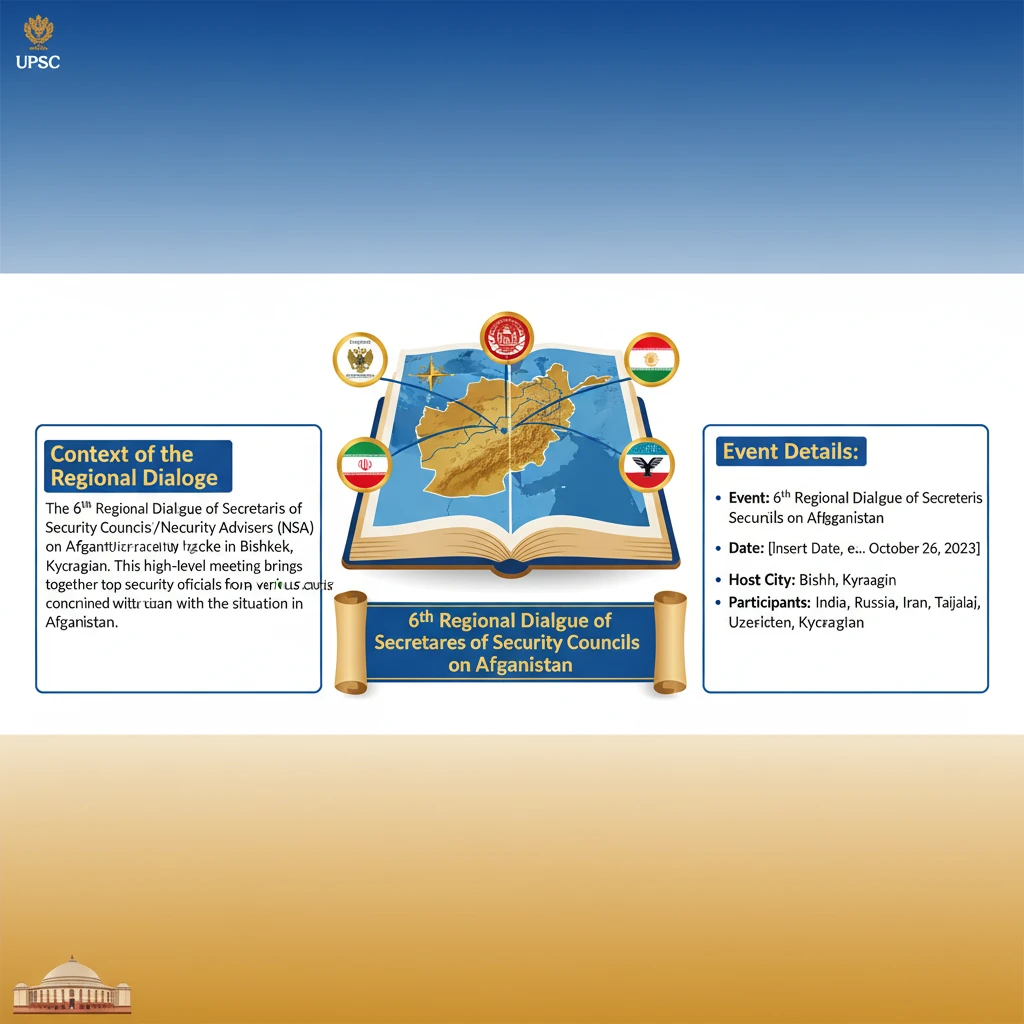
<h4>Context of the Regional Dialogue</h4><p>The <strong>6th Regional Dialogue of Secretaries of Security Councils/National Security Advisers (NSA) on Afghanistan</strong> recently took place in <strong>Bishkek, Kyrgyzstan</strong>. This high-level meeting brings together top security officials from various countries concerned with the situation in Afghanistan.</p><div class='info-box'><p><strong>Event Details:</strong></p><ul><li><strong>Event:</strong> 6th Regional Dialogue of Secretaries of Security Councils/National Security Advisers (NSA)</li><li><strong>Focus:</strong> Afghanistan</li><li><strong>Venue:</strong> Bishkek, Kyrgyzstan</li></ul></div><h4>Purpose of the Dialogue</h4><p>These dialogues serve as crucial platforms for regional stakeholders to discuss the evolving security and humanitarian situation in <strong>Afghanistan</strong>. They aim to foster a collective understanding and coordinated response to the challenges emanating from the country.</p><div class='key-point-box'><p><strong>Key Objective:</strong> To ensure regional stability and address threats such as terrorism, drug trafficking, and humanitarian crises originating from or impacting <strong>Afghanistan</strong>.</p></div><h4>India's Stance and Contribution</h4><p>During the dialogue, <strong>India</strong> strongly reiterated its commitment to a <strong>collective approach to combating terrorism</strong>. This approach aligns with the principles enshrined in <strong>United Nations Security Council Resolution (UNSCR) 2593</strong>.</p><div class='exam-tip-box'><p><strong>UPSC Insight:</strong> India's consistent emphasis on <strong>UNSCR 2593</strong> highlights its principled stand on counter-terrorism and its rejection of any support for terrorist entities operating from Afghan soil. This is vital for <strong>GS Paper 2 (International Relations)</strong> and <strong>GS Paper 3 (Internal Security)</strong>.</p></div><h4>Significance of UNSCR 2593</h4><p><strong>UNSCR 2593</strong>, adopted in <strong>August 2021</strong>, is a landmark resolution that addresses the situation in <strong>Afghanistan</strong> following the Taliban takeover. It specifically calls for the Taliban to prevent Afghan territory from being used to threaten or attack any country or to shelter or train terrorists.</p><div class='info-box'><p><strong>Key Provisions of UNSCR 2593:</strong></p><ul><li>Demands that <strong>Afghanistan</strong> not be used as a base for terrorism.</li><li>Calls for humanitarian access and protection of human rights, including women and minorities.</li><li>Emphasizes the need for an inclusive government.</li></ul></div>
💡 Key Takeaways
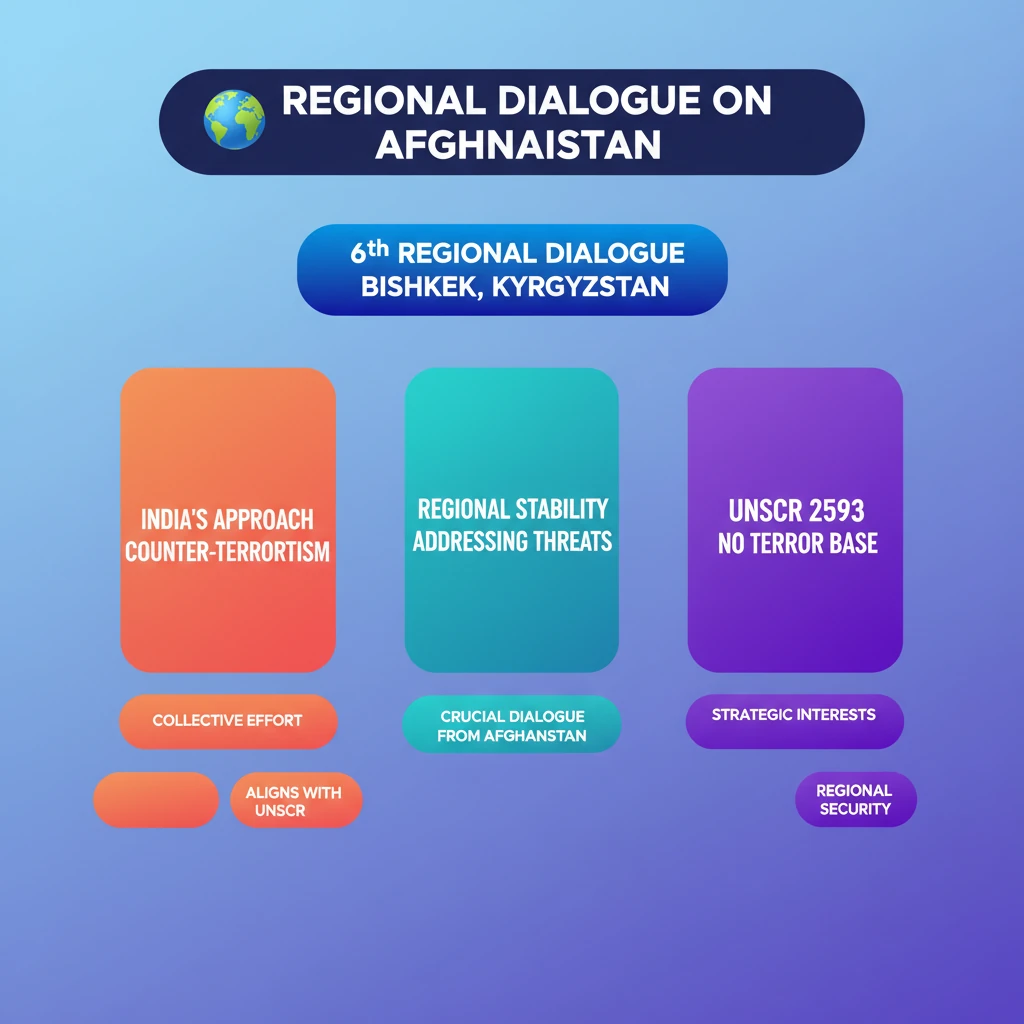
- •The 6th Regional Dialogue on Afghanistan was held in Bishkek, Kyrgyzstan.
- •India emphasized a collective approach to combating terrorism, aligning with UNSCR 2593.
- •These dialogues are crucial for regional stability and addressing threats from Afghanistan.
- •UNSCR 2593 calls for Afghanistan not to be used as a base for terrorism.
- •India's participation reflects its strategic interests and commitment to regional security.
🧠 Memory Techniques
95% Verified Content
📚 Reference Sources
•United Nations Security Council official website (for UNSCR 2593 and 1267 details)
•Ministry of External Affairs (India) press releases
•Reputable international news agencies