LAC vs. LoC: India-China Border Disputes and Management - International Relations | UPSC Learning
Topics
0 topics • 0 completed
🔍
No topics match your search
LAC vs. LoC: India-China Border Disputes and Management
Medium⏱️ 8 min read
international relations
📖 Introduction
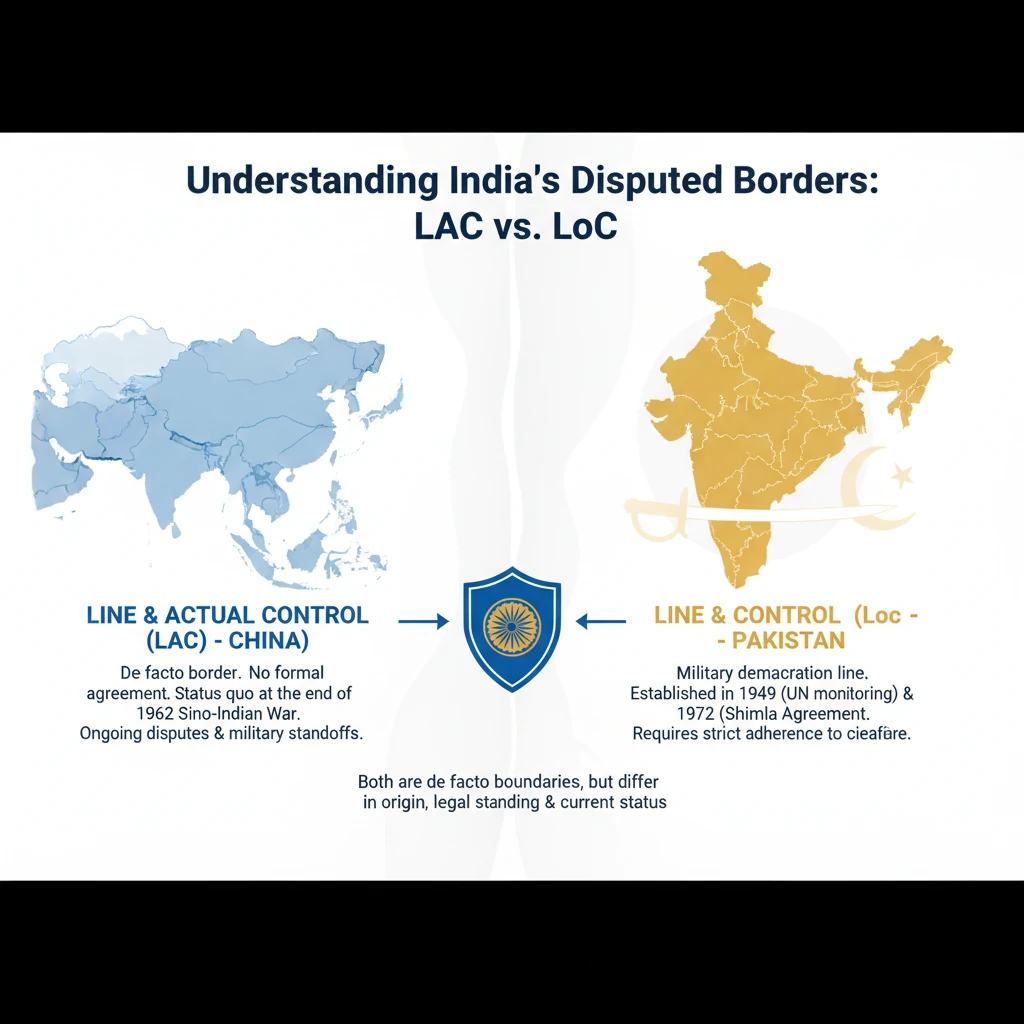
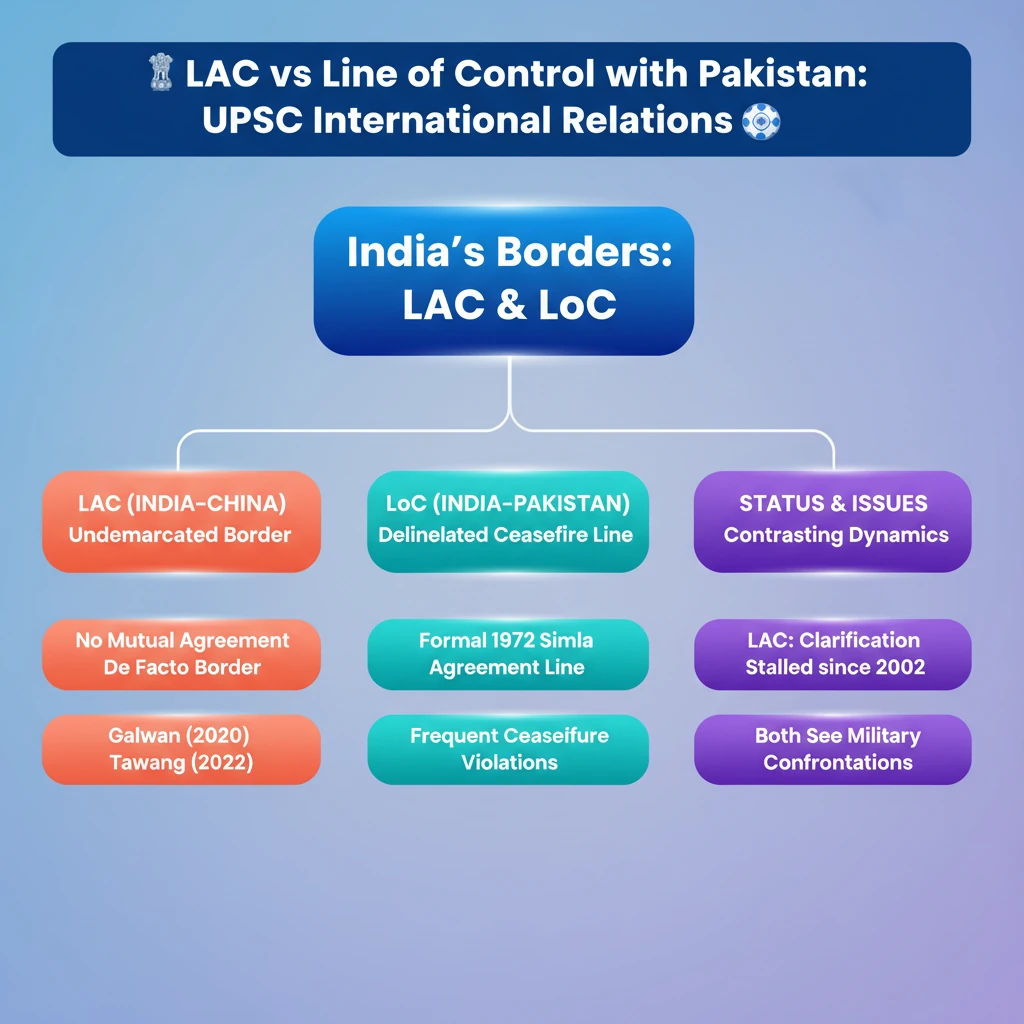
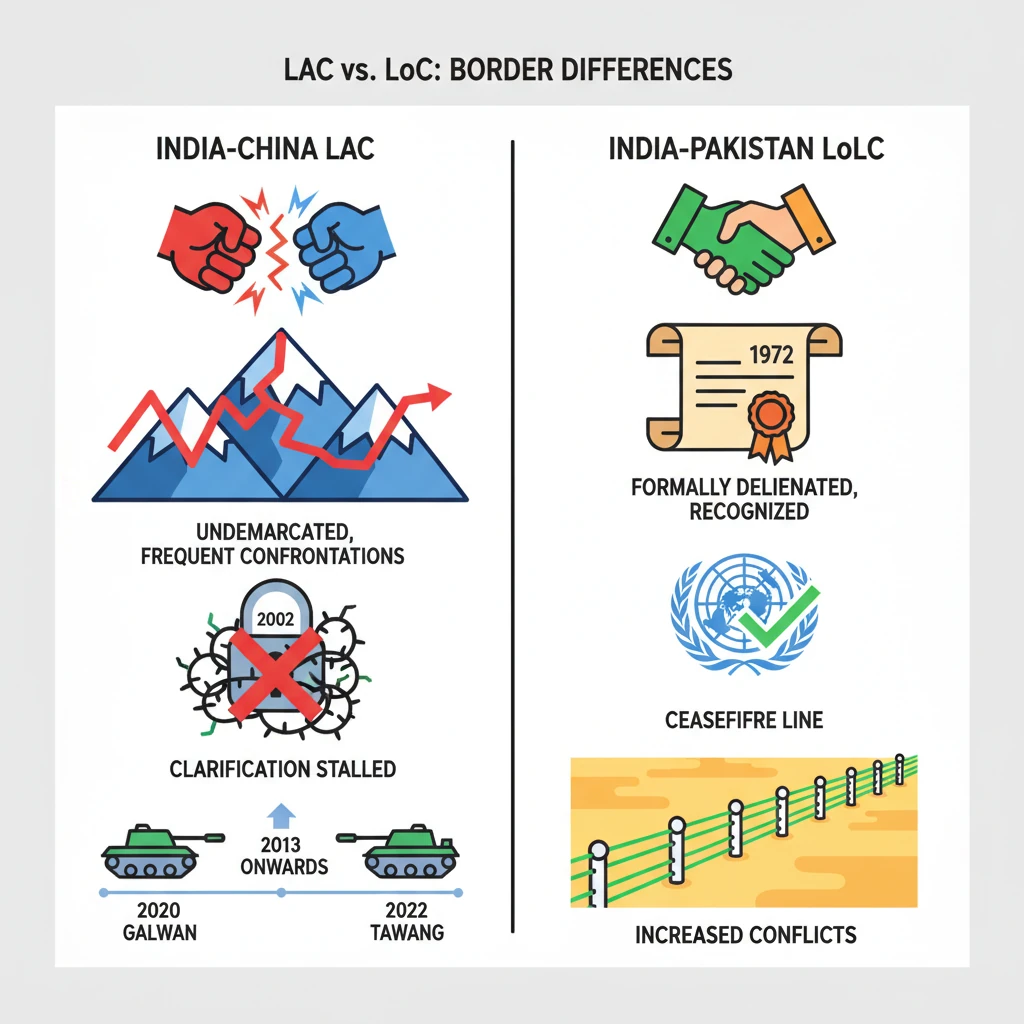
<h4>Understanding India's Disputed Borders: LAC vs. LoC</h4><p>India shares complex and often contested borders with its neighbors, <strong>China</strong> and <strong>Pakistan</strong>. Two critical terms defining these borders are the <strong>Line of Actual Control (LAC)</strong> with China and the <strong>Line of Control (LoC)</strong> with Pakistan.</p><p>While both represent de facto boundaries, their origins, legal standing, and current status differ significantly, impacting India's foreign policy and security strategies.</p><h4>The Line of Actual Control (LAC) with China</h4><p>The <strong>Line of Actual Control (LAC)</strong> is the demarcation line that separates Indian-controlled territory from Chinese-controlled territory in the <strong>Sino-Indian border dispute</strong>. It is a largely undefined and undemarcated boundary.</p><div class="info-box"><p><strong>Formal Acceptance:</strong> India formally accepted the concept of the <strong>LAC</strong> in <strong>1993</strong>. Following this, both sides signed the <strong>Agreement to Maintain Peace and Tranquility at the LAC</strong>.</p></div><p>Despite this agreement, the precise alignment of the <strong>LAC</strong> remains a major point of contention. The two countries have only formally exchanged maps for the <strong>middle sector</strong> of the <strong>LAC</strong>.</p><p>For the more sensitive <strong>Western sector</strong>, maps were “shared” but never formally exchanged. The crucial process of clarifying and delineating the <strong>LAC</strong> has effectively stalled since <strong>2002</strong>.</p><div class="key-point-box"><p><strong>Key Point:</strong> The <strong>LAC</strong> is not agreed upon by both countries, is not delineated on a map signed by both, and is not demarcated on the ground. This ambiguity is a primary cause of frequent border standoffs.</p></div><p>Recent years have witnessed a concerning increase in serious military confrontations along the <strong>LAC</strong>. Observers from both sides agree that such incidents have risen significantly <strong>since 2013</strong>.</p><p>The most severe recent episodes of conflict include the <strong>Galwan Valley clash</strong> in <strong>Ladakh</strong> in <strong>2020</strong> and a skirmish in <strong>Tawang</strong>, <strong>Arunachal Pradesh</strong>, in <strong>2022</strong>. These events highlight the volatile nature of the undemarcated border.</p><h4>The Line of Control (LoC) with Pakistan</h4><p>The <strong>Line of Control (LoC)</strong> is the de facto military control line that divides the Indian-controlled part of <strong>Jammu and Kashmir</strong> from the Pakistan-controlled part of <strong>Gilgit-Baltistan</strong> and <strong>Azad Kashmir</strong>.</p><div class="info-box"><p><strong>Establishment:</strong> The <strong>LoC</strong> was established in <strong>1972</strong> following the <strong>Kashmir War</strong> (also known as the <strong>Indo-Pakistani War of 1971</strong>). It was based on the <strong>ceasefire line</strong> negotiated by the <strong>United Nations (UN)</strong> in <strong>1948</strong>.</p></div><p>Unlike the <strong>LAC</strong>, the <strong>LoC</strong> possesses a higher degree of international recognition and legal validity. It is clearly delineated on a map that has been officially signed by both <strong>India</strong> and <strong>Pakistan</strong>.</p><div class="key-point-box"><p><strong>Key Point:</strong> The <strong>LoC</strong> has international legal validity and is precisely delineated on a map signed by both countries. This formal recognition distinguishes it significantly from the <strong>LAC</strong>.</p></div><p>Despite its formal status, the <strong>LoC</strong> remains a highly militarized and volatile border, frequently witnessing cross-border firing, infiltration attempts, and heightened tensions between the two nuclear-armed nations.</p><h4>Comparative Analysis: LAC vs. LoC</h4><p>Understanding the fundamental differences between these two lines is crucial for comprehending India's strategic challenges. The ambiguity of the <strong>LAC</strong> contrasts sharply with the formal, albeit contested, nature of the <strong>LoC</strong>.</p><div class="highlight-box"><p><strong>LAC (India-China):</strong></p><ul><li><strong>Status:</strong> Not formally agreed upon or delineated on maps by both countries.</li><li><strong>Demarcation:</strong> Not demarcated on the ground.</li><li><strong>Legal Validity:</strong> Lacks international legal recognition as a formal border.</li><li><strong>Clarification Process:</strong> Stalled since <strong>2002</strong>.</li><li><strong>Recent Incidents:</strong> Increased military confrontations, e.g., <strong>Galwan (2020)</strong>, <strong>Tawang (2022)</strong>.</li></ul><p><strong>LoC (India-Pakistan):</strong></p><ul><li><strong>Status:</strong> Established in <strong>1972</strong>, based on <strong>1948 UN ceasefire line</strong>.</li><li><strong>Demarcation:</strong> Delineated on a map signed by both countries and generally understood on the ground.</li><li><strong>Legal Validity:</strong> Possesses international legal validity as a ceasefire line/de facto border.</li><li><strong>Clarification Process:</strong> Clearly defined post-<strong>1971 war</strong>.</li><li><strong>Recent Incidents:</strong> Frequent ceasefire violations, cross-border terrorism.</li></ul></div>
💡 Key Takeaways
- •The LAC (India-China) is an undemarcated, mutually unagreed de facto border, leading to frequent confrontations.
- •The LoC (India-Pakistan) is a formally delineated, internationally recognized ceasefire line established in 1972.
- •Clarification of the LAC has stalled since 2002, especially in the Western sector.
- •Recent LAC conflicts include Galwan (2020) and Tawang (2022), indicating increased military confrontations since 2013.
- •The LoC, despite its formal status, sees frequent ceasefire violations and infiltration attempts.
- •Understanding the distinct legal and practical statuses of LAC and LoC is crucial for India's security and foreign policy.
🧠 Memory Techniques
98% Verified Content
📚 Reference Sources
•Ministry of External Affairs (MEA), Government of India statements
•Reports from reputable Indian think tanks on border security
•Academic analyses of India-China and India-Pakistan border disputes