Russian Consignment to India via INSTC - International Relations | UPSC Learning
Topics
0 topics • 0 completed
🔍
No topics match your search
Russian Consignment to India via INSTC
Medium⏱️ 7 min read
international relations
📖 Introduction
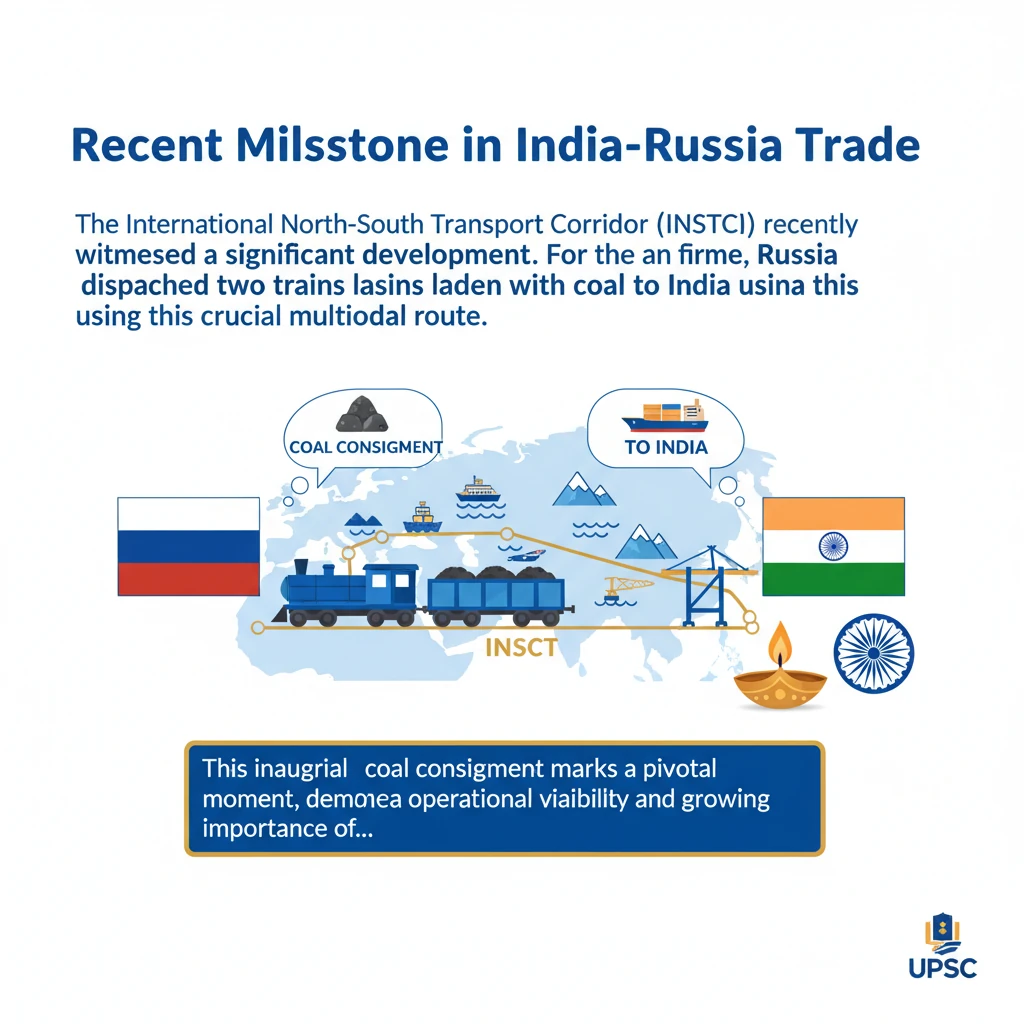
<h4>Recent Milestone in India-Russia Trade</h4><p>The <strong>International North-South Transport Corridor (INSTC)</strong> recently witnessed a significant development. For the first time, <strong>Russia</strong> dispatched two trains laden with <strong>coal</strong> to <strong>India</strong> using this crucial multimodal route.</p><div class='info-box'><p>This inaugural <strong>coal consignment</strong> marks a pivotal moment, demonstrating the operational viability and growing importance of the <strong>INSTC</strong> for direct trade between the two nations.</p></div><h4>Understanding the International North-South Transport Corridor (INSTC)</h4><p>The <strong>INSTC</strong> is a <strong>7,200-km long multimodal network</strong> of ship, rail, and road routes. Its primary objective is to facilitate the movement of freight between <strong>India, Iran, Azerbaijan, Russia, Central Asia, and Europe</strong>.</p><p>It serves as a critical alternative to traditional routes, offering a more efficient and cost-effective pathway for trade. The corridor significantly reduces transit time and logistics costs.</p><div class='key-point-box'><p><strong>Key features of INSTC:</strong><ul><li><strong>Multimodal:</strong> Combines sea, rail, and road transport.</li><li><strong>Strategic Connectivity:</strong> Connects the <strong>Indian Ocean</strong> and <strong>Persian Gulf</strong> to the <strong>Caspian Sea</strong> and onwards to <strong>Northern Europe</strong>.</li><li><strong>Reduced Transit Time:</strong> Expected to cut transit time by <strong>30-40%</strong> compared to the <strong>Suez Canal</strong> route.</li><li><strong>Cost Savings:</strong> Anticipated reduction in freight costs by approximately <strong>30%</strong>.</li></ul></p></div><h4>Significance of the Russian Coal Consignment</h4><p>The successful transit of <strong>Russian coal</strong> through the <strong>INSTC</strong> underscores the corridor's potential to reshape regional trade dynamics. It provides a direct and sanctions-resilient pathway for goods.</p><p>This development is particularly relevant in the current geopolitical climate, offering <strong>Russia</strong> an alternative export route and ensuring a stable supply of resources for <strong>India</strong>.</p><div class='exam-tip-box'><p><strong>UPSC Insight:</strong> Questions on <strong>INSTC</strong> often focus on its geopolitical implications, economic benefits, and its role in <strong>India's foreign policy</strong> (e.g., <strong>Connect Central Asia Policy</strong>). Understand its strategic importance beyond just trade.</p></div>
💡 Key Takeaways
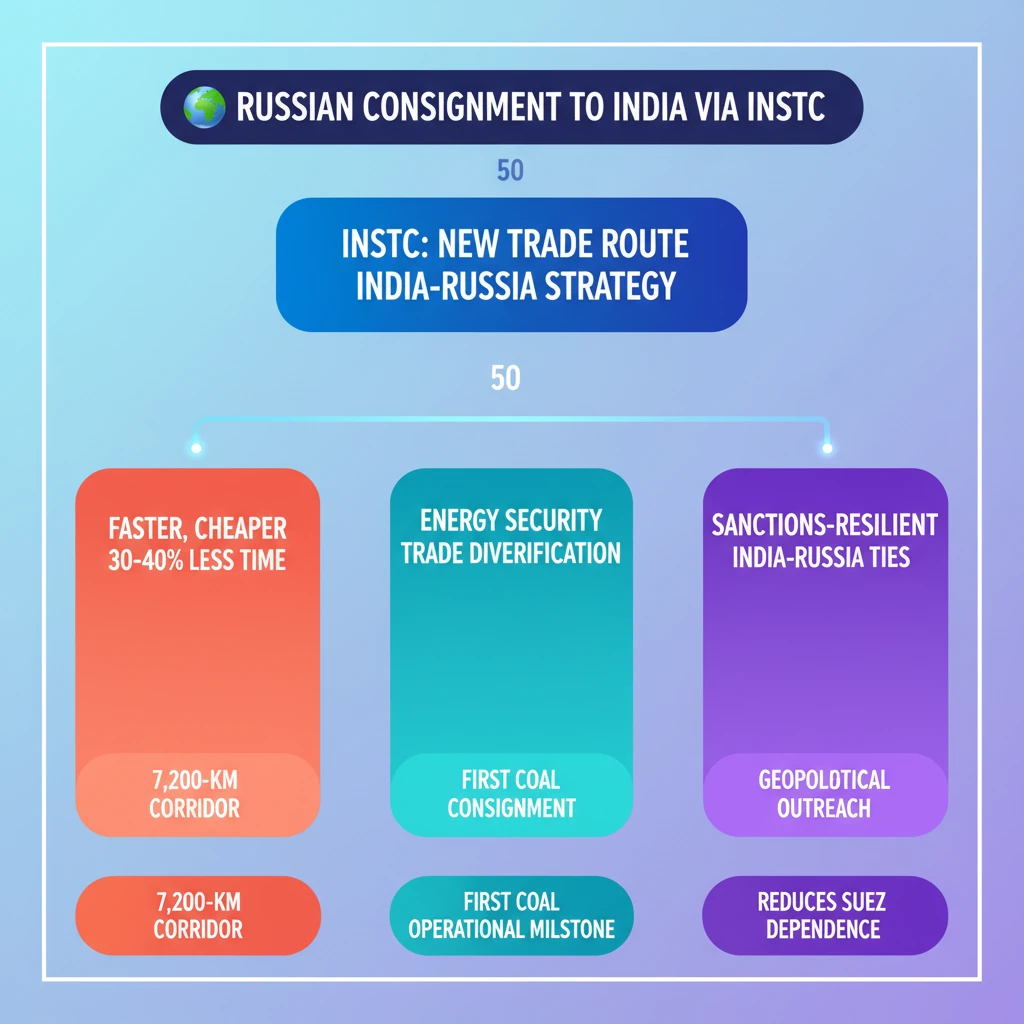
- •INSTC is a 7,200-km multimodal transport corridor connecting India, Iran, Russia, and Central Asia.
- •Russia recently sent its first coal consignment to India via INSTC, marking a significant operational milestone.
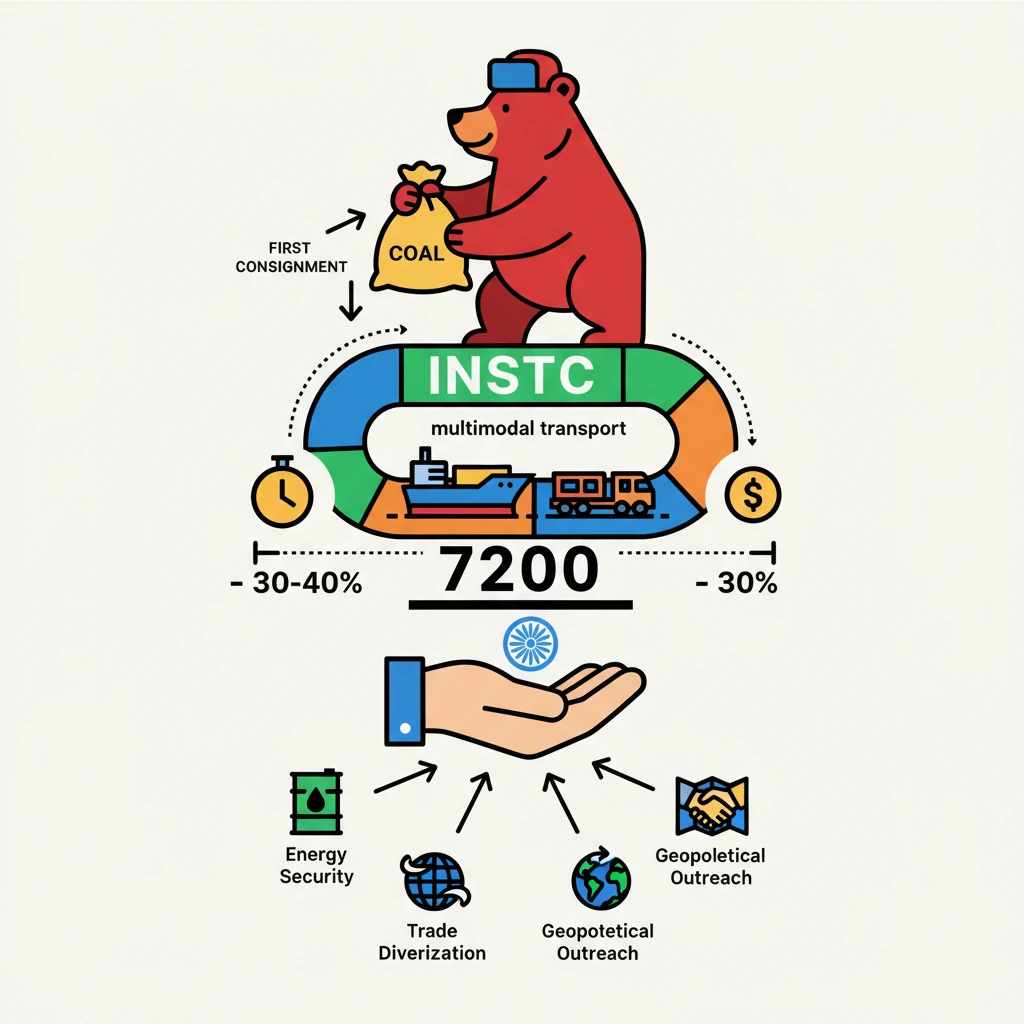
- •The corridor reduces transit time by 30-40% and costs by 30% compared to the Suez Canal route.
- •INSTC is crucial for India's energy security, trade diversification, and geopolitical outreach.
- •It offers a sanctions-resilient trade route, strengthening India-Russia economic ties.
🧠 Memory Techniques
95% Verified Content
📚 Reference Sources
•Press Information Bureau (PIB)
•The Hindu newspaper archives
•Indian Express newspaper archives
•PTI (Press Trust of India) reports