Pravasi Bharatiya - International Relations | UPSC Learning
Topics
0 topics • 0 completed
🔍
No topics match your search
Pravasi Bharatiya
Medium⏱️ 7 min read
international relations
📖 Introduction
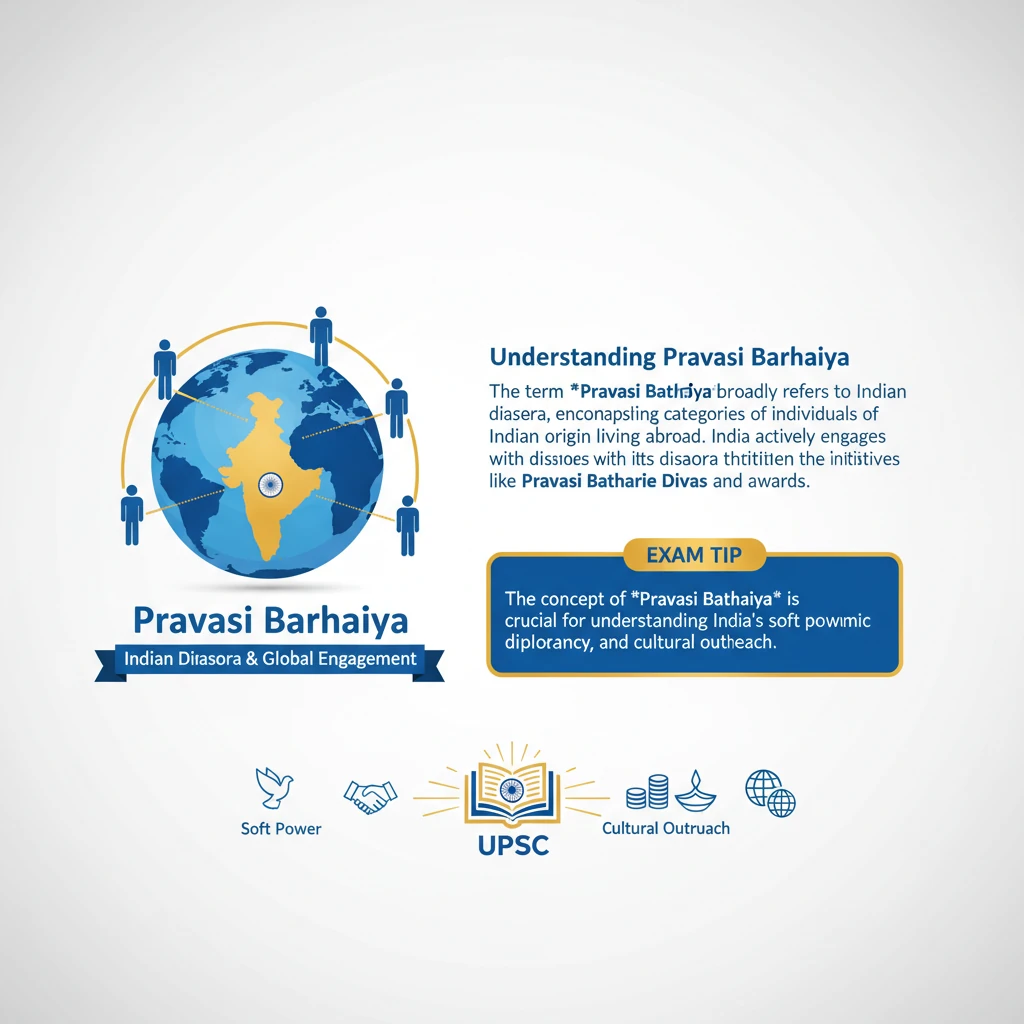
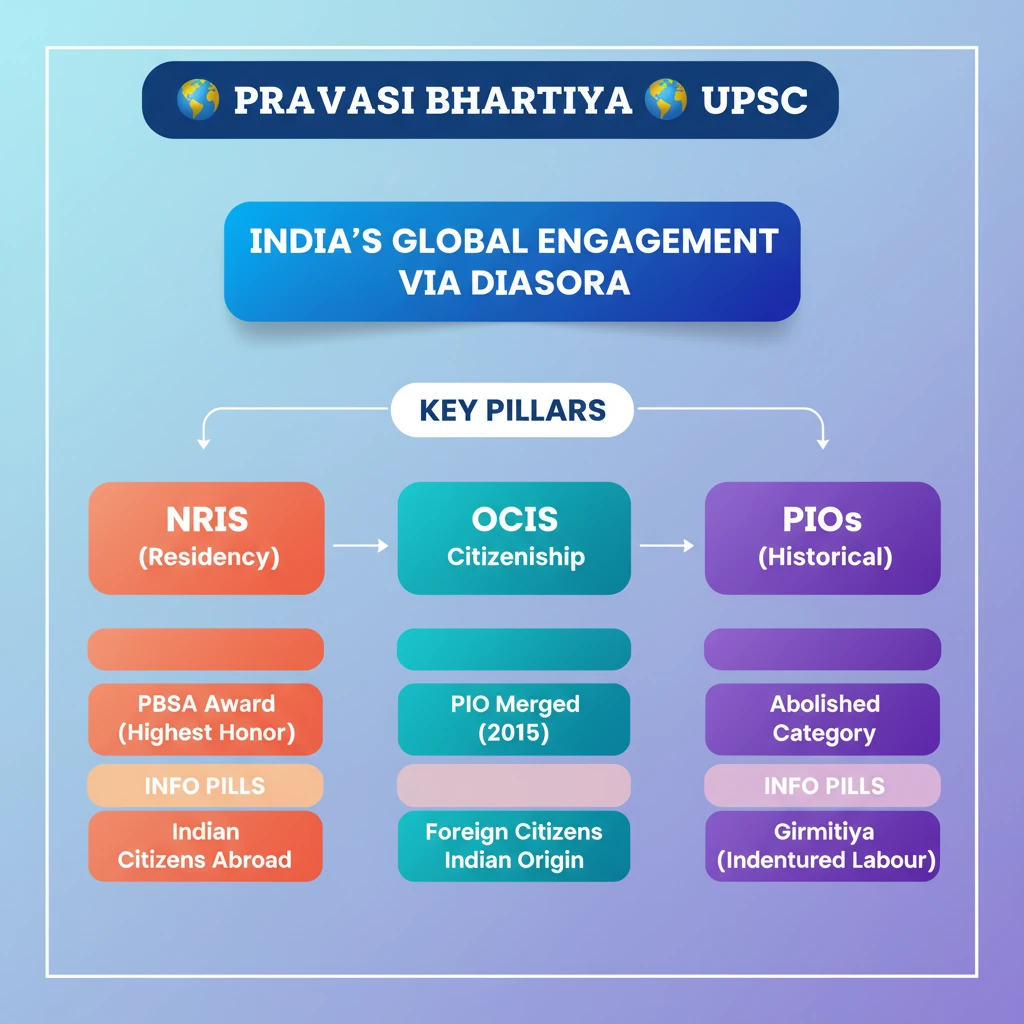
<h4>Understanding Pravasi Bharatiya</h4><p>The term <strong>Pravasi Bharatiya</strong> broadly refers to the Indian diaspora, encompassing various categories of individuals of Indian origin living abroad. India actively engages with its diaspora through initiatives like the <strong>Pravasi Bharatiya Divas</strong> and awards.</p><div class='exam-tip-box'><p>The concept of <strong>Pravasi Bharatiya</strong> is crucial for understanding India's soft power, economic diplomacy, and cultural outreach, often appearing in <strong>GS Paper II (International Relations)</strong>.</p></div><h4>Pravasi Bharatiya Samman Award (PBSA)</h4><p>The <strong>Pravasi Bharatiya Samman Award (PBSA)</strong> represents the highest honour bestowed by the President of India. It is presented as part of the <strong>Pravasi Bharatiya programme</strong>.</p><div class='info-box'><p><strong>Award Recipients:</strong> The PBSA is conferred upon a <strong>Non-Resident Indian (NRI)</strong>, a <strong>Person of Indian Origin (PIO)</strong>, or an organisation/institution established and managed by them.</p></div><p>This prestigious award serves to acknowledge and celebrate the significant contributions of the <strong>Indian diaspora</strong>. It highlights their efforts in enhancing India's image globally and supporting its various causes.</p><p>Furthermore, the award recognizes their dedication to the welfare and upliftment of the local Indian communities in their respective countries of residence.</p><h4>Classification of Indian Diaspora</h4><p>The Indian diaspora is categorized into distinct groups based on their residency and citizenship status. Understanding these classifications is essential for policy formulation and engagement.</p><div class='key-point-box'><p>The classification includes <strong>Non-Resident Indians (NRIs)</strong>, <strong>Persons of Indian Origin (PIOs)</strong>, and <strong>Overseas Citizens of India (OCIs)</strong>, each with specific legal definitions and implications.</p></div><h4>Non-Resident Indians (NRIs)</h4><p><strong>Non-Resident Indians (NRIs)</strong> are Indian citizens who reside outside India. Their status is primarily determined by the duration of their stay in India during a financial year.</p><div class='info-box'><p><strong>NRI Criteria:</strong> A person is considered an <strong>NRI</strong> if they are in India for:<br><ul><li>Less than <strong>182 days</strong> in a financial year, OR</li><li>Less than <strong>365 days</strong> in the preceding <strong>4 years</strong> AND less than <strong>60 days</strong> in the current year.</li></ul></p></div><h4>Persons of Indian Origin (PIOs)</h4><p>A <strong>Person of Indian Origin (PIO)</strong> referred to a foreign citizen who had a historical connection to India. This category was significant for many years.</p><div class='info-box'><p><strong>PIO Definition:</strong> A foreign citizen (excluding certain nationalities) who:<br><ul><li>Previously held an <strong>Indian passport</strong>, OR</li><li>Whose parents or grandparents were <strong>born in India</strong>, OR</li><li>Is a spouse of a <strong>citizen of India</strong> or a <strong>PIO</strong>.</li></ul></p></div><p>However, certain nationalities were explicitly excluded from applying for PIO status. These included citizens of <strong>Pakistan, Afghanistan, Bangladesh, China, Iran, Bhutan, Sri Lanka</strong>, and <strong>Nepal</strong>.</p><div class='key-point-box'><p><strong>Important Update:</strong> The <strong>PIO category</strong> was officially <strong>abolished in 2015</strong>. It was subsequently <strong>merged with the Overseas Citizen of India (OCI) category</strong> to streamline the process.</p></div><h4>Overseas Citizens of India (OCIs)</h4><p>The <strong>Overseas Citizen of India (OCI)</strong> category was introduced to provide a closer link for foreign nationals of Indian descent. This status offers certain benefits, though it is not full citizenship.</p><div class='info-box'><p><strong>OCI Card Eligibility:</strong> An <strong>OCI card</strong> is granted to a foreign national (excluding nationals of Pakistan and Bangladesh) who:<br><ul><li>Was eligible to become a <strong>citizen of India on January 26, 1950</strong>, OR</li><li>Belonged to a territory that became part of <strong>India after August 15, 1947</strong>.</li></ul></p></div><p>Additionally, <strong>minor children</strong> of such eligible individuals were also qualified to receive <strong>OCI Cards</strong>, further extending the reach of this important category.</p>
💡 Key Takeaways
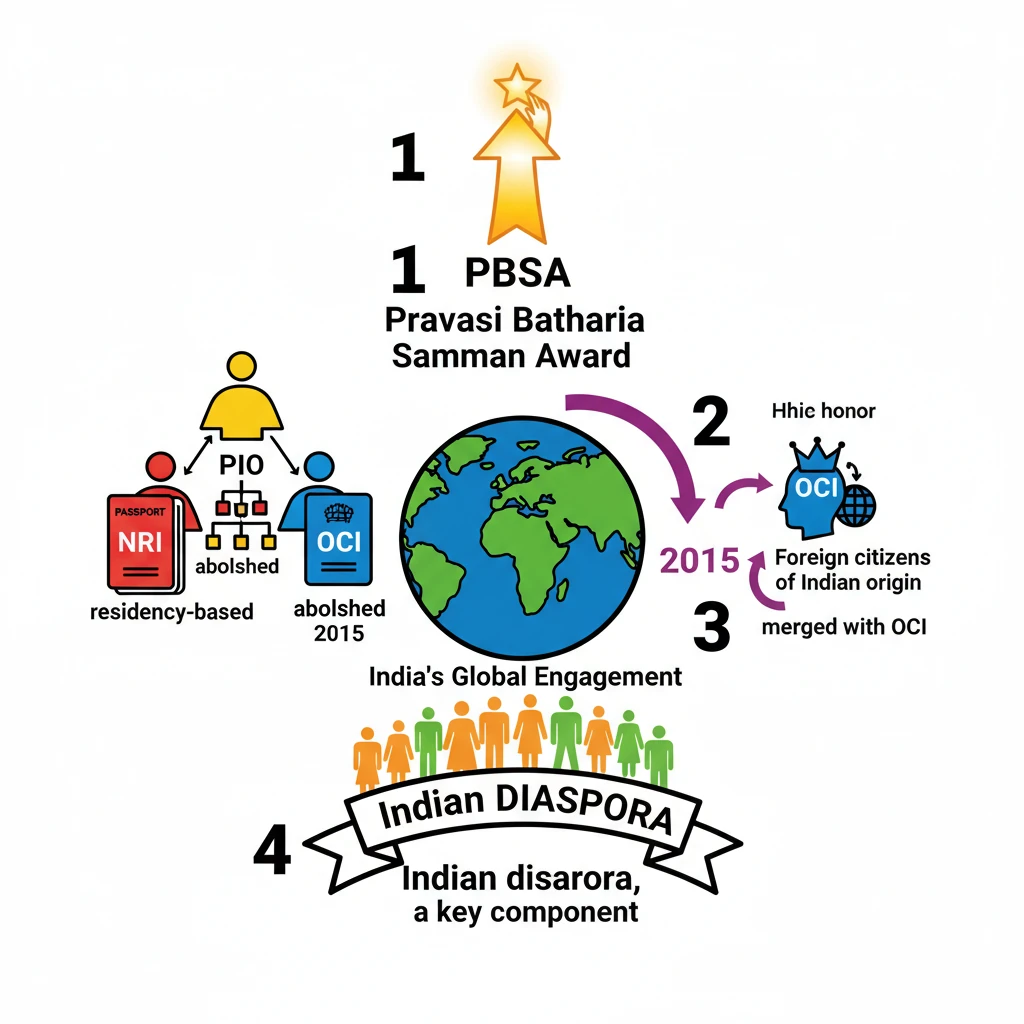
- •Pravasi Bharatiya refers to the Indian diaspora, a key component of India's global engagement.
- •Pravasi Bharatiya Samman Award (PBSA) is the highest honor for NRIs, PIOs, or diaspora organizations.
- •Indian diaspora is classified into NRIs (residency-based), PIOs (historical Indian connection, now merged), and OCIs (foreign citizens of Indian origin).
- •The PIO category was abolished in 2015 and merged with OCI to streamline status.
- •The 'Girmitiya' system represents the historical indentured labour migration that formed early diaspora communities.
- •A comprehensive database for Girmitiyas has been suggested to connect with descendants of early migrants.
🧠 Memory Techniques
98% Verified Content
📚 Reference Sources
•Ministry of External Affairs, Government of India - Overseas Indian Affairs Division
•Citizenship Act, 1955 and subsequent amendments