Codex Alimentarius: Standards, Regional Variations, and India's Role - International Relations | UPSC Learning
Topics
0 topics • 0 completed
🔍
No topics match your search
Codex Alimentarius: Standards, Regional Variations, and India's Role
Medium⏱️ 7 min read
international relations
📖 Introduction
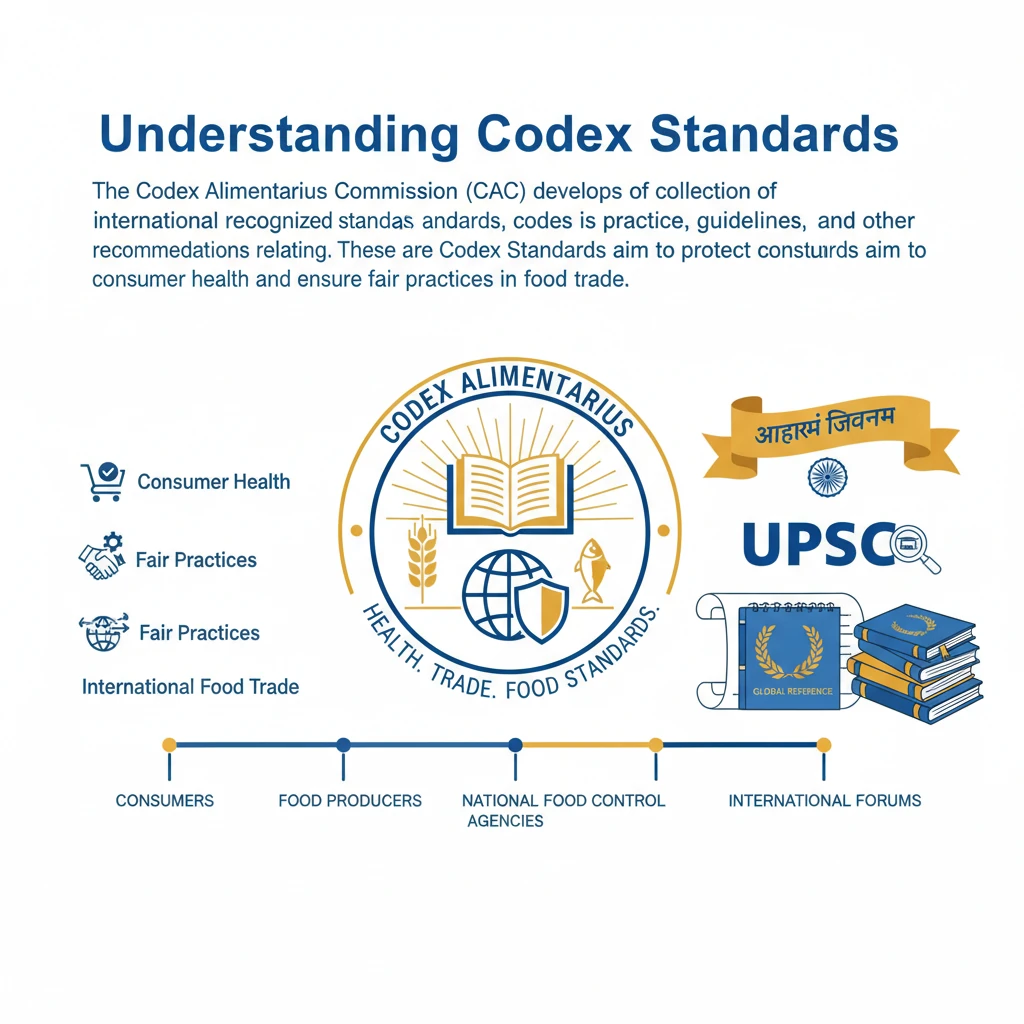
<h4>Understanding Codex Standards</h4><p>The <strong>Codex Alimentarius Commission (CAC)</strong> develops a collection of internationally recognized standards, codes of practice, guidelines, and other recommendations relating to food. These are known as <strong>Codex Standards</strong> and aim to protect consumer health and ensure fair practices in food trade.</p><p>These standards serve as a global reference for consumers, food producers, national food control agencies, and the international food trade. They are crucial for harmonizing food regulations worldwide.</p><h4>Types of Codex Standards</h4><p>Codex Standards are broadly categorized into three main types, each serving a distinct purpose in regulating the global food supply chain:</p><ul><li><p><strong>General Standards, Guidelines and Codes of Practice:</strong> These are foundational texts that apply across various products and categories. They cover critical aspects such as <strong>hygienic practice</strong>, <strong>labelling requirements</strong>, acceptable levels of <strong>contaminants</strong>, use of <strong>additives</strong>, and procedures for <strong>inspection & certification</strong>.</p><div class='info-box'><p>These general standards also address <strong>nutrition</strong>, and the permissible <strong>residues of veterinary drugs and pesticides</strong>, ensuring broad applicability and safety.</p></div></li><li><p><strong>Commodity Standards:</strong> These standards are developed for specific food products or, increasingly, for entire food groups. They define the essential composition, quality factors, and safety requirements for individual commodities, facilitating their trade.</p></li><li><p><strong>Regional Standards:</strong> These are developed by the respective <strong>Regional Coordinating Committees</strong> of the CAC. They are specifically applicable to the food products and trade practices within their designated geographical regions.</p></li></ul><h4>86th Session of the Executive Committee (CCEXEC) of CAC</h4><p>The <strong>86th Session of the Codex Alimentarius Commission’s Executive Committee (CCEXEC)</strong> was a significant event for global food standard setting. It took place at the <strong>FAO Headquarters in Rome</strong>, bringing together key stakeholders from around the world.</p><div class='info-box'><p>The <strong>CCEXEC</strong> plays a vital role in the <strong>CAC</strong>. Its responsibilities include reviewing proposals for new work and diligently monitoring the progress of existing standards development initiatives.</p></div><h4>India's Active Participation and Support</h4><p><strong>India</strong> demonstrated strong leadership and active participation at the <strong>86th CCEXEC session</strong>. The country was represented by the <strong>CEO of FSSAI</strong> (Food Safety and Standards Authority of India), highlighting its commitment to global food safety.</p><div class='key-point-box'><p>During the session, <strong>India</strong> strongly advocated for and supported the advancement of <strong>standards development for various spices</strong>. This initiative is particularly significant for India, given its status as a major global producer and exporter of these commodities.</p></div><p>Specific spices for which India championed standards development included <strong>small cardamom</strong>, <strong>turmeric</strong>, and <strong>vanilla</strong>. Establishing international standards for these products will greatly facilitate smoother and more efficient international trade.</p><p>Beyond spices, <strong>India</strong> also backed the progression of standards for <strong>vegetable oils</strong>. This demonstrates a comprehensive approach to ensuring safety and quality across diverse food categories.</p><p>Furthermore, <strong>India</strong> supported guidelines for the control of hazardous substances such as <strong>dioxin-dioxin-like polychlorinated biphenyls (PCBs)</strong>. This reflects a commitment to addressing chemical contaminants in the food chain.</p><p>Another key area of India's support was the safe use and reuse of <strong>water in food production and processing</strong>. This is crucial for sustainable and hygienic food manufacturing practices globally.</p><p>Finally, <strong>India</strong> championed a proposal for developing <strong>Codex guidance on food safety considerations related to the use of recycled materials in food packaging</strong>. This forward-thinking initiative addresses emerging challenges in food safety and environmental sustainability.</p><div class='exam-tip-box'><p><strong>UPSC Insight:</strong> India's proactive role in <strong>Codex Alimentarius Commission</strong> meetings, especially in advocating for standards for key export commodities like spices, is a significant point for <strong>GS Paper 2 (International Relations)</strong> and <strong>GS Paper 3 (Economy, Food Processing)</strong>. Be prepared to discuss its implications for trade and public health.</p></div>
💡 Key Takeaways
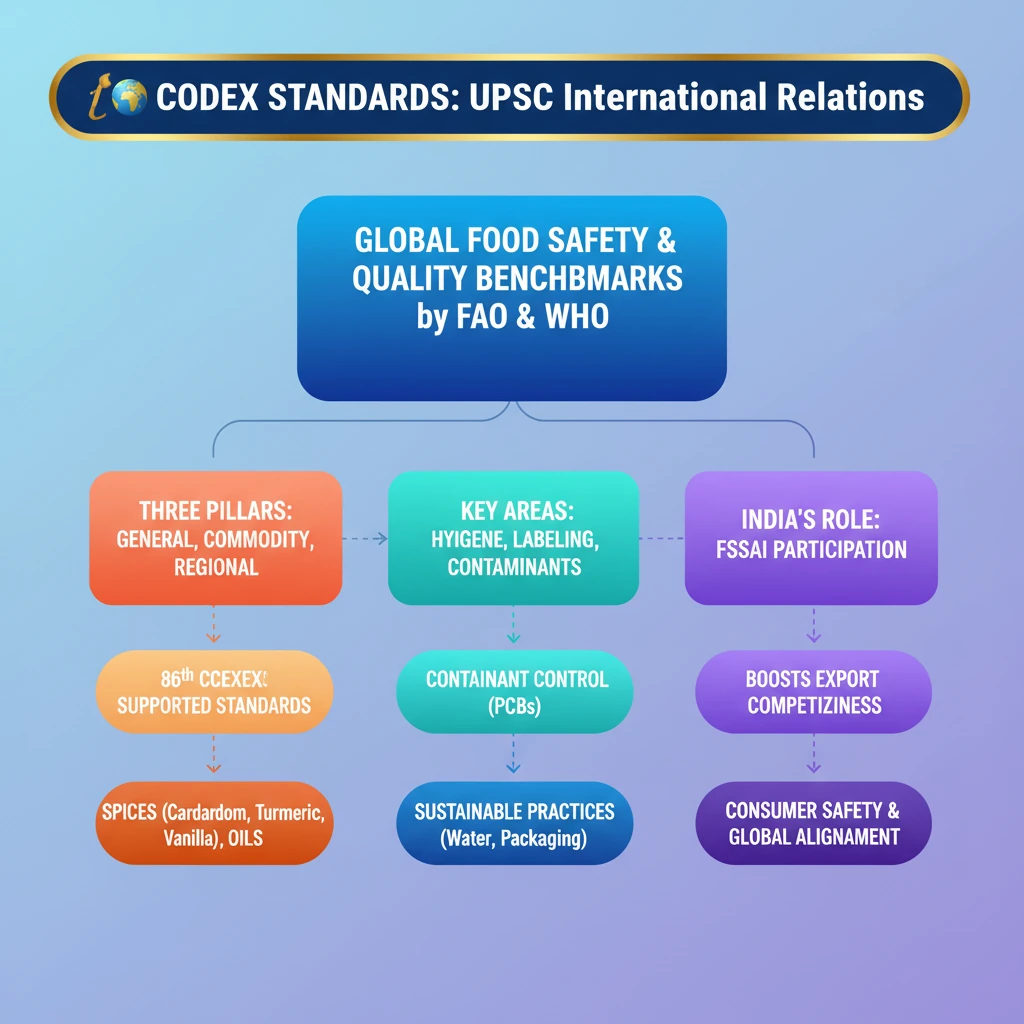
- •Codex Standards are international benchmarks for food safety and quality, developed by FAO and WHO.
- •They are categorized into General, Commodity, and Regional standards, covering hygiene, labeling, contaminants, and specific products.
- •India, represented by FSSAI, actively participates in Codex meetings, advocating for standards in key export areas.
- •At the 86th CCEXEC, India supported standards for spices (cardamom, turmeric, vanilla), vegetable oils, contaminant control (PCBs), and sustainable practices (water reuse, recycled packaging).
- •India's engagement boosts its export competitiveness, ensures consumer safety, and aligns national food regulations with global best practices.
🧠 Memory Techniques

98% Verified Content
📚 Reference Sources
•Food and Agriculture Organization (FAO) Official Website
•World Health Organization (WHO) Official Website
•Food Safety and Standards Authority of India (FSSAI) Official Website