What is Diaspora? - International Relations | UPSC Learning
Topics
0 topics • 0 completed
🔍
No topics match your search
What is Diaspora?
Medium⏱️ 8 min read
international relations
📖 Introduction
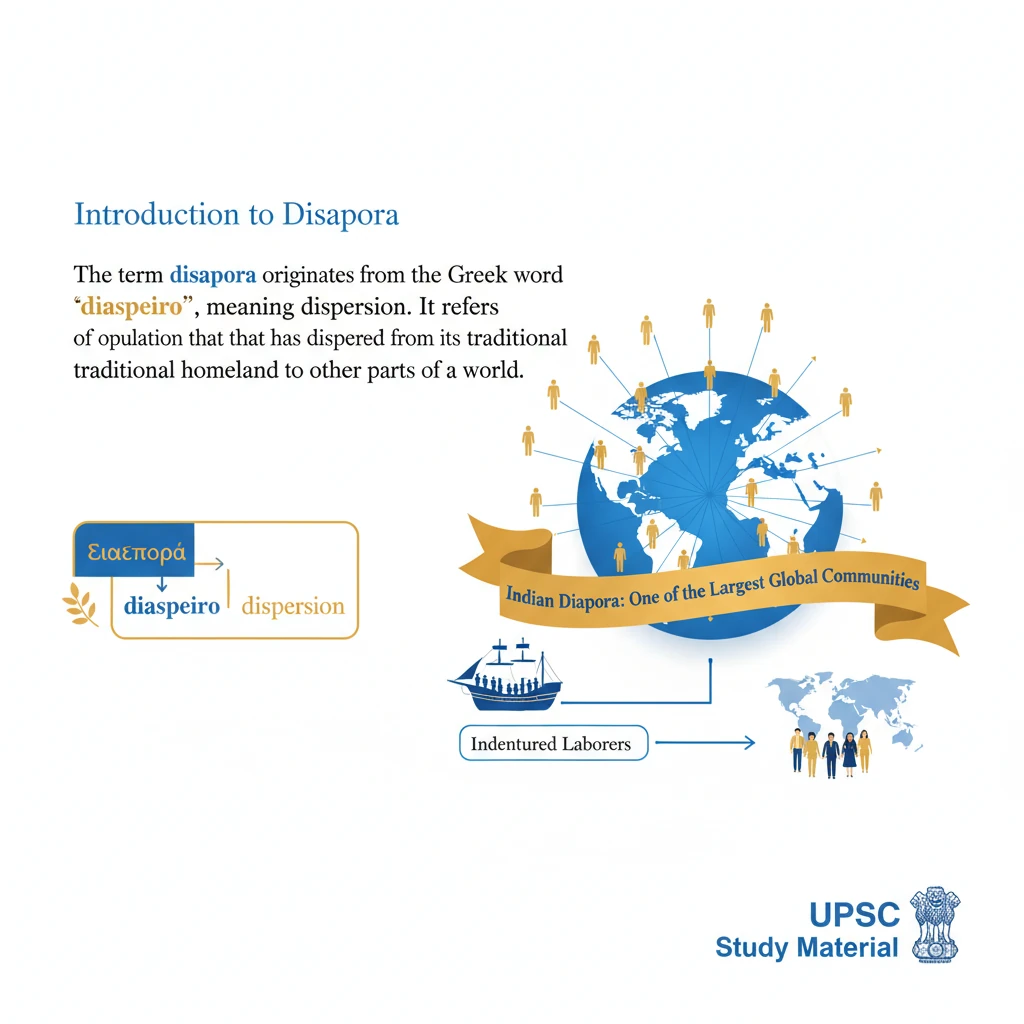
<h4>Introduction to Diaspora</h4><p>The term <strong>diaspora</strong> originates from the <strong>Greek word 'diaspeiro'</strong>, meaning <strong>dispersion</strong>. It refers to a population that has been dispersed from its traditional homeland to other parts of the world.</p><p>The <strong>Indian diaspora</strong> represents one of the largest and most diverse global communities. Its growth began significantly with the historical movement of <strong>indentured laborers</strong>.</p><div class='info-box'><p>The <strong>'Girmitiya' arrangement</strong> involved the transportation of indentured laborers, primarily from India, to various countries. These included regions in the <strong>East Pacific</strong> and the <strong>Caribbean Islands</strong> during the 19th and early 20th centuries.</p></div><h4>Classification of Indian Diaspora</h4><p>The Indian government classifies its overseas population into distinct categories to facilitate engagement and policy formulation. These categories are primarily based on residency status and citizenship.</p><h4>Non-Resident Indians (NRIs)</h4><p><strong>Non-Resident Indians (NRIs)</strong> are Indian citizens who reside outside India for employment, business, or any other purpose, indicating an indefinite stay abroad. They retain their Indian citizenship.</p><div class='info-box'><p>A person is considered an <strong>NRI</strong> if they meet specific residency criteria:</p><ul><li>They are in India for <strong>less than 182 days</strong> in a financial year.</li><li>They are in India for <strong>less than 365 days</strong> in the preceding 4 years AND <strong>less than 60 days</strong> in the current year.</li></ul></div><h4>Persons of Indian Origin (PIOs)</h4><p>The category of <strong>Persons of Indian Origin (PIOs)</strong> historically referred to foreign citizens who had an Indian connection. This connection could be through past Indian citizenship, or through their parents or grandparents being born in India.</p><p>A spouse of an Indian citizen or a PIO was also eligible under this category. However, certain nationalities were excluded from applying.</p><div class='info-box'><p><strong>Excluded Nationalities</strong> for PIO application included citizens of <strong>Pakistan, Afghanistan, Bangladesh, China, Iran, Bhutan, Sri Lanka, and Nepal</strong>.</p></div><div class='exam-tip-box'><p>It is crucial for UPSC aspirants to note that the <strong>PIO card category was abolished in 2015</strong>. It was subsequently <strong>merged with the Overseas Citizen of India (OCI) category</strong>, simplifying the classification system for persons of Indian origin.</p></div><h4>Overseas Citizens of India (OCIs)</h4><p>The <strong>Overseas Citizen of India (OCI)</strong> category was introduced in <strong>2005</strong> as a separate immigration status. It offers certain benefits to foreign nationals of Indian origin, allowing them to live and work in India indefinitely.</p><div class='info-box'><p>An <strong>OCI card</strong> is granted to a foreign national who meets specific eligibility criteria:</p><ul><li>They were eligible to become a citizen of India on <strong>January 26, 1950</strong>.</li><li>They belonged to a territory that became part of India after <strong>August 15, 1947</strong>.</li><li><strong>Minor children</strong> of such individuals are also eligible.</li></ul><p>Similar to PIO, nationals of <strong>Pakistan and Bangladesh</strong> are explicitly excluded from OCI card eligibility.</p></div>
💡 Key Takeaways
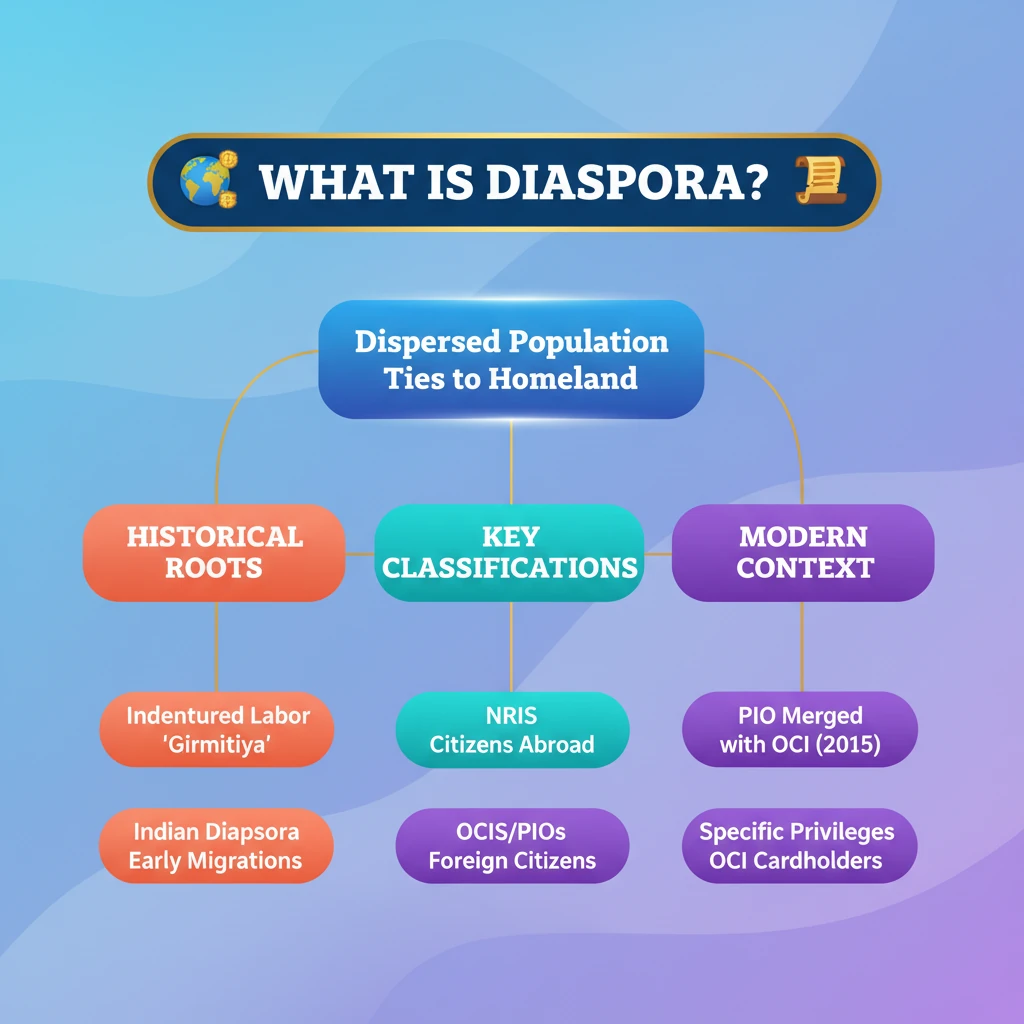
- •Diaspora refers to a dispersed population maintaining ties to its homeland.
- •The Indian diaspora has historical roots in indentured labor ('Girmitiya' system) and modern migrations.
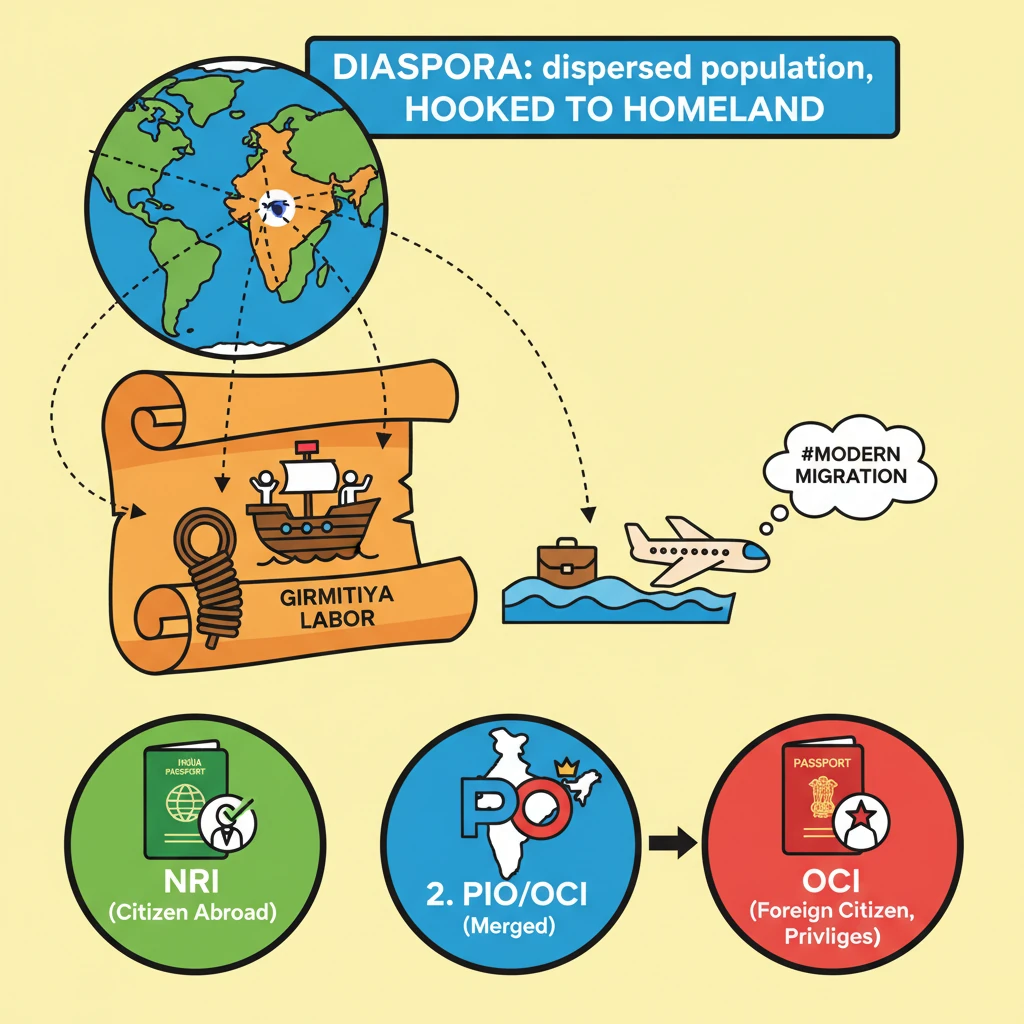
- •Key classifications are Non-Resident Indians (NRIs), Persons of Indian Origin (PIOs - merged with OCI), and Overseas Citizens of India (OCIs).
- •NRIs are Indian citizens residing abroad; OCIs are foreign citizens of Indian origin with specific privileges.
- •The PIO card scheme was abolished in 2015 and merged with OCI.
- •The Indian diaspora significantly contributes to India's economy (remittances) and soft power.
🧠 Memory Techniques
95% Verified Content