India’s Neighbourhood First Policy - International Relations | UPSC Learning
Topics
0 topics • 0 completed
🔍
No topics match your search
India’s Neighbourhood First Policy
Medium⏱️ 6 min read
international relations
📖 Introduction
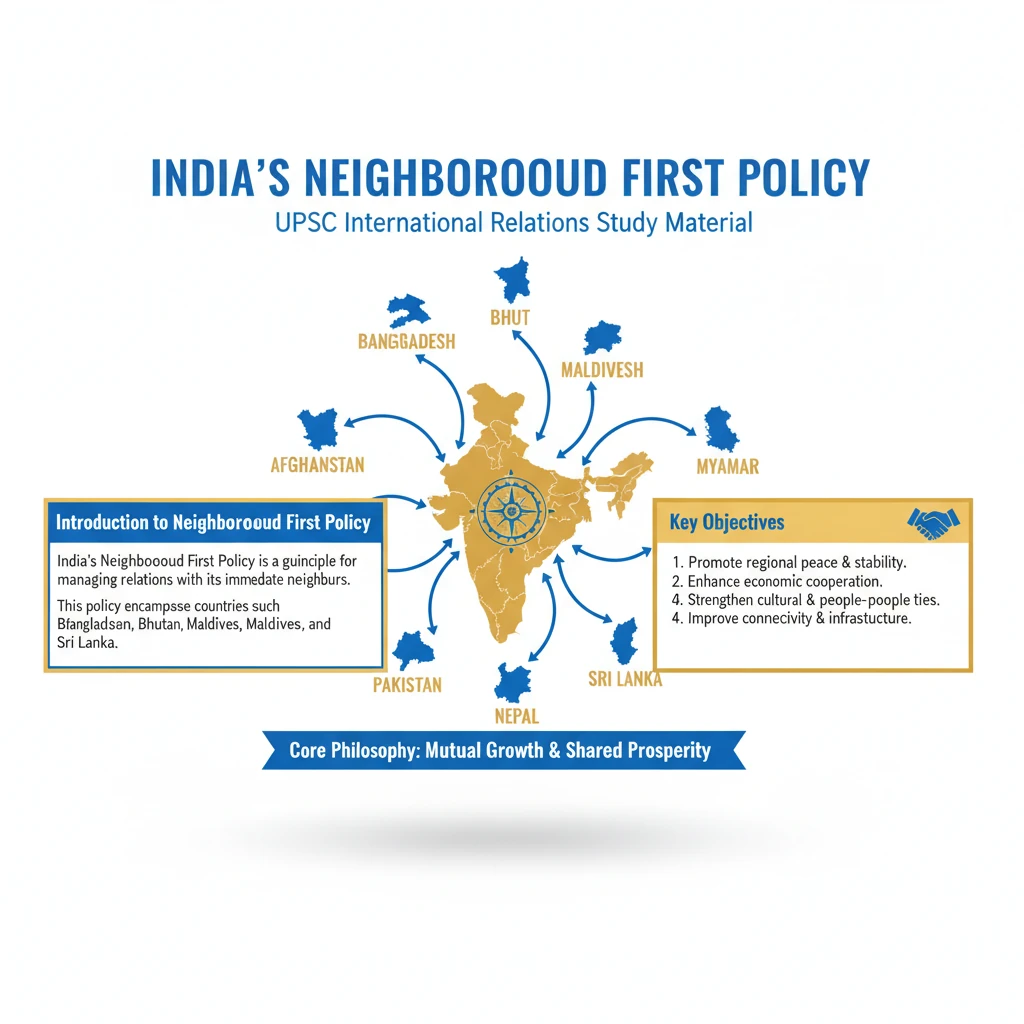
<h4>Introduction to Neighbourhood First Policy</h4><p>India's <strong>Neighbourhood First Policy</strong> is a guiding principle for managing relations with its immediate neighbours.</p><p>This policy encompasses countries such as <strong>Afghanistan</strong>, <strong>Bangladesh</strong>, <strong>Bhutan</strong>, <strong>Maldives</strong>, <strong>Myanmar</strong>, <strong>Nepal</strong>, <strong>Pakistan</strong>, and <strong>Sri Lanka</strong>.</p><div class='key-point-box'><p>The core objective is to foster mutually beneficial and proactive engagement with these nations.</p></div><h4>India-Bhutan Bilateral Relations: A Strong Pillar</h4><p><strong>Bhutan</strong> is a significant partner, characterized by deep civilisational and cultural ties spanning centuries.</p><p>The Bhutanese refer to India as <strong>Gyagar</strong>, meaning 'the holy land,' due to <strong>Buddhism's</strong> origin in India, which is the majority religion in Bhutan.</p><h4>High Impact Community Development Projects (HICDPs)</h4><p>India has committed to supporting grassroots development in Bhutan through <strong>High Impact Community Development Projects (HICDPs)</strong>, also known as <strong>Small Development Projects (SDPs)</strong>.</p><div class='info-box'><ul><li>These are <strong>short-gestation small projects</strong>.</li><li>They are primarily situated in <strong>remote parts of Bhutan</strong>.</li><li>Their aim is to create essential infrastructure and foster <strong>capacity development</strong> at the local level.</li></ul></div><p>Examples of infrastructure include <strong>Farm Roads</strong>, <strong>livestock centres</strong>, and <strong>water supply and irrigation systems</strong>.</p><h4>Hydro-power Cooperation: A Key Economic Pillar</h4><p><strong>Mutually beneficial hydro-power cooperation</strong> is a central element of the bilateral economic relationship between India and Bhutan.</p><p>For Bhutan, hydro-power development serves as a vital catalyst for its <strong>socio-economic development</strong>.</p><div class='info-box'><p>The framework for this cooperation is established under the <strong>2006 inter-governmental cooperation agreement</strong> and its <strong>Protocol signed in 2009</strong>.</p></div><h4>Operational and Under-Implementation Hydroelectric Projects (HEPs)</h4><p>Currently, <strong>four hydroelectric projects (HEPs)</strong> with a combined capacity of <strong>2136 MW</strong> are operational in Bhutan and supply electricity to India.</p><div class='info-box'><ul><li>The <strong>720 MW Mangdechhu project</strong> was commissioned in <strong>August 2019</strong> and formally handed over to Bhutan in <strong>December 2022</strong>.</li></ul></div><p>Two other HEPs, namely <strong>1200 MW Punatsangchhu-I</strong> and <strong>1020 MW Punatsangchhu-II</strong>, are under various stages of implementation in an <strong>Inter-Governmental mode</strong>.</p><h4>Joint Venture Hydro-Project: Kholongchhu</h4><p>India and Bhutan also commissioned their <strong>first-ever joint venture project</strong>, the <strong>500 MW Kholongchhu hydroproject</strong>.</p><div class='key-point-box'><p>This project aims to generate surplus hydroelectricity for Bhutan, which will then be <strong>exported to India</strong>, significantly aiding Bhutan's <strong>revenue generation</strong> and <strong>employment opportunities</strong>.</p></div><h4>Trade Partnership</h4><p>India holds the position of <strong>Bhutan's top trade partner</strong>, serving as both its primary import source and its largest export destination.</p>
💡 Key Takeaways
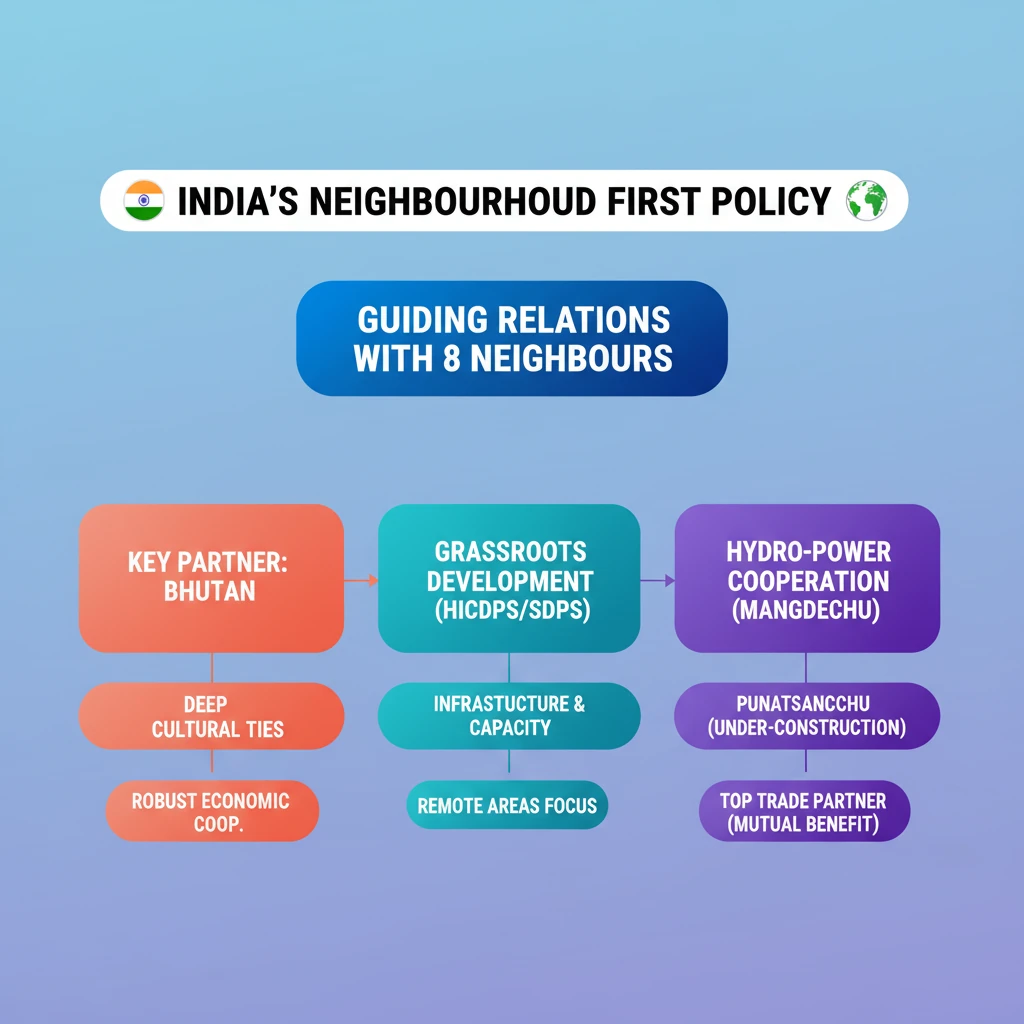
- •Neighbourhood First Policy guides India's relations with its 8 immediate neighbours.
- •Bhutan is a key partner, with deep cultural ties and robust economic cooperation.
- •HICDPs/SDPs support grassroots development, building infrastructure and capacity in remote Bhutan.
- •Hydro-power cooperation is a vital pillar, with operational (e.g., Mangdechhu), under-construction (Punatsangchhu), and joint venture (Kholongchhu) projects.
- •India is Bhutan's top trade partner, underscoring strong economic interdependence and mutual benefit.
🧠 Memory Techniques

98% Verified Content