What is the International North-South Transport Corridor (INSTC)? - International Relations | UPSC Learning
Topics
0 topics • 0 completed
🔍
No topics match your search
What is the International North-South Transport Corridor (INSTC)?
Medium⏱️ 8 min read
international relations
📖 Introduction
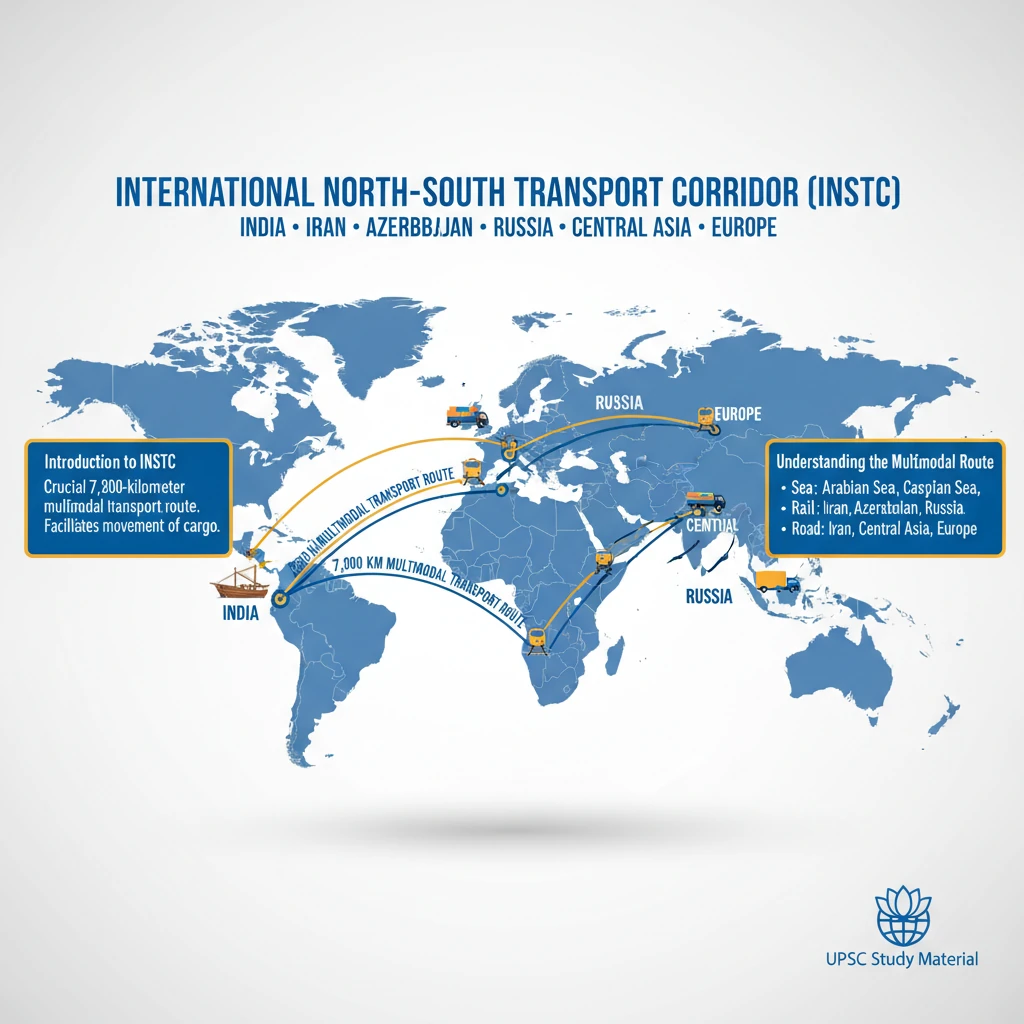
<h4>Introduction to INSTC</h4><p>The <strong>International North-South Transport Corridor (INSTC)</strong> is a crucial <strong>7,200-kilometer multimodal transport route</strong>.</p><p>It aims to facilitate the movement of <strong>cargo</strong> between <strong>India</strong>, <strong>Iran</strong>, <strong>Azerbaijan</strong>, <strong>Russia</strong>, <strong>Central Asia</strong>, and <strong>Europe</strong>.</p><h4>Understanding the Multimodal Route</h4><div class='info-box'><p>The <strong>INSTC</strong> integrates <strong>ship</strong>, <strong>rail</strong>, and <strong>road routes</strong> to ensure efficient and cost-effective transportation of goods.</p></div><p>This comprehensive network links the <strong>Indian Ocean</strong> and the <strong>Persian Gulf</strong> to the <strong>Caspian Sea</strong> via <strong>Iran</strong>, extending further to <strong>northern Europe</strong> through <strong>St. Petersburg</strong> in <strong>Russia</strong>.</p><h4>Origin and Establishment</h4><p>The concept of <strong>INSTC</strong> was formally launched on <strong>September 12, 2000</strong>, in <strong>St. Petersburg</strong>, <strong>Russia</strong>.</p><p>It was established through a <strong>trilateral agreement</strong> signed by <strong>Iran</strong>, <strong>Russia</strong>, and <strong>India</strong> at the <strong>Euro-Asian Conference on Transport</strong>.</p><div class='key-point-box'><p>The primary objective was to foster <strong>transportation cooperation</strong> among the participating member states.</p></div><h4>Expanding Membership and Reach</h4><p>Initially, the agreement involved <strong>Iran</strong>, <strong>Russia</strong>, and <strong>India</strong>.</p><p>Since its inception, the <strong>INSTC membership</strong> has significantly expanded to include <strong>10 additional countries</strong>, bringing the total to <strong>13 member states</strong>.</p><div class='info-box'><p>Current members include: <strong>Azerbaijan</strong>, <strong>Armenia</strong>, <strong>Kazakhstan</strong>, <strong>Kyrgyzstan</strong>, <strong>Tajikistan</strong>, <strong>Turkey</strong>, <strong>Ukraine</strong>, <strong>Syria</strong>, <strong>Belarus</strong>, and <strong>Oman</strong>.</p></div><h4>Key Corridors and Operational Routes</h4><p>The <strong>INSTC</strong> is structured into several vital corridors, each designed to optimize connectivity across different regions.</p><ul><li><strong>Central Corridor:</strong> This route originates from the <strong>Jawaharlal Nehru Port</strong> in <strong>Mumbai</strong>, <strong>India</strong>. It connects to <strong>Bandar Abbas port</strong> (<strong>Iran</strong>) on the <strong>Strait of Hormuz</strong>. Subsequently, it traverses <strong>Iranian territory</strong> via <strong>Nowshahr</strong>, <strong>Amirabad</strong>, and <strong>Bandar-e-Anzali</strong>, along the <strong>Caspian Sea</strong>, reaching <strong>Olya</strong> and <strong>Astrakhan Ports</strong> in <strong>Russia</strong>.</li><li><strong>Western Corridor:</strong> This corridor links the <strong>railway network of Azerbaijan</strong> to that of <strong>Iran</strong>. The connection occurs through the cross-border nodal points of <strong>Astara</strong> (<strong>Azerbaijan</strong>) and <strong>Astara</strong> (<strong>Iran</strong>). From there, it extends to the <strong>Jawaharlal Nehru Port</strong> in <strong>India</strong> via a <strong>sea route</strong>.</li><li><strong>Eastern Corridor:</strong> This route establishes connectivity between <strong>Russia</strong> and <strong>India</strong>. It passes through the <strong>Central Asian countries</strong> of <strong>Kazakhstan</strong>, <strong>Uzbekistan</strong>, and <strong>Turkmenistan</strong>.</li></ul><div class='exam-tip-box'><p>Understanding the specific routes and their geographic significance is crucial for questions on <strong>connectivity projects</strong> and <strong>India's strategic partnerships</strong> in <strong>UPSC Mains GS-II</strong>.</p></div>
💡 Key Takeaways
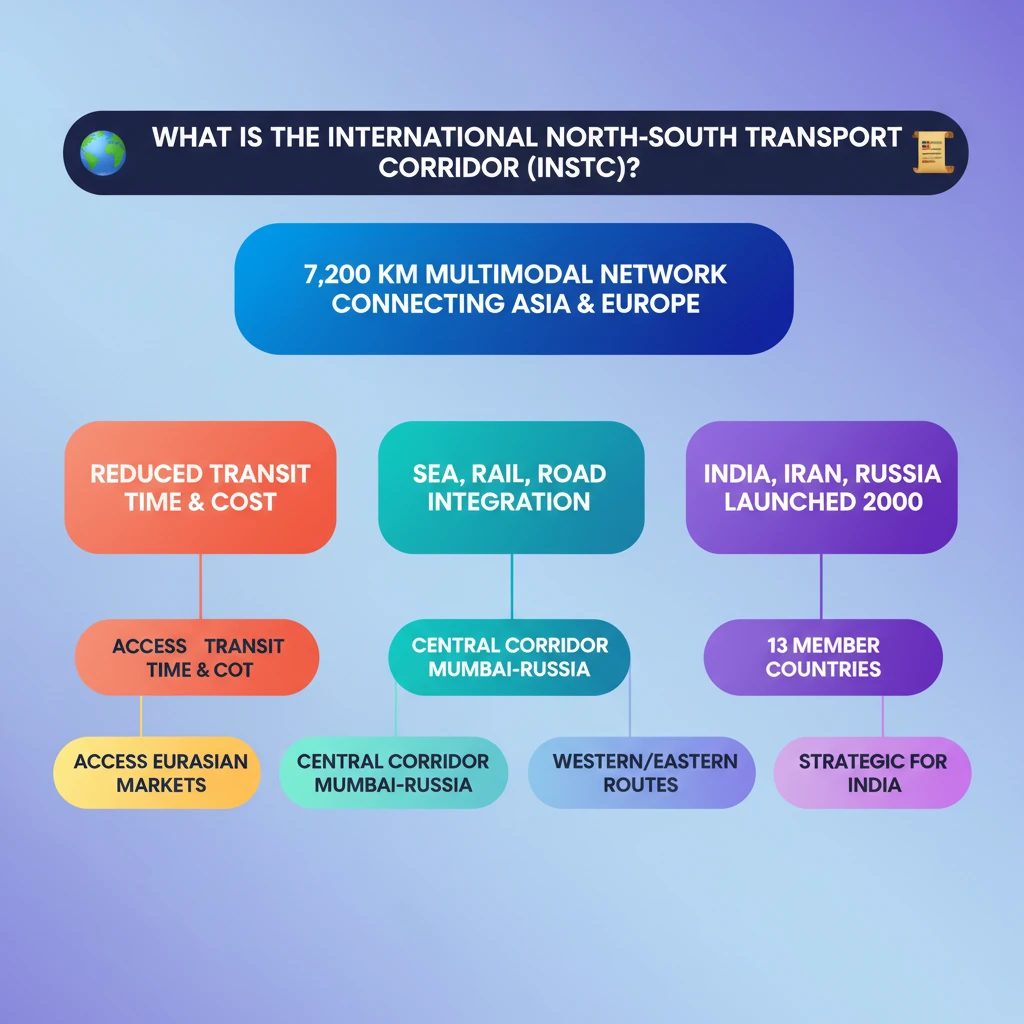
- •INSTC is a 7,200 km multimodal corridor connecting India, Iran, Russia, Central Asia, and Europe.
- •It integrates sea, rail, and road routes, significantly reducing transit time and costs compared to traditional routes.
- •Launched in 2000 by India, Iran, and Russia, its membership has expanded to 13 countries.
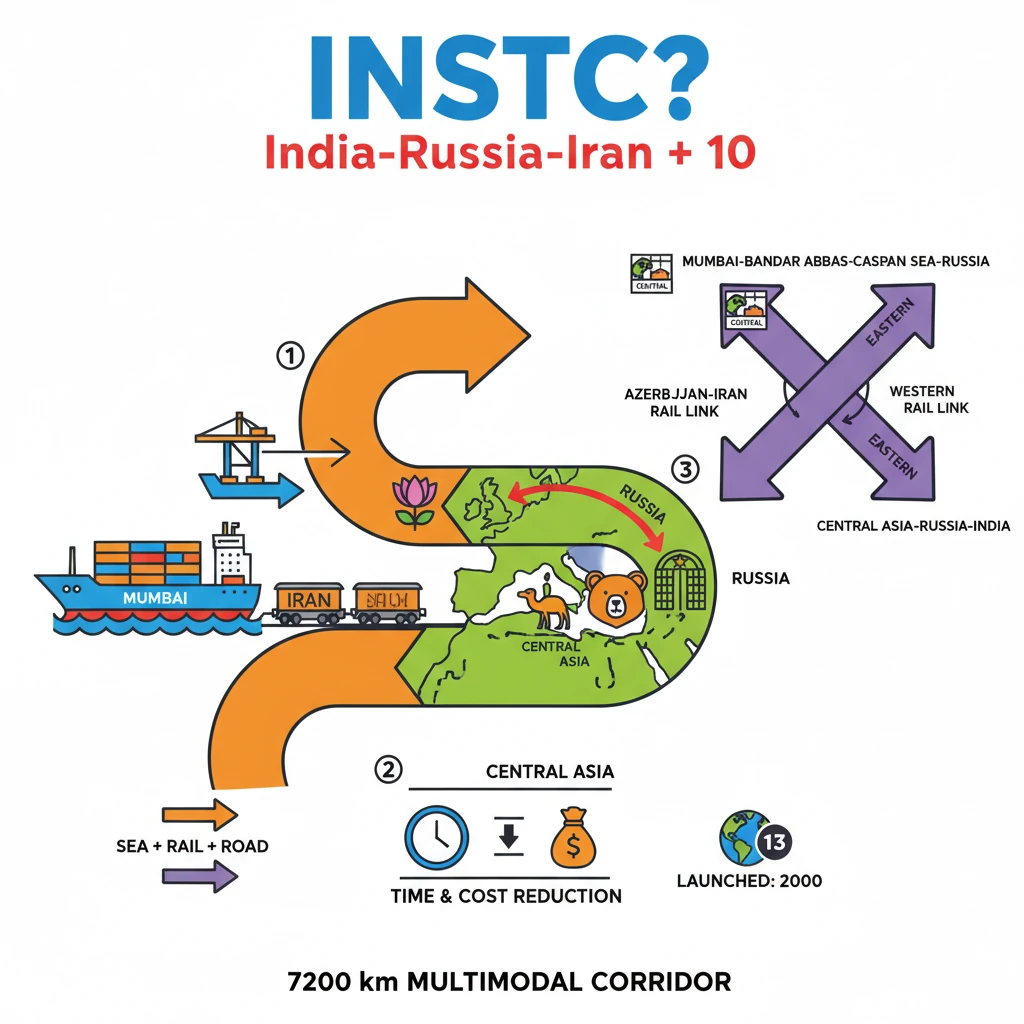
- •Key corridors include Central (Mumbai-Bandar Abbas-Caspian Sea-Russia), Western (Azerbaijan-Iran rail link), and Eastern (Central Asia-Russia-India).
- •Strategically important for India to access Eurasian markets, enhance connectivity, and diversify trade routes.
🧠 Memory Techniques
95% Verified Content
📚 Reference Sources
•Ministry of External Affairs (India) reports on INSTC
•Official INSTC website (if available)