Other US Nonimmigrant Visa Categories - International Relations | UPSC Learning
Topics
0 topics • 0 completed
🔍
No topics match your search
Other US Nonimmigrant Visa Categories
Medium⏱️ 8 min read
international relations
📖 Introduction
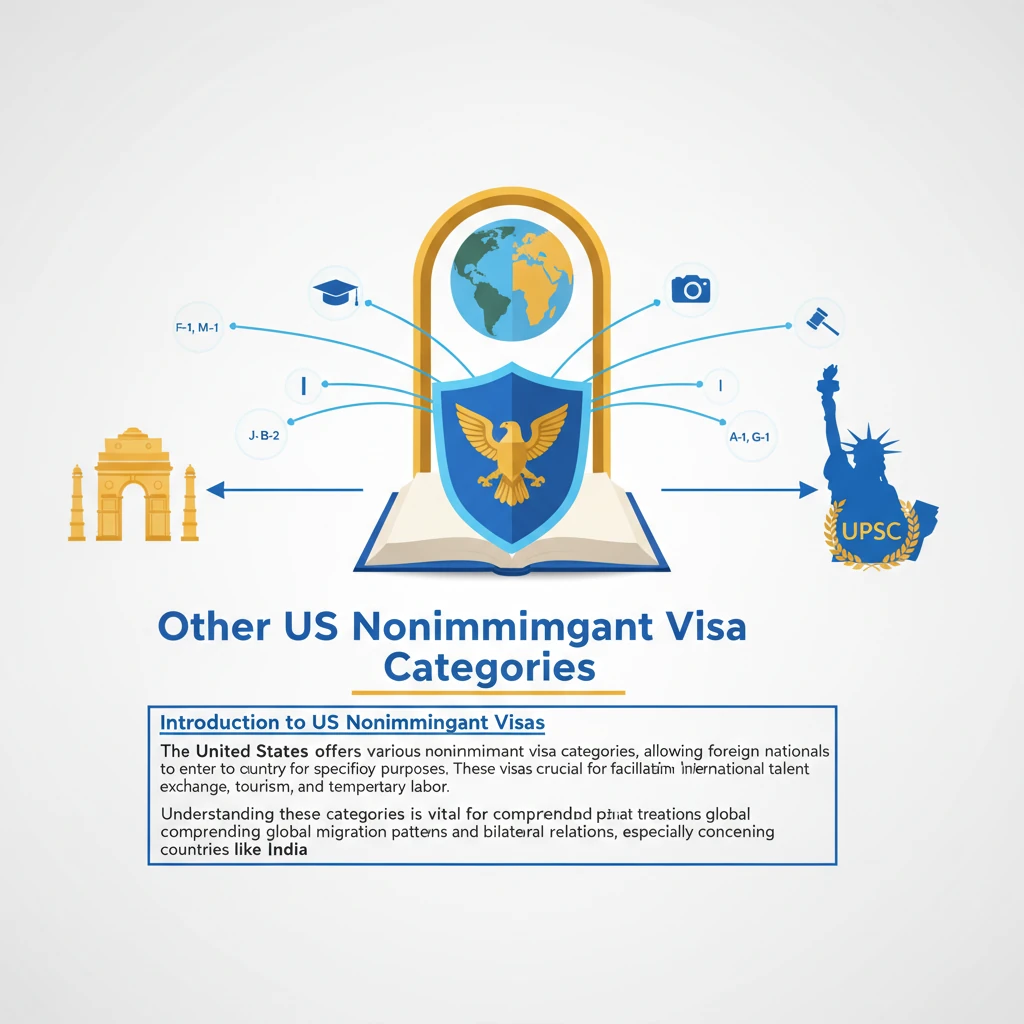
<h4>Introduction to US Nonimmigrant Visas</h4><p>The <strong>United States</strong> offers various <strong>nonimmigrant visa categories</strong>, allowing foreign nationals to enter the country for specific, temporary purposes. These visas are crucial for facilitating international talent exchange, tourism, and temporary labor.</p><p>Understanding these categories is vital for comprehending global migration patterns and bilateral relations, especially concerning countries like <strong>India</strong> and <strong>China</strong>.</p><h4>H-1B Visa Cap Exemptions</h4><p>The <strong>H-1B visa</strong> is a nonimmigrant visa that allows U.S. employers to temporarily employ foreign workers in specialty occupations. While generally subject to an annual cap, certain petitions are exempt from this limit.</p><div class="key-point-box"><p><strong>Cap exemption</strong> applies to petitions for <strong>H-1B visa holders</strong> seeking continued employment. This ensures continuity for existing skilled workers in the U.S. workforce.</p><p>Furthermore, employment at specific institutions also qualifies for exemption. This includes positions at <strong>higher education institutions</strong>, their <strong>affiliated nonprofit organizations</strong>, and <strong>government research organizations</strong>.</p></div><div class="exam-tip-box"><p>UPSC often asks about the nuances of <strong>international agreements</strong> and <strong>migration policies</strong>. Understanding H-1B cap exemptions can be crucial for answering questions on U.S. immigration policy and its impact on India.</p></div><h4>Demographic Trends in H-1B Visas</h4><p>The <strong>H-1B visa program</strong> has significant implications for skilled professionals globally, with specific countries dominating the beneficiary landscape.</p><div class="info-box"><p><strong>Dominance of Indian Beneficiaries:</strong> Since <strong>2015</strong>, individuals born in <strong>India</strong> have consistently been the largest beneficiaries of the <strong>H-1B visa program</strong>. They account for <strong>more than 70%</strong> of all approved H-1B petitions annually.</p><p><strong>China's Contribution:</strong> Individuals born in <strong>China</strong> consistently rank second. Since <strong>2018</strong>, they have made up approximately <strong>12-13%</strong> of all H-1B petitions.</p></div><p>These trends highlight the significant role of Indian and Chinese professionals in the U.S. technology and specialty occupation sectors, reflecting global talent flows.</p><h4>Overview of Other Key Nonimmigrant Visa Categories</h4><p>Beyond the H-1B, the U.S. offers a range of other nonimmigrant visas tailored for diverse purposes of travel and temporary stay.</p><table class="info-table"><tr><th>Visa Category</th><th>Purpose of Travel</th></tr><tr><td><strong>O Visa</strong></td><td>Foreign national with <strong>extraordinary ability</strong> in <strong>Sciences, Arts, Education, Business or Athletics</strong>.</td></tr><tr><td><strong>H-2A Visa</strong></td><td><strong>Temporary agricultural worker</strong>, addressing seasonal labor needs in the agricultural sector.</td></tr><tr><td><strong>H-2B Visa</strong></td><td><strong>Temporary worker</strong> performing other services or labor of a <strong>temporary or seasonal nature</strong>, outside of agriculture.</td></tr><tr><td><strong>B-2 Visa</strong></td><td>For <strong>Tourism, vacation, pleasure visitor</strong>. This is a common visa for short-term personal travel.</td></tr><tr><td><strong>V Visa</strong></td><td><strong>Nonimmigrant Visa</strong> for <strong>Spouse and Children</strong> of a <strong>Lawful Permanent Resident</strong>, allowing family reunification while awaiting immigrant visas.</td></tr></table><p>Each of these categories serves a distinct function in managing the flow of temporary visitors and workers into the United States.</p>
💡 Key Takeaways
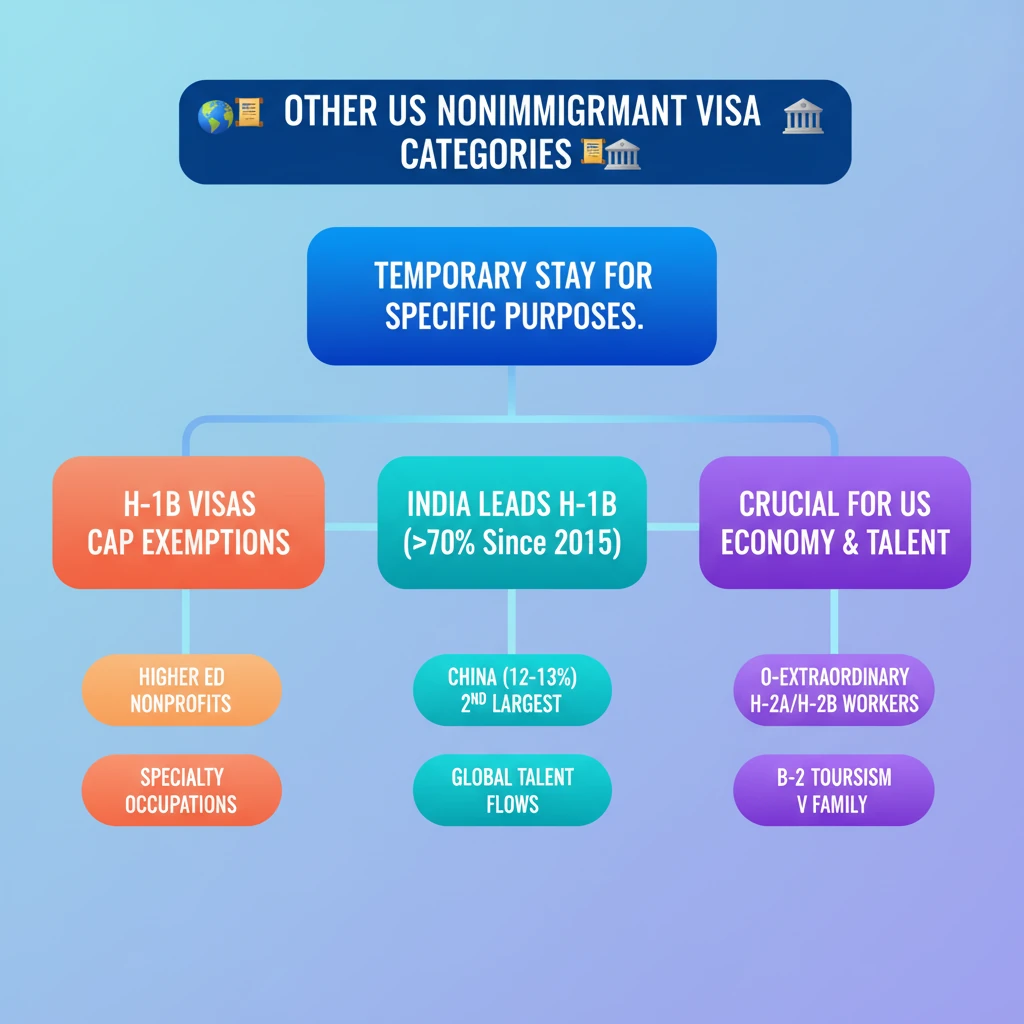
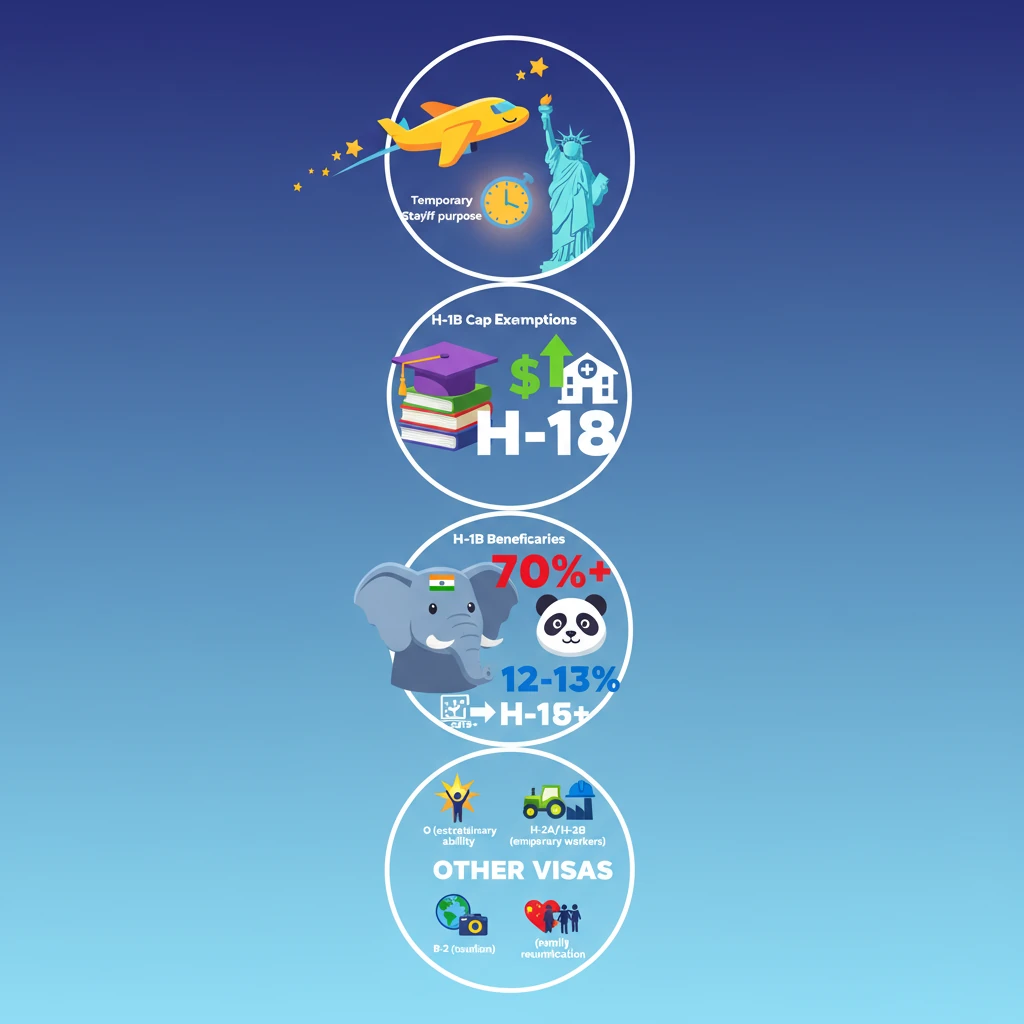
- •US nonimmigrant visas allow temporary stay for specific purposes.
- •H-1B visas have cap exemptions for certain employment types (e.g., higher education, nonprofits).
- •Indians are the largest beneficiaries of H-1B visas (over 70% since 2015), followed by Chinese (12-13%).
- •Other key nonimmigrant visas include O (extraordinary ability), H-2A/H-2B (temporary workers), B-2 (tourism), and V (family reunification).
- •These visas are crucial for U.S. economy, international relations, and global talent management.
🧠 Memory Techniques
95% Verified Content
📚 Reference Sources
•U.S. Citizenship and Immigration Services (USCIS) official website
•U.S. Department of State - Bureau of Consular Affairs website