Codex Standards - International Relations | UPSC Learning
Topics
0 topics • 0 completed
🔍
No topics match your search
Codex Standards
Medium⏱️ 8 min read
international relations
📖 Introduction
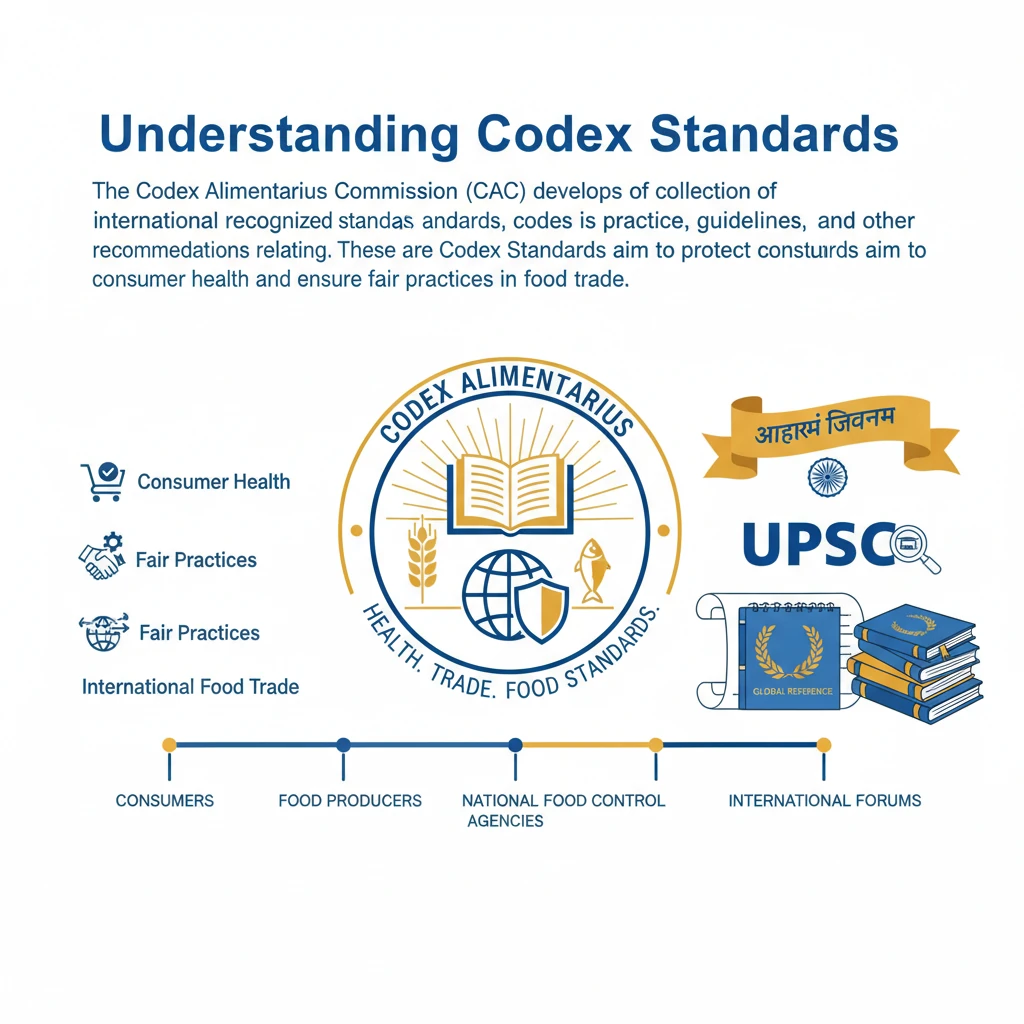
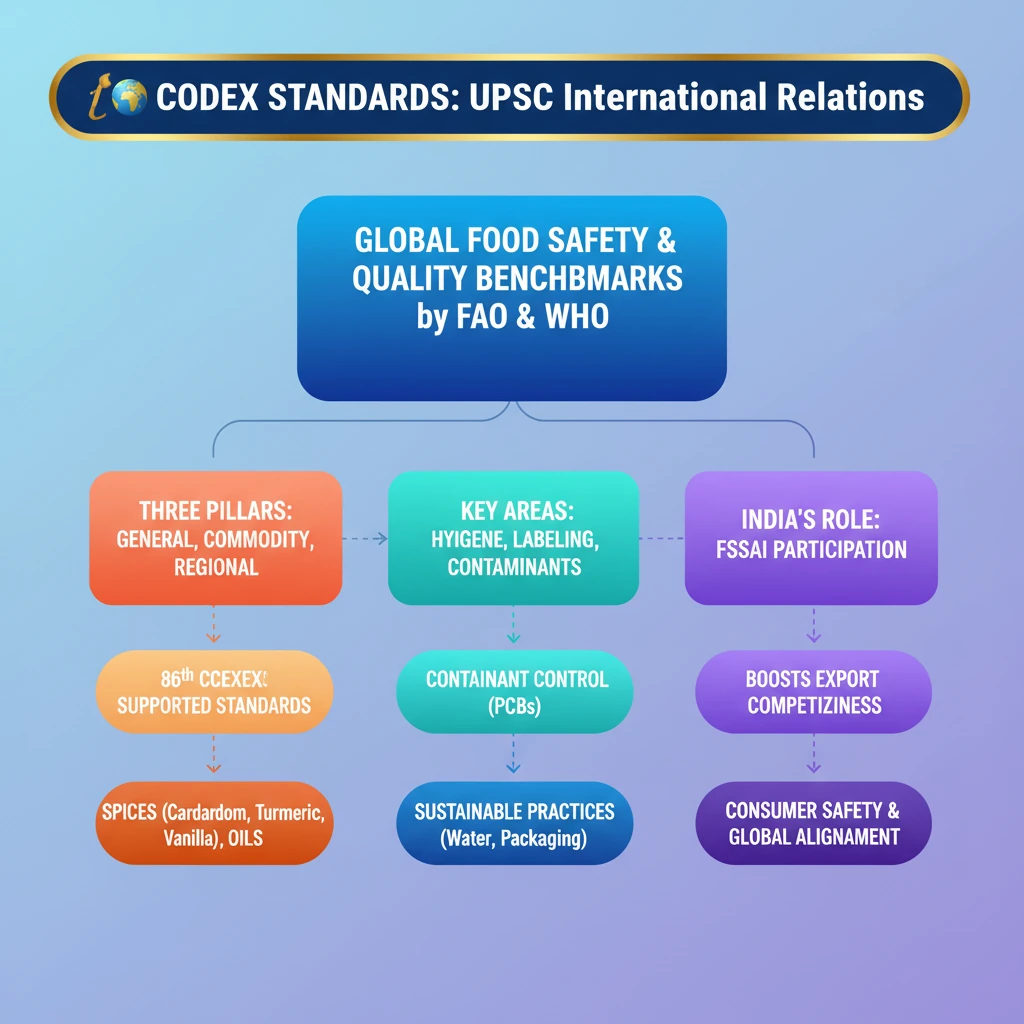
<h4>Understanding Codex Standards</h4><p>The <strong>Codex Alimentarius Commission (CAC)</strong> develops international <strong>food standards</strong>, guidelines, and codes of practice. These standards aim to protect consumer health and ensure fair practices in food trade.</p><p>They cover a wide range of aspects, from hygiene and labelling to contaminants and nutritional requirements. Adherence to these standards facilitates smoother global food commerce.</p><h4>Types of Codex Standards</h4><p><strong>Codex Standards</strong> are broadly categorized into three main types, each serving a specific purpose in regulating the global food supply chain.</p><div class='info-box'><ul><li><strong>General Standards, Guidelines and Codes of Practice:</strong> These are foundational texts that apply broadly across various food products and categories. They cover critical areas such as <strong>hygienic practice</strong>, <strong>labelling</strong>, <strong>contaminants</strong>, <strong>food additives</strong>, <strong>inspection & certification</strong>, <strong>nutrition</strong>, and residues of <strong>veterinary drugs</strong> and <strong>pesticides</strong>.</li><li><strong>Commodity Standards:</strong> These standards are specific to individual food products or increasingly, to groups of related food products. They define the characteristics, quality, and safety requirements for particular commodities, ensuring consistency and safety for consumers.</li><li><strong>Regional Standards:</strong> Developed by the respective <strong>Regional Coordinating Committees</strong>, these standards are tailored to the specific needs and contexts of particular geographic regions. They are applicable only within their designated regions.</li></ul></div><h4>India's Active Role in the 86th CCEXEC Session</h4><p>India actively participated in the <strong>86th Session of the Commission’s Executive Committee (CCEXEC)</strong> of the <strong>Codex Alimentarius Commission (CAC)</strong>. This significant session took place at the <strong>FAO Headquarters in Rome</strong>.</p><p>India was represented by the <strong>CEO of FSSAI</strong> (Food Safety and Standards Authority of India), highlighting the nation's commitment to global food safety and trade harmonization.</p><div class='key-point-box'><p>The <strong>CCEXEC</strong> plays a vital role in the <strong>Codex</strong> process. It is responsible for reviewing proposals for new work and monitoring the progress of ongoing standards development, ensuring efficiency and relevance.</p></div><h4>India's Support for Key Standards Development</h4><p>During the <strong>86th CCEXEC session</strong>, India strongly advocated for the advancement of several crucial standards. These initiatives align with India's interests as a major global player in food production and trade.</p><ul><li><strong>Spices Standards:</strong> India vigorously supported the development of standards for various important spices, including <strong>small cardamom</strong>, <strong>turmeric</strong>, and <strong>vanilla</strong>.</li><li><strong>Facilitating International Trade:</strong> This initiative is particularly significant for India, given its position as a major producer and exporter of these spices. Establishing international standards would greatly facilitate smoother and more transparent international trade.</li><li><strong>Vegetable Oils and Contaminants:</strong> India also backed the progression of standards for <strong>vegetable oils</strong>. Additionally, it supported guidelines for the control of <strong>Dioxin-like polychlorinated biphenyls (PCBs)</strong>, addressing critical food safety concerns.</li><li><strong>Water Use in Food Production:</strong> The country championed guidelines for the <strong>safe use and reuse of water</strong> in both food production and processing, emphasizing sustainable and hygienic practices.</li><li><strong>Recycled Materials in Packaging:</strong> A forward-thinking proposal supported by India was the development of <strong>Codex guidance on food safety considerations</strong> related to the use of <strong>recycled materials in food packaging</strong>, promoting environmental sustainability alongside safety.</li></ul><div class='exam-tip-box'><p><strong>UPSC Insight:</strong> India's active participation in bodies like <strong>Codex Alimentarius Commission</strong> demonstrates its growing influence in global governance and its commitment to multilateralism, particularly in areas like <strong>food safety</strong> and <strong>international trade</strong>. This is relevant for <strong>GS Paper 2 (International Relations)</strong> and <strong>GS Paper 3 (Economy, Food Processing)</strong>.</p></div>
💡 Key Takeaways
- •Codex Standards are international food safety and quality guidelines developed by FAO/WHO's Codex Alimentarius Commission.
- •They are categorized into General, Commodity, and Regional Standards, covering hygiene, labelling, contaminants, and specific products.
- •India actively participates in Codex, notably at the 86th CCEXEC, represented by the FSSAI CEO.
- •India advocated for standards for spices (cardamom, turmeric, vanilla), vegetable oils, water reuse, and recycled food packaging.
- •These standards are crucial for consumer health protection, fair international trade, and harmonizing national food regulations.
- •WTO recognizes Codex Standards as international benchmarks for food safety under the SPS Agreement.
🧠 Memory Techniques

95% Verified Content
📚 Reference Sources
•Official website of Codex Alimentarius Commission (FAO/WHO)
•Food Safety and Standards Authority of India (FSSAI) official communications
•World Trade Organization (WTO) SPS Agreement information