Indus River and its Tributaries - International Relations | UPSC Learning
Topics
0 topics • 0 completed
🔍
No topics match your search
Indus River and its Tributaries
Medium⏱️ 8 min read
international relations
📖 Introduction
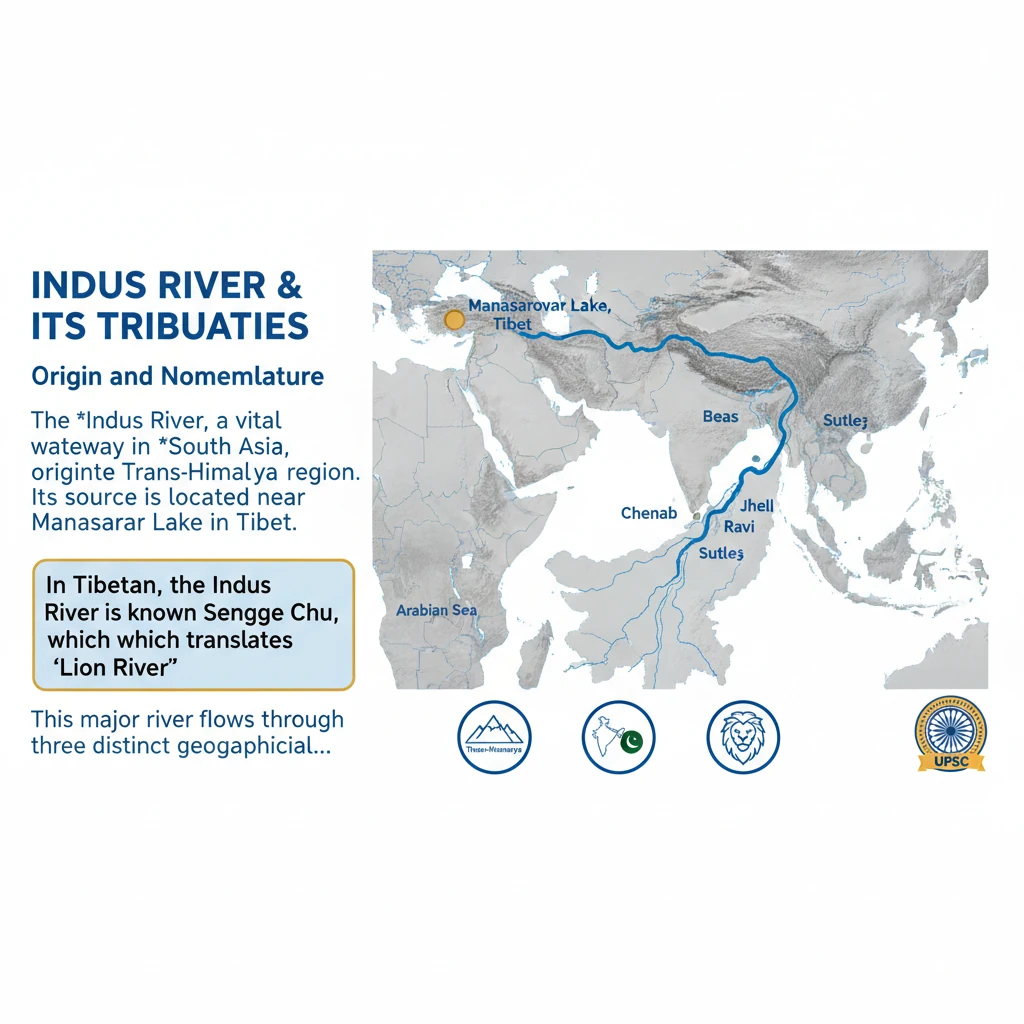
<h4>Origin and Nomenclature</h4><p>The <strong>Indus River</strong>, a vital waterway in <strong>South Asia</strong>, originates in the <strong>Trans-Himalaya</strong> region. Its source is located near <strong>Manasarovar Lake</strong> in <strong>Tibet</strong>.</p><div class='info-box'><p>In <strong>Tibetan</strong>, the Indus River is known as <strong>Sengge Chu</strong>, which translates to <strong>‘Lion River’</strong>.</p></div><p>This major river flows through three distinct geographical entities: <strong>Tibet</strong>, <strong>India</strong>, and <strong>Pakistan</strong>. Its extensive drainage basin supports approximately <strong>200 million people</strong>.</p><h4>Course through India and Pakistan</h4><p>Upon entering <strong>India</strong>, the Indus River first traverses through <strong>Ladakh</strong>. It then continues its journey through the region of <strong>Jammu and Kashmir</strong>.</p><p>After flowing through Indian territory, the river proceeds into <strong>Pakistan</strong>, specifically through its <strong>Gilgit-Baltistan</strong> region. Its final destination is the <strong>Arabian Sea</strong>.</p><div class='info-box'><p>The <strong>Indus River</strong> discharges into the <strong>Arabian Sea</strong> near the city of <strong>Karachi</strong>, located in southern <strong>Pakistan</strong>.</p></div><h4>Major Tributaries: Left Bank</h4><p>The <strong>Indus River System</strong> is characterized by numerous tributaries that feed into its main course. These are categorized based on whether they join from the left or right bank.</p><div class='key-point-box'><p>The <strong>left-bank tributaries</strong> are crucial components of the Indus system, contributing significantly to its volume and geographical spread.</p></div><ul><li><strong>Zaskar River</strong></li><li><strong>Suru River</strong></li><li><strong>Soan River</strong></li><li><strong>Jhelum River</strong></li><li><strong>Chenab River</strong></li><li><strong>Ravi River</strong></li><li><strong>Beas River</strong></li><li><strong>Satluj River</strong></li><li><strong>Panjnad River</strong> (a confluence of the Jhelum, Chenab, Ravi, Beas, and Satluj)</li></ul><h4>Major Tributaries: Right Bank</h4><p>Complementing the left-bank rivers, several significant tributaries join the <strong>Indus</strong> from its right bank. These rivers originate primarily from the <strong>Karakoram</strong> and <strong>Hindu Kush</strong> ranges.</p><div class='key-point-box'><p>The <strong>right-bank tributaries</strong> often play a vital role in the regions they traverse, especially for irrigation and local economies.</p></div><ul><li><strong>Shyok River</strong></li><li><strong>Gilgit River</strong></li><li><strong>Hunza River</strong></li><li><strong>Swat River</strong></li><li><strong>Kunar River</strong></li><li><strong>Kurram River</strong></li><li><strong>Gomal River</strong></li><li><strong>Kabul River</strong></li></ul><div class='exam-tip-box'><p>For <strong>UPSC Prelims</strong>, it is essential to remember the names of both <strong>left-bank</strong> and <strong>right-bank tributaries</strong>, as questions often test this specific factual knowledge. Pay attention to their geographical sequence or associated regions.</p></div>
💡 Key Takeaways
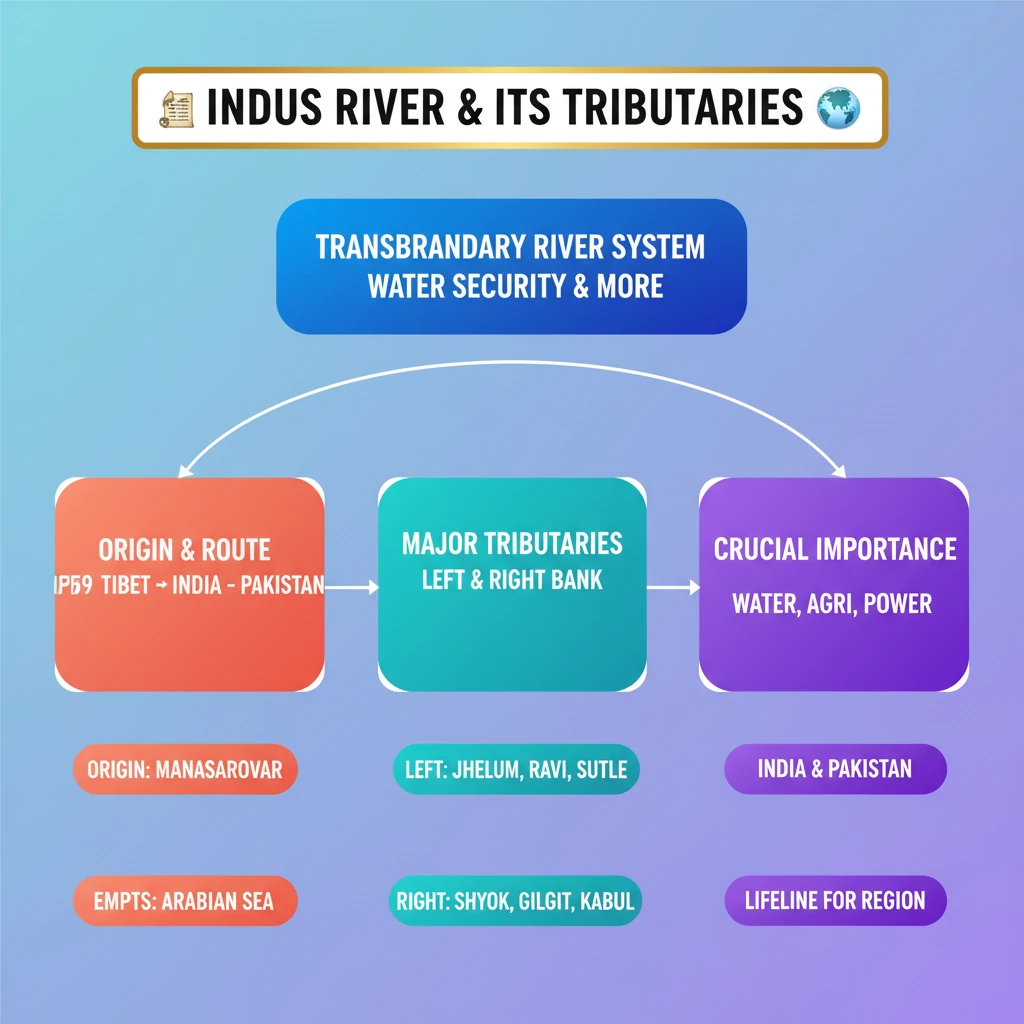
- •The Indus River originates in Tibet near Manasarovar Lake (Sengge Chu).
- •It flows through Tibet, India (Ladakh, J&K), and Pakistan, emptying into the Arabian Sea near Karachi.
- •Major left-bank tributaries: Zaskar, Suru, Soan, Jhelum, Chenab, Ravi, Beas, Satluj, Panjnad.
- •Major right-bank tributaries: Shyok, Gilgit, Hunza, Swat, Kunar, Kurram, Gomal, Kabul.
- •The Indus River System is crucial for water resources, agriculture, and hydroelectric power in India and Pakistan.
- •The Indus Water Treaty (1960) governs water sharing between India and Pakistan.
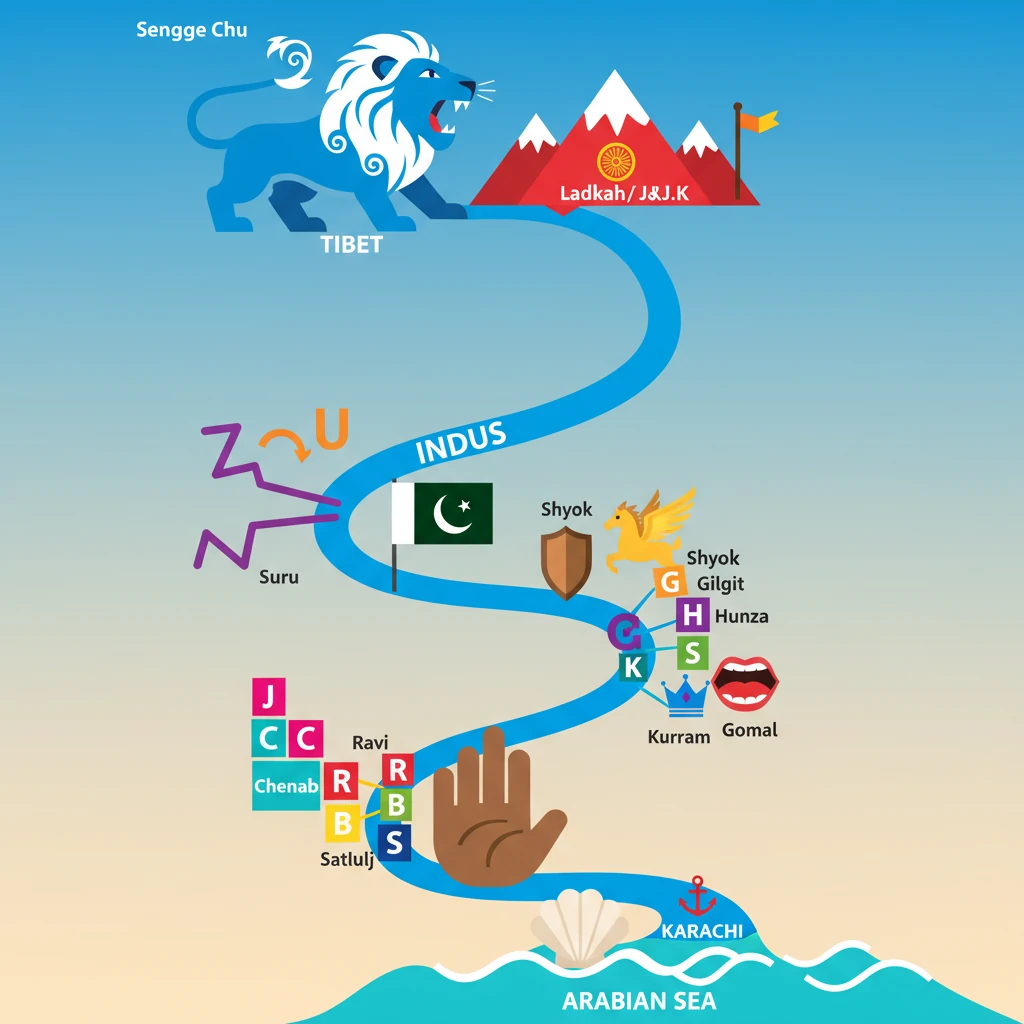
🧠 Memory Techniques
98% Verified Content
📚 Reference Sources
•NCERT Geography Textbooks (Class XI, India Physical Environment)
•Ministry of Jal Shakti, Government of India