Katchatheevu Island - International Relations | UPSC Learning
Topics
0 topics • 0 completed
🔍
No topics match your search
Katchatheevu Island
Medium⏱️ 8 min read
international relations
📖 Introduction
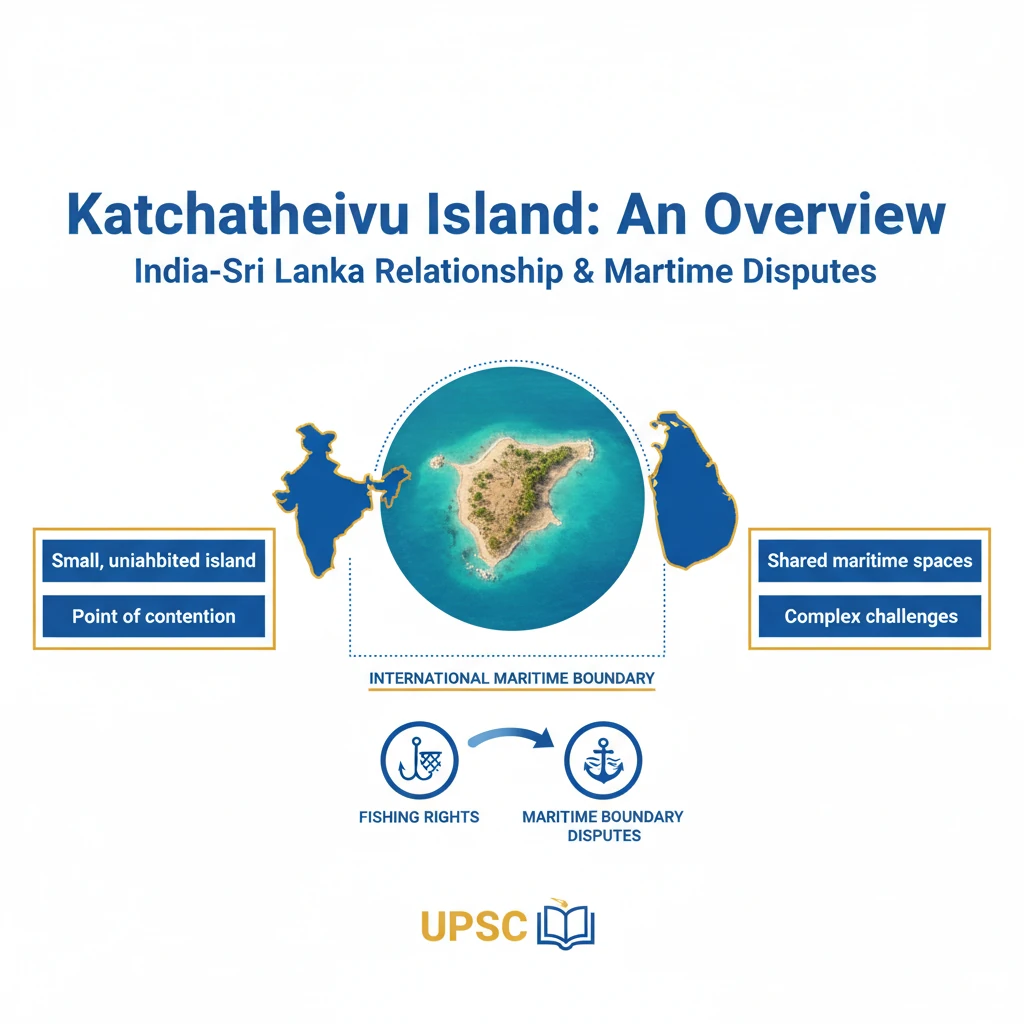
<h4>Katchatheevu Island: An Overview</h4><p>The <strong>Katchatheevu Island</strong> has garnered significant attention due to its central role in the complex <strong>India-Sri Lanka relationship</strong>. It represents a persistent point of contention, primarily concerning <strong>maritime boundary disputes</strong> and the contentious issue of <strong>fishing rights</strong>.</p><p>This small, uninhabited island highlights the intricate challenges involved in managing shared maritime spaces and the livelihoods of traditional fishing communities.</p><h4>Geographical Location and Strategic Importance</h4><p><strong>Katchatheevu</strong> is located in the <strong>Palk Strait</strong>, a narrow strip of water separating the Indian state of <strong>Tamil Nadu</strong> from <strong>Sri Lanka</strong>. Its position is strategically significant for both nations.</p><p>It lies approximately <strong>16 nautical miles (30 km)</strong> southwest of <strong>Jaffna, Sri Lanka</strong>, and about <strong>10.5 nautical miles (19 km)</strong> northeast of <strong>Rameswaram, India</strong>.</p><div class="info-box"><p><strong>Location:</strong> Palk Strait, between India and Sri Lanka.</p><p><strong>Area:</strong> Approximately 285 acres (1.15 sq km).</p><p><strong>Status:</strong> Uninhabited, ceded to Sri Lanka in <strong>1974</strong>.</p></div><h4>The Contentious Fishing Rights Issue</h4><p>The most prominent aspect of the <strong>Katchatheevu</strong> dispute is the issue of <strong>traditional fishing rights</strong>. Indian fishermen, particularly from <strong>Tamil Nadu</strong>, have historically fished in the rich waters around the island.</p><p>Despite the island being formally ceded to Sri Lanka, these fishermen continue to venture into these waters, often leading to confrontations with the <strong>Sri Lankan Navy</strong>.</p><h4>Maritime Boundary Disputes and Demarcation</h4><p>The status of <strong>Katchatheevu</strong> became a key factor in the demarcation of the <strong>maritime boundary</strong> between India and Sri Lanka. Agreements in <strong>1974</strong> and <strong>1976</strong> formally established the <strong>International Maritime Boundary Line (IMBL)</strong>.</p><p>These agreements placed <strong>Katchatheevu</strong> firmly on the Sri Lankan side of the IMBL, thereby restricting Indian fishermen's access to what they consider their traditional fishing grounds.</p><div class="key-point-box"><p>The <strong>Katchatheevu Island</strong> issue encapsulates the complexities of <strong>historical claims</strong>, <strong>national sovereignty</strong>, <strong>international maritime law</strong>, and the crucial aspect of <strong>livelihoods of fishing communities</strong> in bilateral relations.</p></div><h4>Impact on India-Sri Lanka Relations</h4><p>The recurring incidents of Indian fishermen being arrested by the Sri Lankan Navy frequently strain <strong>India-Sri Lanka relations</strong>. These events often trigger strong political reactions in <strong>Tamil Nadu</strong> and become a significant domestic issue in India.</p><p>Both governments face continuous pressure to find a sustainable and mutually acceptable solution that respects national sovereignty while protecting the economic interests and safety of their respective fishing populations.</p><div class="exam-tip-box"><p>When addressing <strong>India-Sri Lanka relations</strong> in <strong>UPSC Mains (GS Paper 2)</strong>, the <strong>Katchatheevu issue</strong> and associated <strong>fishing rights</strong> are critical examples to illustrate ongoing challenges and areas of diplomatic engagement.</p></div>
💡 Key Takeaways
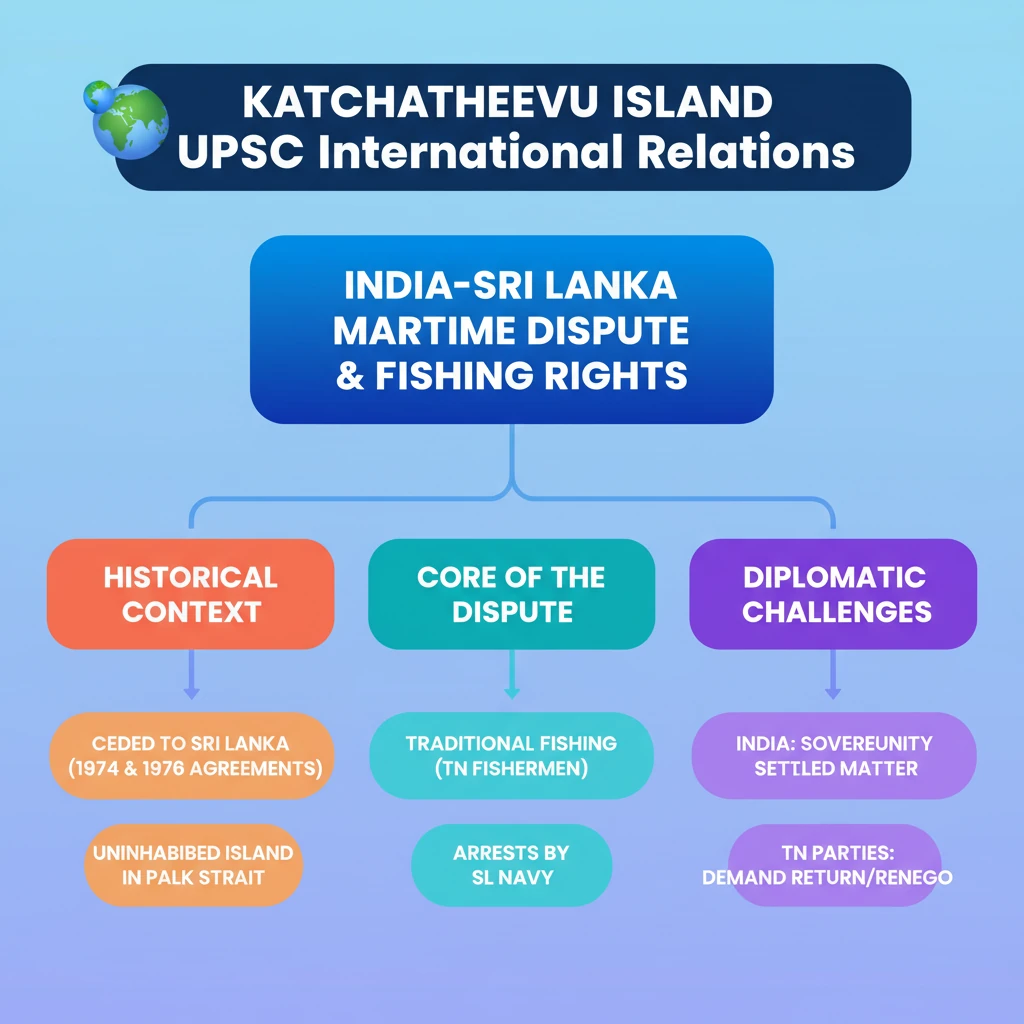
- •Katchatheevu is a small, uninhabited island in the Palk Strait, ceded to Sri Lanka by India through agreements in 1974 and 1976.
- •The core of the dispute revolves around traditional fishing rights of Indian (Tamil Nadu) fishermen in waters around Katchatheevu, leading to frequent arrests by the Sri Lankan Navy.
- •India considers Katchatheevu's sovereignty a settled matter under international law, while political parties in Tamil Nadu often demand its retrieval or renegotiation of fishing rights.
- •The issue consistently strains India-Sri Lanka bilateral relations but is managed through ongoing diplomatic channels and efforts to promote sustainable fishing practices.
- •It exemplifies the complex interplay of maritime boundaries, livelihoods, historical claims, and the influence of domestic politics on foreign policy.
🧠 Memory Techniques
95% Verified Content
📚 Reference Sources
•United Nations Convention on the Law of the Sea (UNCLOS) document
•Archival records of India-Sri Lanka agreements (1974, 1976)
•Reports from reputable Indian and international news agencies (e.g., The Hindu, PTI, Reuters)
•Academic papers and analyses on India-Sri Lanka relations and maritime disputes