Kalapani Territorial Dispute: Nepal's Claims and Historical Context - International Relations | UPSC Learning
Topics
0 topics • 0 completed
🔍
No topics match your search
Kalapani Territorial Dispute: Nepal's Claims and Historical Context
Medium⏱️ 6 min read
international relations
📖 Introduction
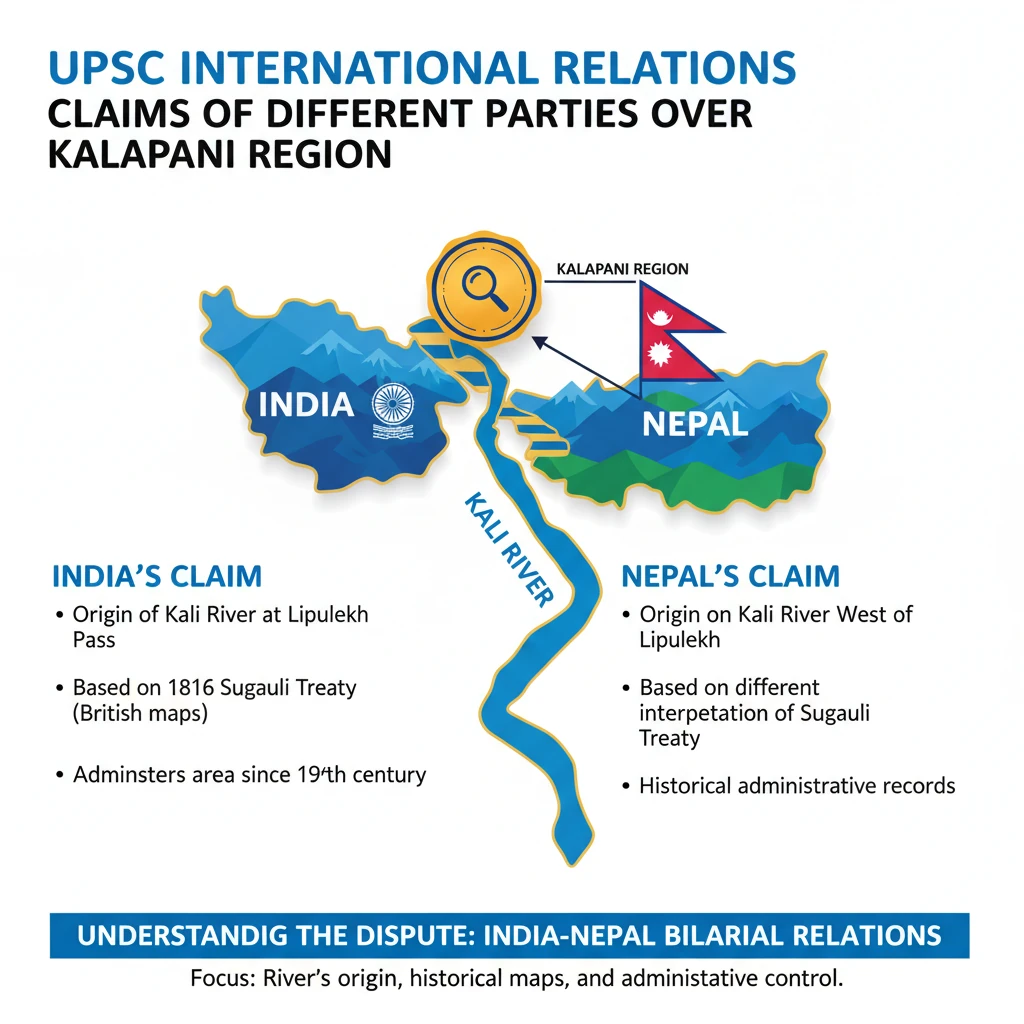
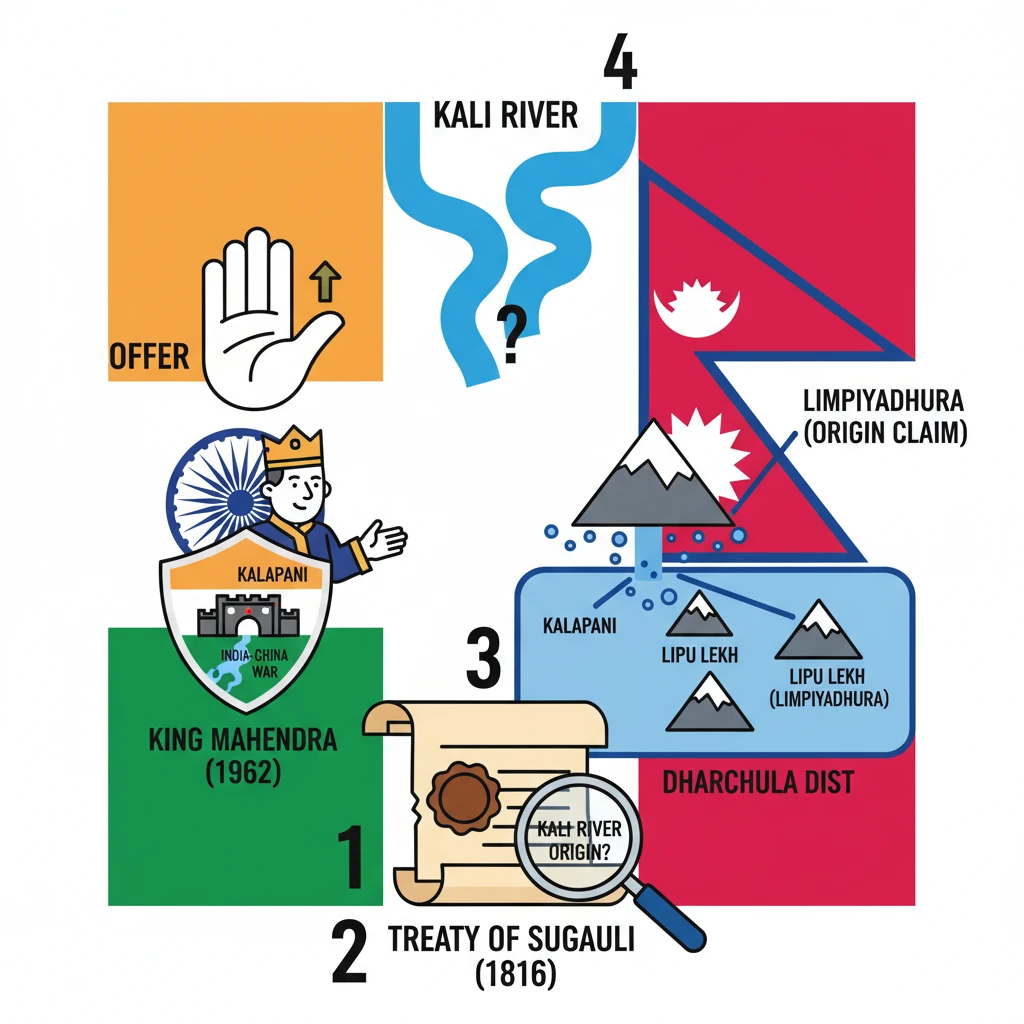
<h4>Understanding the Kalapani Region Dispute</h4><p>The <strong>Kalapani region</strong> is a significant area of contention between <strong>India</strong> and <strong>Nepal</strong>. This dispute primarily revolves around the origin of the <strong>Kali River</strong>, which forms a natural boundary between the two nations.</p><p>Understanding the claims of both parties is crucial for comprehending the complexities of <strong>India-Nepal bilateral relations</strong> and regional geopolitics.</p><h4>Nepal's Core Claim on Kalapani</h4><p><strong>Nepal's primary claim</strong> asserts that the <strong>Kali River</strong> originates from a stream located at <strong>Limpiyadhura</strong>. This specific point is situated to the northwest of <strong>Lipu Lekh</strong>, a mountain pass.</p><div class='info-box'><p>According to <strong>Nepal's perspective</strong>, if the <strong>Kali River</strong> originates at <strong>Limpiyadhura</strong>, then the territories lying to the east of this river should rightfully belong to <strong>Nepal</strong>.</p></div><div class='key-point-box'><p>Consequently, <strong>Nepal</strong> claims that <strong>Kalapani</strong>, <strong>Limpiyadhura</strong>, and <strong>Lipu Lekh</strong> all fall to the east of the river's main course. Therefore, these areas are considered integral parts of <strong>Nepal's Dharchula district</strong>.</p></div><h4>Historical Context of Nepal's Stance</h4><p>A notable aspect of <strong>Nepal's claim</strong> involves a historical offer. Following the <strong>1962 India-China war</strong>, <strong>King Mahendra of Nepal</strong> reportedly offered the territory of <strong>Kalapani</strong> to <strong>India</strong>.</p><p>This offer was made to assist <strong>India</strong> with its security concerns. It was driven by the perceived lingering threats from <strong>China</strong> in the aftermath of the conflict.</p><div class='exam-tip-box'><p><strong>UPSC Insight:</strong> The <strong>Kalapani dispute</strong> highlights the importance of historical treaties and geographical interpretations in border demarcations. Candidates should be prepared to analyze both historical and contemporary aspects of such disputes in <strong>GS Paper 2 (International Relations)</strong>.</p></div>
💡 Key Takeaways
- •Kalapani is a disputed territory between India and Nepal.
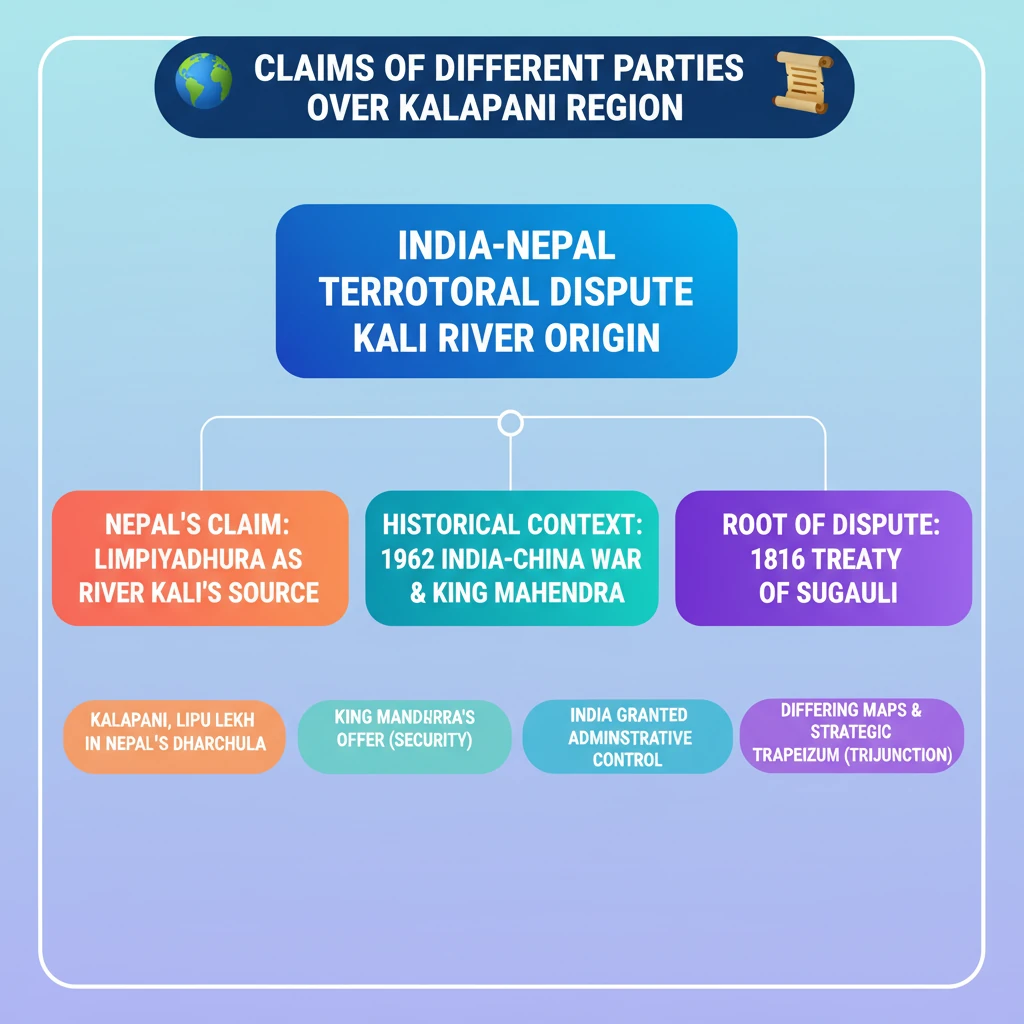
- •Nepal claims the Kali River originates at Limpiyadhura, placing Kalapani, Limpiyadhura, and Lipu Lekh within its Dharchula district.
- •Historically, King Mahendra of Nepal reportedly offered Kalapani to India after the 1962 India-China war for security reasons.
- •The dispute stems from differing interpretations of the 1816 Treaty of Sugauli regarding the Kali River's origin.
- •The region holds strategic importance due to its location at the India-China-Nepal trijunction.
🧠 Memory Techniques
90% Verified Content
📚 Reference Sources
•General knowledge of India-Nepal border disputes and the Treaty of Sugauli
•Public domain information on the 1962 India-China War and its aftermath