Global Security Concerns: Emerging Threats & Challenges - International Relations | UPSC Learning
Topics
0 topics • 0 completed
🔍
No topics match your search
Global Security Concerns: Emerging Threats & Challenges
Medium⏱️ 10 min read
international relations
📖 Introduction
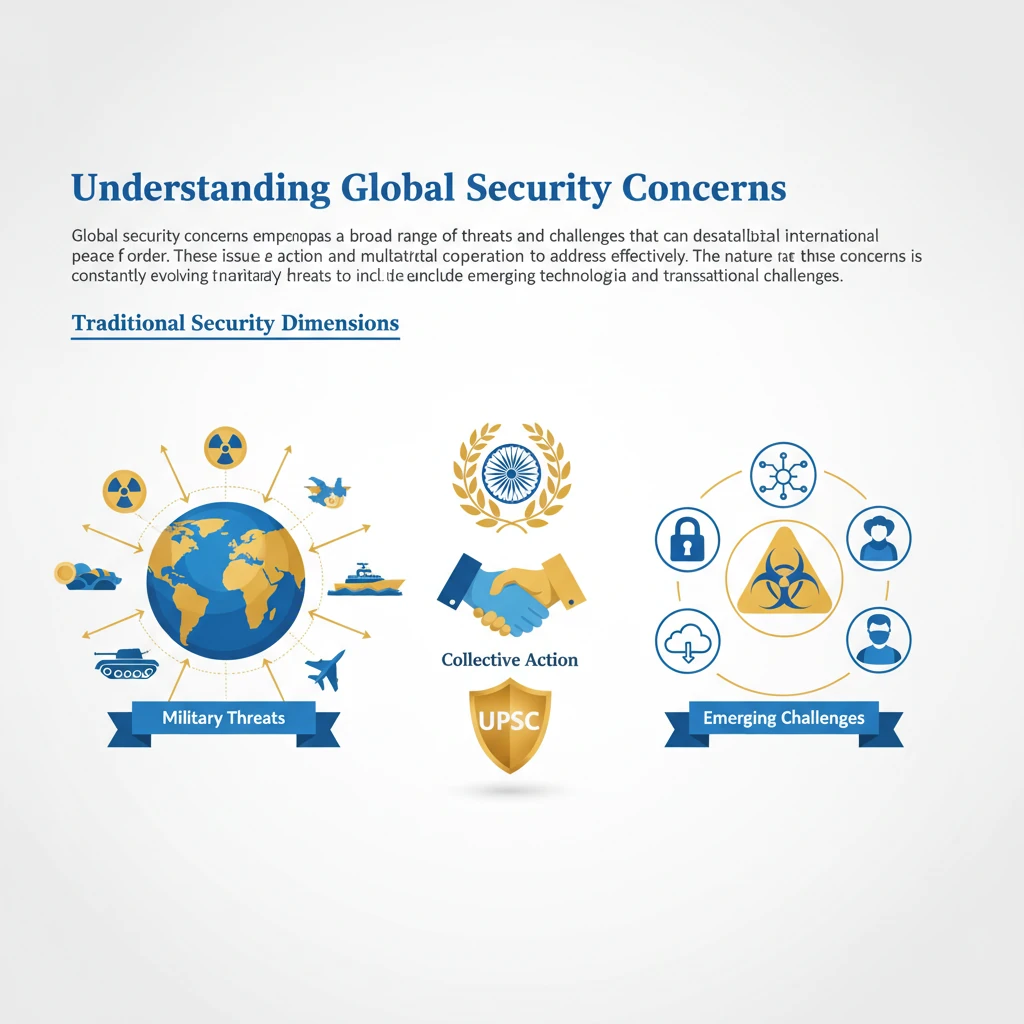
<h4>Understanding Global Security Concerns</h4><p><strong>Global security concerns</strong> encompass a broad range of threats and challenges that can destabilize international peace and order. These issues require collective action and multilateral cooperation to address effectively.</p><p>The nature of these concerns is constantly evolving, moving beyond traditional military threats to include emerging technological and transnational challenges.</p><h4>Traditional Security Dimensions</h4><p>Historically, global security discussions have focused heavily on state-centric military capabilities and conflicts. Key aspects include <strong>military expenditure</strong> and <strong>arms transfers</strong>.</p><div class='info-box'><p><strong>Military Expenditure:</strong> Refers to the financial resources a nation allocates for its defense and military operations. High expenditures can signal potential conflicts or an arms race, leading to regional instability.</p></div><p>Another significant aspect is <strong>arms transfers</strong>, which involve the sale or donation of weapons and military technology between countries. Unregulated arms transfers can fuel conflicts, empower non-state actors, and exacerbate humanitarian crises.</p><p>The role of <strong>private military companies (PMCs)</strong> in conflicts has also gained prominence. PMCs are private businesses that provide specialized services, including combat operations, logistics, and intelligence, often raising questions about accountability and international law.</p><div class='key-point-box'><p><strong>Key Point:</strong> Traditional security concerns often involve state actors and the proliferation of conventional and unconventional weapons, impacting regional and global stability.</p></div><h4>Emerging Security Dimensions</h4><p>The modern era has introduced a new set of complex security concerns, driven largely by rapid technological advancements and interconnectedness. These include risks related to <strong>artificial intelligence (AI)</strong>, <strong>outer space</strong>, and <strong>cyberspace</strong>.</p><div class='info-box'><p><strong>Artificial Intelligence (AI):</strong> The development of autonomous weapon systems (LAWS) raises profound ethical, legal, and operational questions. The potential for AI to accelerate conflicts or make decisions without human oversight is a significant concern.</p></div><p><strong>Outer space</strong> is increasingly viewed as a potential domain for conflict. The militarization of space, development of anti-satellite weapons (ASATs), and space debris pose threats to critical infrastructure and global communication networks.</p><p><strong>Cyberspace</strong> represents a vast and vulnerable domain. Cyberattacks can target critical national infrastructure, disrupt economies, and even interfere with democratic processes, making cyber warfare a potent non-kinetic threat.</p><p>Furthermore, the <strong>protection of civilians in war zones</strong> remains a paramount global security concern. Despite international humanitarian law, civilians often bear the brunt of conflicts, necessitating robust international mechanisms for their safety and assistance.</p><div class='exam-tip-box'><p><strong>UPSC Insight:</strong> When addressing global security, remember to categorize threats into traditional (military, arms) and non-traditional (cyber, AI, space, environmental) to provide a comprehensive answer. Emphasize the interconnectedness of these challenges.</p></div>

💡 Key Takeaways
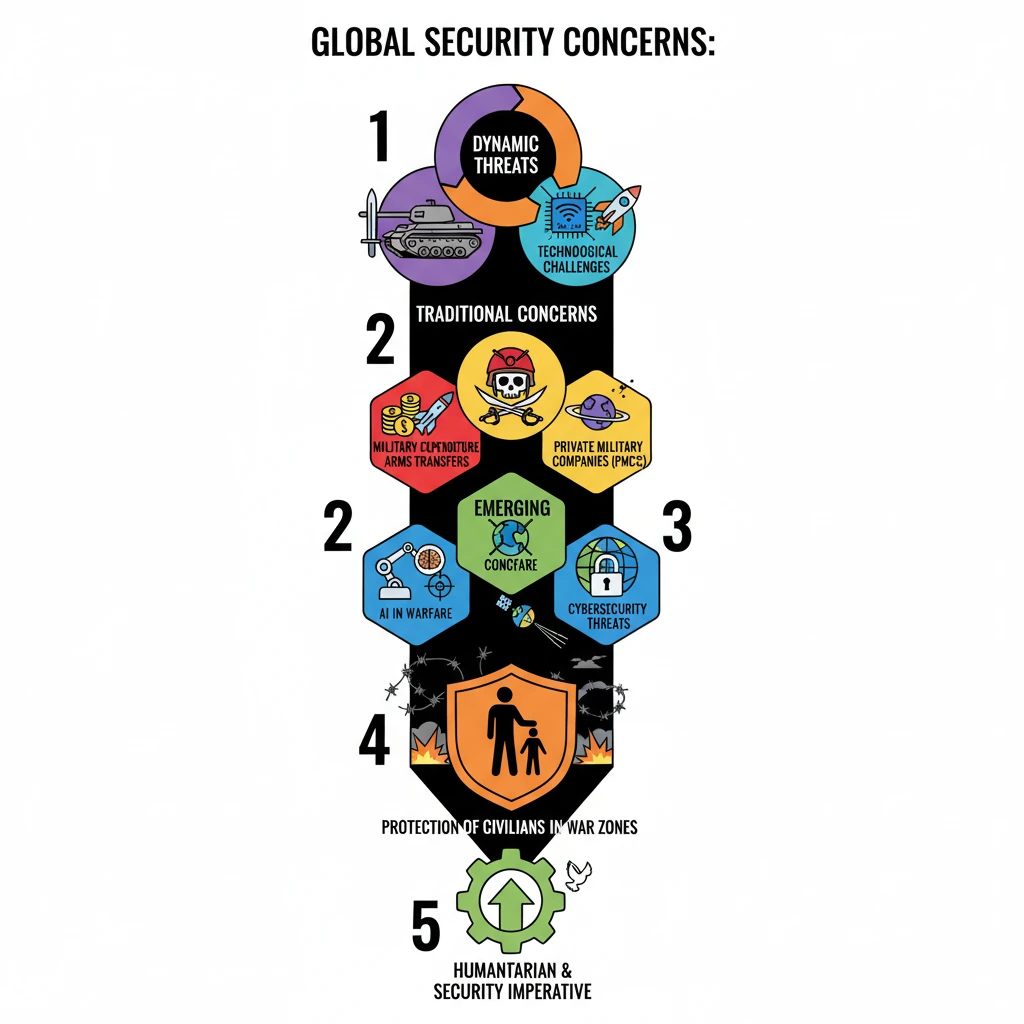
- •Global security concerns are dynamic, encompassing both traditional military threats and emerging technological challenges.
- •Traditional concerns include military expenditure, arms transfers, and the role of private military companies (PMCs).
- •Emerging concerns involve artificial intelligence (AI) in warfare, militarization of outer space, and cybersecurity threats.
- •The protection of civilians in war zones remains a critical humanitarian and security imperative.
- •Addressing these complex issues requires robust international cooperation, multilateral frameworks, and adherence to international law.
- •Technological advancements necessitate continuous adaptation in security strategies and ethical considerations.
🧠 Memory Techniques
95% Verified Content
📚 Reference Sources
•Stockholm International Peace Research Institute (SIPRI) reports on military expenditure and arms transfers
•United Nations Office for Disarmament Affairs (UNODA) publications on LAWS and outer space security
•International Committee of the Red Cross (ICRC) reports on International Humanitarian Law and civilian protection
•Council on Foreign Relations (CFR) analyses on cybersecurity and AI