What are Key Findings of the Global Risks Report 2025? - International Relations | UPSC Learning
Topics
0 topics • 0 completed
🔍
No topics match your search
What are Key Findings of the Global Risks Report 2025?
Medium⏱️ 8 min read
international relations
📖 Introduction
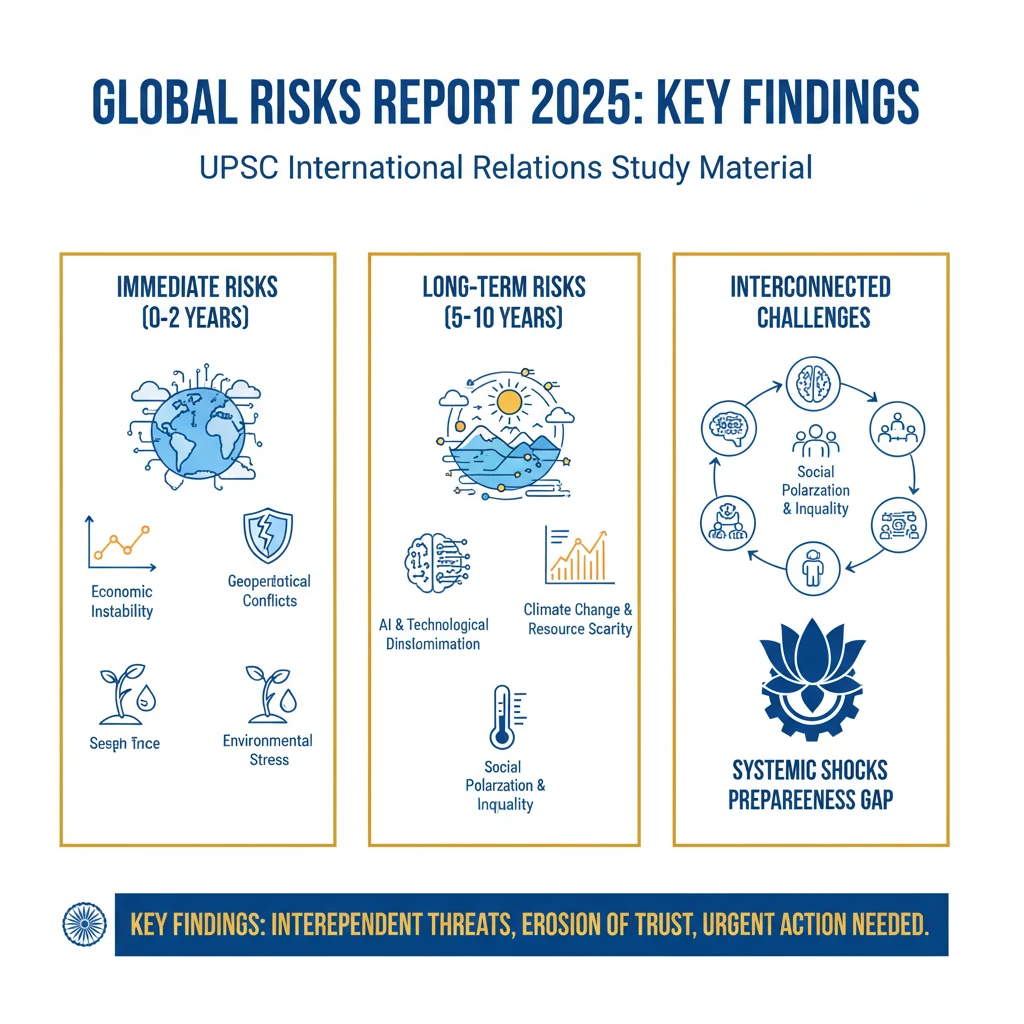
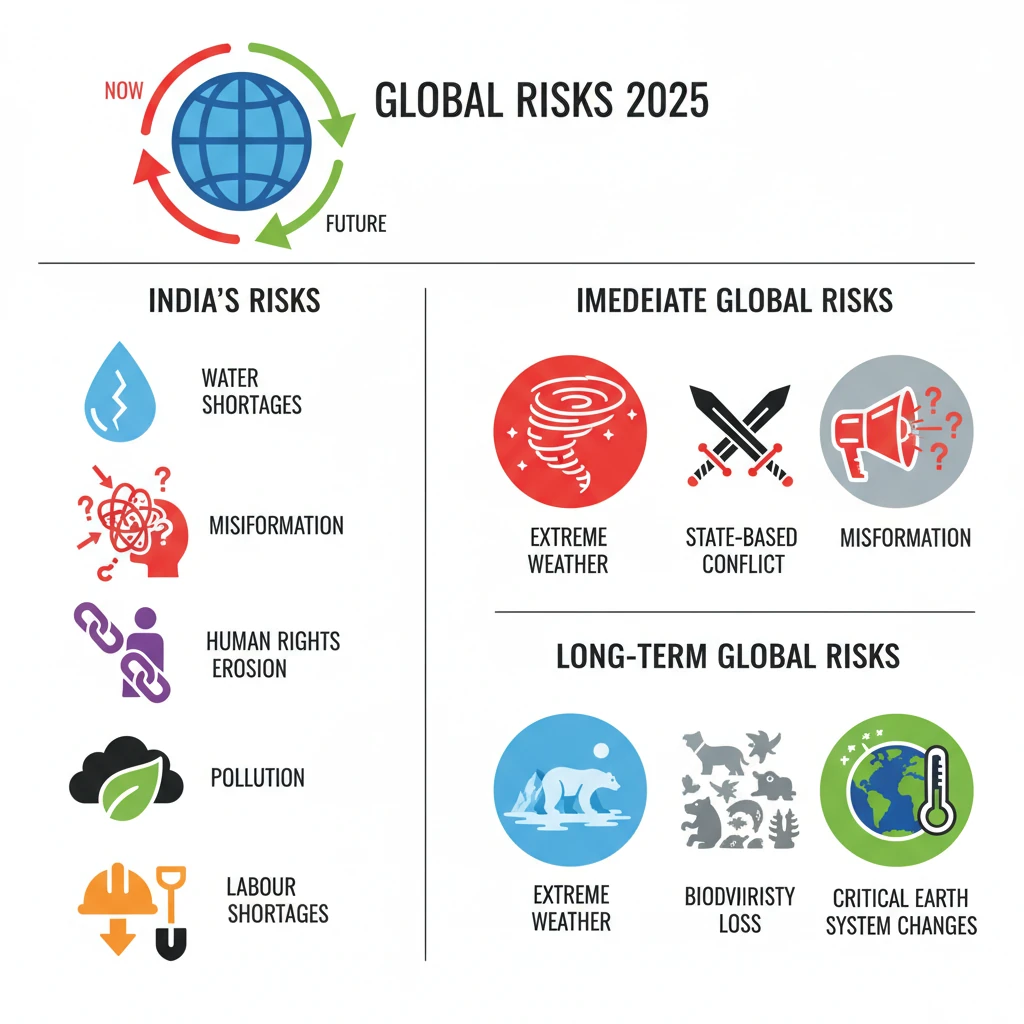
<h4>Understanding the Global Risks Report 2025</h4><p>The <strong>Global Risks Report 2025</strong> provides a crucial assessment of the most significant threats facing the world in the near and long term. Published annually, it serves as a vital tool for policymakers, businesses, and civil society to understand and prepare for potential future challenges.</p><div class='key-point-box'><p>This report categorizes risks by their potential impact and likelihood, offering insights into both immediate and long-term global concerns.</p></div><h4>Top Risks Identified for India</h4><p>The <strong>Global Risks Report 2025</strong> specifically highlights several critical risks that India is expected to face. These challenges span environmental, social, and governance dimensions, demanding comprehensive policy responses.</p><ul><li><strong>Water Supply Shortages:</strong> A persistent and escalating threat, impacting agriculture, industry, and public health across various regions in India.</li><li><strong>Misinformation and Disinformation:</strong> The spread of false or misleading information poses significant risks to social cohesion, public trust, and democratic processes.</li><li><strong>Erosion of Human Rights and Civic Freedoms:</strong> Concerns regarding the shrinking space for civil society and potential infringements on fundamental rights.</li><li><strong>Pollution (Air, Water, and Soil):</strong> Widespread environmental degradation continues to be a major health and economic burden for the nation.</li><li><strong>Labour and Talent Shortages:</strong> A growing challenge impacting economic productivity and requiring strategic interventions in education and skill development.</li></ul><div class='exam-tip-box'><p>For UPSC, understanding <strong>India's specific risks</strong> helps in answering questions related to governance, environment, social issues, and economic development (<strong>GS-I, GS-II, GS-III</strong>).</p></div><h4>Immediate Global Risks (Next 2 Years)</h4><p>The report identifies several risks that are expected to manifest with significant impact within the next two years. These require urgent attention and proactive measures from global leaders.</p><ul><li><strong>Misinformation and Disinformation:</strong> Ranked as a top immediate threat, highlighting its potential to destabilize societies and political systems globally.</li><li><strong>Extreme Weather Events:</strong> Increasingly frequent and intense weather phenomena continue to cause widespread damage and humanitarian crises.</li><li><strong>State-based Armed Conflict:</strong> Geopolitical tensions and conflicts between states remain a critical concern, threatening international peace and stability.</li></ul><h4>Long-Term Global Risks (Next 10 Years)</h4><p>Looking further ahead, the report outlines systemic risks that pose profound challenges over the next decade. These require sustained international cooperation and transformative solutions.</p><ul><li><strong>Extreme Weather Events:</strong> Continues to be a dominant long-term risk, underscoring the escalating climate crisis.</li><li><strong>Biodiversity Loss and Ecosystem Collapse:</strong> The rapid decline in species and degradation of natural habitats threaten planetary health and human well-being.</li><li><strong>Critical Changes to Earth Systems:</strong> Encompasses large-scale, irreversible alterations to the planet's climate and ecological systems, such as melting ice sheets or ocean acidification.</li></ul><div class='info-box'><p>The distinction between immediate and long-term risks helps in prioritizing policy interventions and resource allocation for both crisis management and strategic planning.</p></div>
💡 Key Takeaways
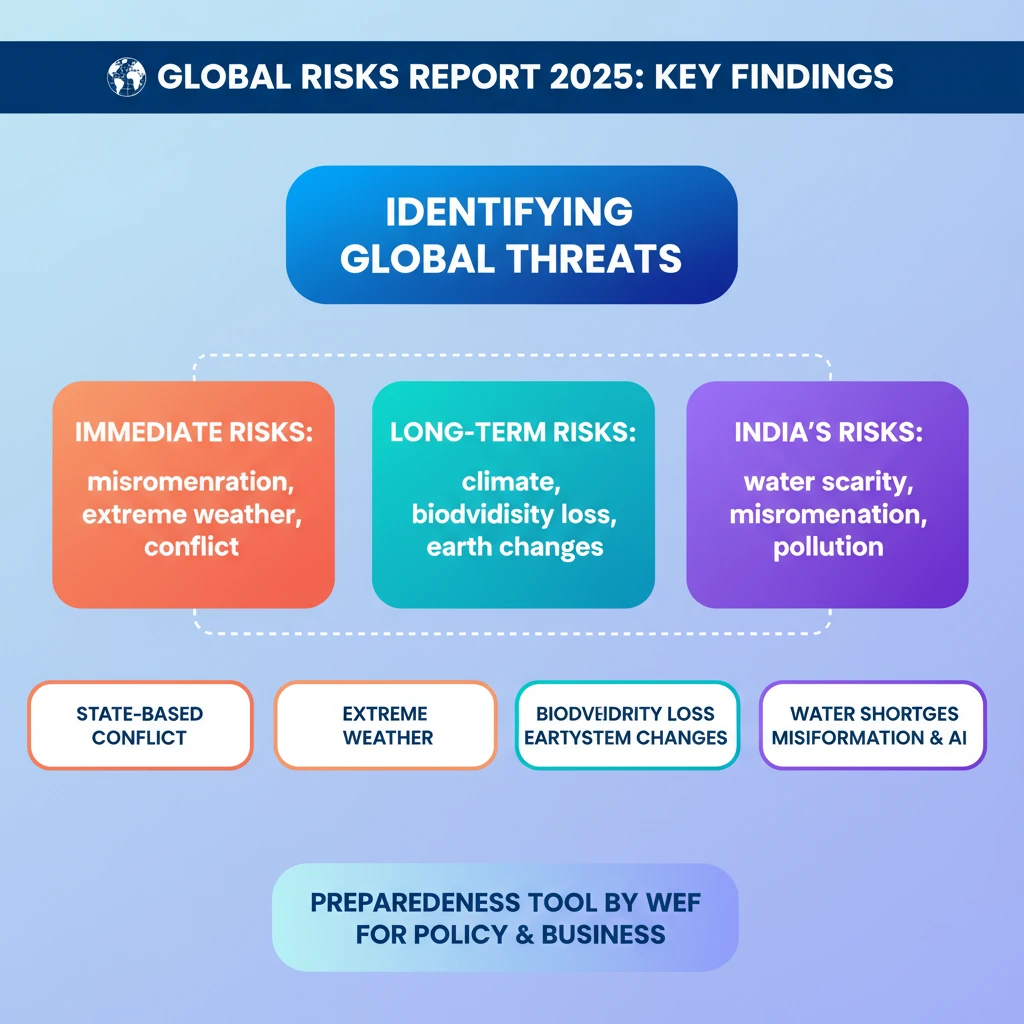
- •Global Risks Report 2025 identifies top immediate and long-term global threats.
- •For India, key risks include water shortages, misinformation, human rights erosion, pollution, and labour shortages.
- •Immediate global risks: misinformation, extreme weather, state-based conflict.
- •Long-term global risks: extreme weather, biodiversity loss, critical earth system changes.
- •The report by WEF serves as a crucial tool for policy, business, and societal preparedness.
🧠 Memory Techniques
95% Verified Content
📚 Reference Sources
•Drishti IAS Summary (provided source content)