Bilateral Groupings and Agreements - International Relations | UPSC Learning
Topics
0 topics • 0 completed
🔍
No topics match your search
Bilateral Groupings and Agreements
Medium⏱️ 7 min read
international relations
📖 Introduction
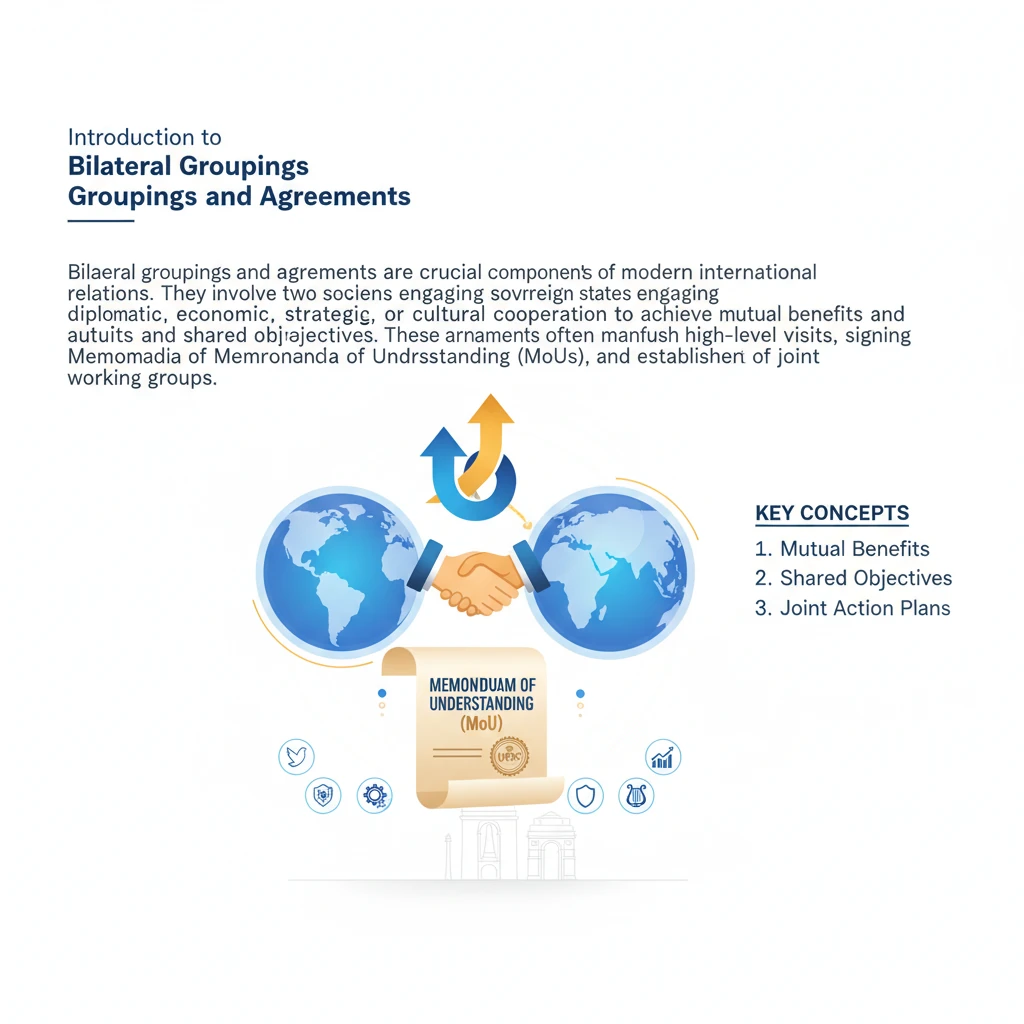
<h4>Introduction to Bilateral Groupings and Agreements</h4><p><strong>Bilateral groupings and agreements</strong> are crucial components of modern international relations. They involve two sovereign states engaging in diplomatic, economic, strategic, or cultural cooperation to achieve mutual benefits and shared objectives.</p><p>These arrangements often manifest through high-level visits, signing of Memoranda of Understanding (MoUs), and establishment of joint working groups.</p><div class='key-point-box'><p><strong>Key Point:</strong> Bilateral ties allow for focused engagement on specific issues, fostering deeper trust and understanding between nations compared to multilateral platforms.</p></div><h4>Significance of PM's Visits to Brunei and Singapore</h4><p>The recent visits by the <strong>Prime Minister of India</strong> to <strong>Brunei Darussalam</strong> and <strong>Singapore</strong> signify India's enhanced diplomatic and strategic outreach in <strong>Southeast Asia</strong>. These visits are integral to India's broader <strong>Act East Policy</strong>.</p><p>Such high-level engagements underscore India's commitment to strengthening ties with key partners in the region, promoting stability, and expanding economic opportunities.</p><div class='info-box'><p><strong>Why in News:</strong> Prime Minister of India’s visits to <strong>Brunei Darussalam</strong> and <strong>Singapore</strong> have marked significant advancements in India’s diplomatic and strategic engagements in Southeast Asia.</p></div><h4>India's Act East Policy Context</h4><p>The <strong>Act East Policy</strong>, launched in <strong>2014</strong>, is a successor to the <strong>Look East Policy</strong> of <strong>1991</strong>. It aims to promote economic cooperation, cultural ties, and strategic relationships with countries in the <strong>Asia-Pacific region</strong>.</p><p>These visits reinforce the policy's objectives, emphasizing India's role as a reliable partner and a growing power in the <strong>Indo-Pacific</strong>.</p><div class='exam-tip-box'><p><strong>UPSC Insight:</strong> Understanding the evolution from 'Look East' to 'Act East' is vital for Mains answers on India's foreign policy and regional diplomacy (<strong>GS Paper 2</strong>).</p></div><h4>Key Areas of Cooperation with Singapore</h4><p>India's relationship with <strong>Singapore</strong> is a comprehensive <strong>Strategic Partnership</strong>. Cooperation spans defence, trade, investment, technology, and skill development.</p><ul><li><strong>Defence:</strong> Joint military exercises, training, and defence technology collaboration.</li><li><strong>Economic:</strong> Significant trade volume, Singapore as a major source of FDI for India.</li><li><strong>Technology & Innovation:</strong> Collaboration in smart cities, fintech, and digital economy.</li></ul><h4>Key Areas of Cooperation with Brunei Darussalam</h4><p>India's ties with <strong>Brunei Darussalam</strong> focus primarily on energy security, defence, and cultural exchanges.</p><ul><li><strong>Energy Security:</strong> Brunei is a significant source of crude oil and LNG.</li><li><strong>Defence:</strong> Cooperation in maritime security and naval exchanges.</li><li><strong>People-to-People:</strong> Cultural exchange programs and tourism promotion.</li></ul>
💡 Key Takeaways
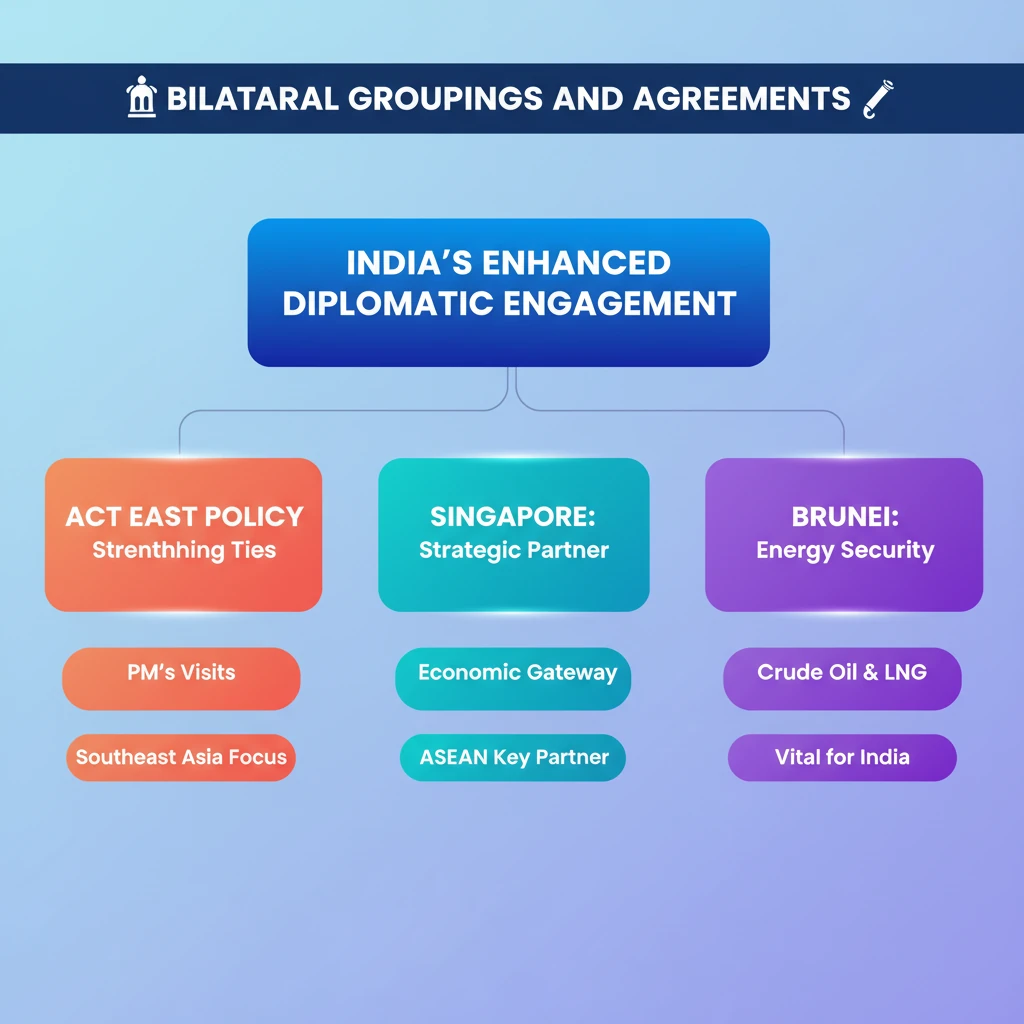
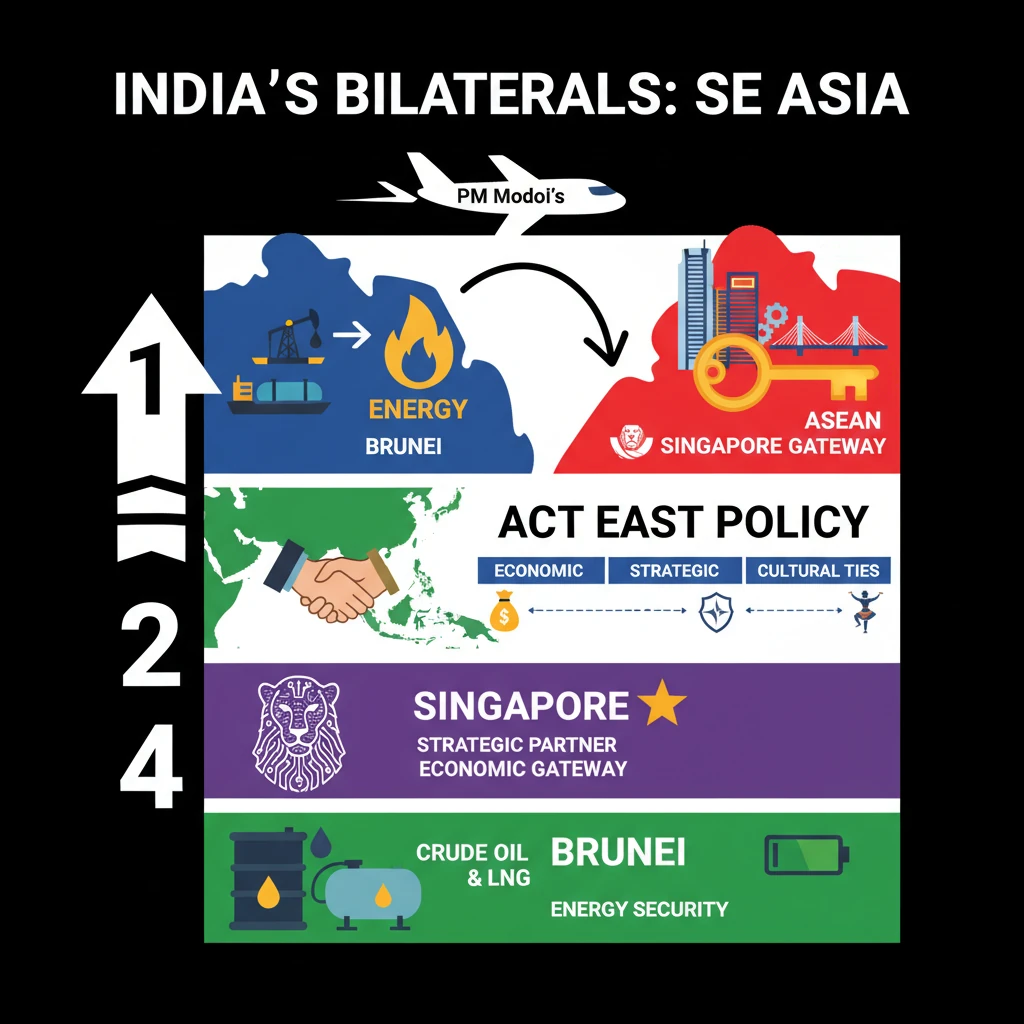
- •PM's visits to Brunei and Singapore signify India's enhanced diplomatic engagement in Southeast Asia.
- •These visits are crucial for India's Act East Policy, strengthening economic, strategic, and cultural ties.
- •Singapore is a key strategic partner and economic gateway for India in ASEAN.
- •Brunei is vital for India's energy security, providing crude oil and LNG.
- •Bilateral agreements are fundamental tools for advancing national interests and regional stability in the Indo-Pacific.
🧠 Memory Techniques
95% Verified Content
📚 Reference Sources
•Drishti IAS current affairs summaries.
•Observer Research Foundation (ORF) analyses on India's foreign policy.
•ASEAN-India Summit joint statements.