Initiatives Taken to Combat Misinformation and Disinformation - International Relations | UPSC Learning
Topics
0 topics • 0 completed
🔍
No topics match your search
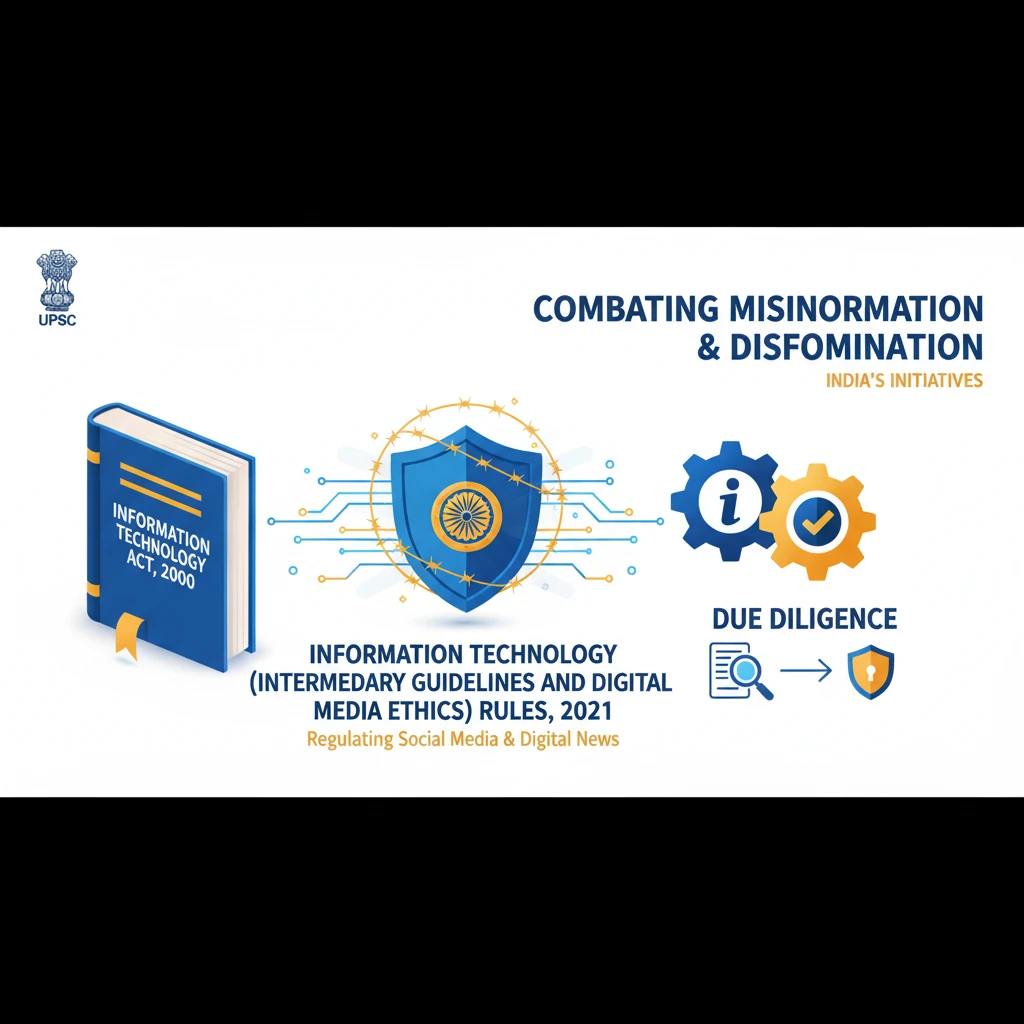
Initiatives Taken to Combat Misinformation and Disinformation
Medium⏱️ 9 min read
international relations
📖 Introduction
<h4>Information Technology (Intermediary Guidelines and Digital Media Ethics Code) Rules, 2021</h4><p>The <strong>Information Technology (Intermediary Guidelines and Digital Media Ethics Code) Rules, 2021</strong>, were notified under the <strong>Information Technology Act, 2000</strong>. These rules aim to regulate social media intermediaries and digital news publishers in India.</p><p>They impose significant obligations on intermediaries to exercise <strong>due diligence</strong> and establish a robust <strong>grievance redressal mechanism</strong>. This includes appointing a <strong>Chief Compliance Officer</strong>, a <strong>Nodal Contact Person</strong>, and a <strong>Resident Grievance Officer</strong>.</p><div class='info-box'><p>Key provisions require intermediaries to remove content deemed unlawful within <strong>36 hours</strong> upon government or court order. They also mandate enabling the identification of the <strong>first originator of a message</strong> in specific, legally sanctioned cases.</p></div><div class='key-point-box'><p>The rules introduce a <strong>three-tier regulatory framework</strong> for digital news media and Over-The-Top (OTT) platforms, focusing on content classification and a self-regulatory body.</p></div><h4>Disaster Management Act, 2005</h4><p>The <strong>Disaster Management Act, 2005</strong>, provides a comprehensive legal framework for the effective management of disasters. It establishes authorities like the <strong>National Disaster Management Authority (NDMA)</strong>.</p><p>While its primary focus is on disaster response and mitigation, <strong>Section 54</strong> of the Act is frequently invoked to combat misinformation during crises. It penalizes anyone making or circulating a <strong>false alarm or warning</strong> regarding a disaster or its severity.</p><div class='info-box'><p>Punishment under <strong>Section 54</strong> can include imprisonment for a term up to <strong>one year</strong> or with a fine, or both. This provision helps in preventing panic and ensuring accurate information dissemination during emergencies.</p></div><div class='exam-tip-box'><p>During the <strong>COVID-19 pandemic</strong>, this Act was widely utilized by both central and state governments to counter the spread of false information related to the virus, treatments, and lockdown measures, highlighting its adaptability.</p></div><h4>Epidemic Diseases Act, 1897</h4><p>The <strong>Epidemic Diseases Act, 1897</strong>, is an older law designed to prevent the spread of dangerous epidemic diseases. It grants broad powers to central and state governments to take special measures and prescribe regulations during an outbreak.</p><p>Although not directly aimed at misinformation, its wide-ranging powers allow governments to issue directions to control the spread of an epidemic. This can include controlling information flows to prevent public panic or the spread of false claims about cures or prevention.</p><div class='info-box'><p><strong>Section 2</strong> allows the state government to prescribe regulations and measures to be observed by the public. <strong>Section 3</strong> provides penalties for disobeying any regulation or order made under the Act.</p></div><div class='key-point-box'><p>Similar to the <strong>Disaster Management Act</strong>, this Act gained renewed relevance during the <strong>COVID-19 pandemic</strong>, often used in conjunction with other laws to manage public health crises and associated information challenges effectively.</p></div><h4>Information Technology Amendment Rules, 2023</h4><p>The <strong>Information Technology (Intermediary Guidelines and Digital Media Ethics Code) Second Amendment Rules, 2023</strong>, further modified the 2021 IT Rules. These amendments notably introduced provisions for a <strong>Fact Check Unit (FCU)</strong>.</p><p>The FCU, which is to be notified by the <strong>Ministry of Electronics and Information Technology (MeitY)</strong>, is tasked with identifying false or misleading information related to any business of the <strong>Central Government</strong>.</p><div class='info-box'><p>Intermediaries are required to make reasonable efforts to ensure that users do not host, display, upload, modify, publish, transmit, store, update, or share any information identified as false or misleading by the FCU.</p></div><div class='exam-tip-box'><p>The constitutionality and scope of the <strong>Fact Check Unit</strong> have been subjects of significant debate and legal challenges, raising important concerns about freedom of speech and potential censorship in India.</p></div><h4>Digital Personal Data Protection Bill (now Act), 2023</h4><p>The <strong>Digital Personal Data Protection Bill, 2023</strong>, was passed by Parliament and subsequently enacted as the <strong>Digital Personal Data Protection Act, 2023</strong>. While its primary focus is on data privacy, it has indirect implications for combating misinformation.</p><p>By rigorously regulating how personal data is collected, processed, and stored, the Act aims to prevent the misuse of data. This misuse could potentially be leveraged for spreading targeted disinformation campaigns and manipulating public opinion.</p><div class='info-box'><p>The Act introduces stringent obligations on <strong>Data Fiduciaries</strong> (entities determining the purpose and means of processing personal data) and grants extensive rights to <strong>Data Principals</strong> (individuals whose data is being processed).</p></div><div class='key-point-box'><p>Although not a direct tool against misinformation, robust data protection can help curb the underlying infrastructure that enables large-scale, personalized disinformation operations by limiting access to and misuse of personal information.</p></div>
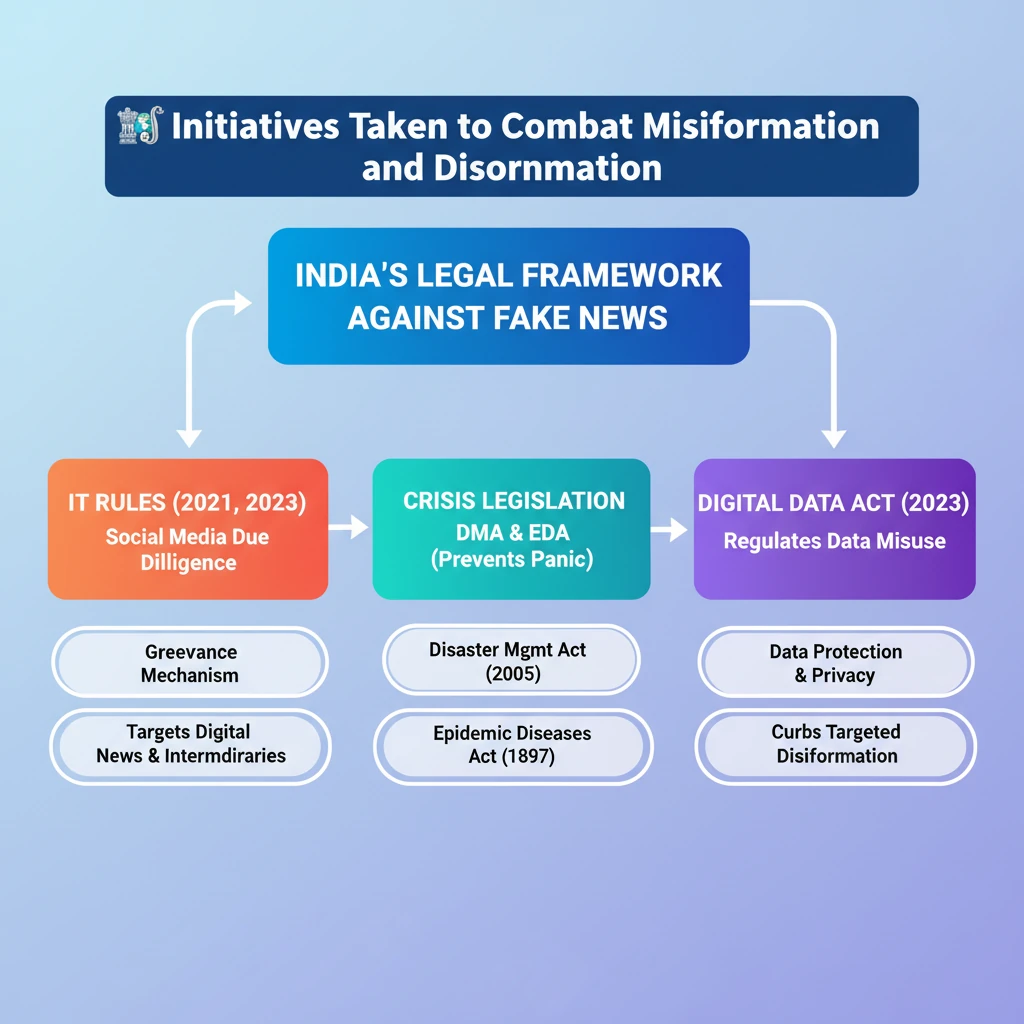
💡 Key Takeaways
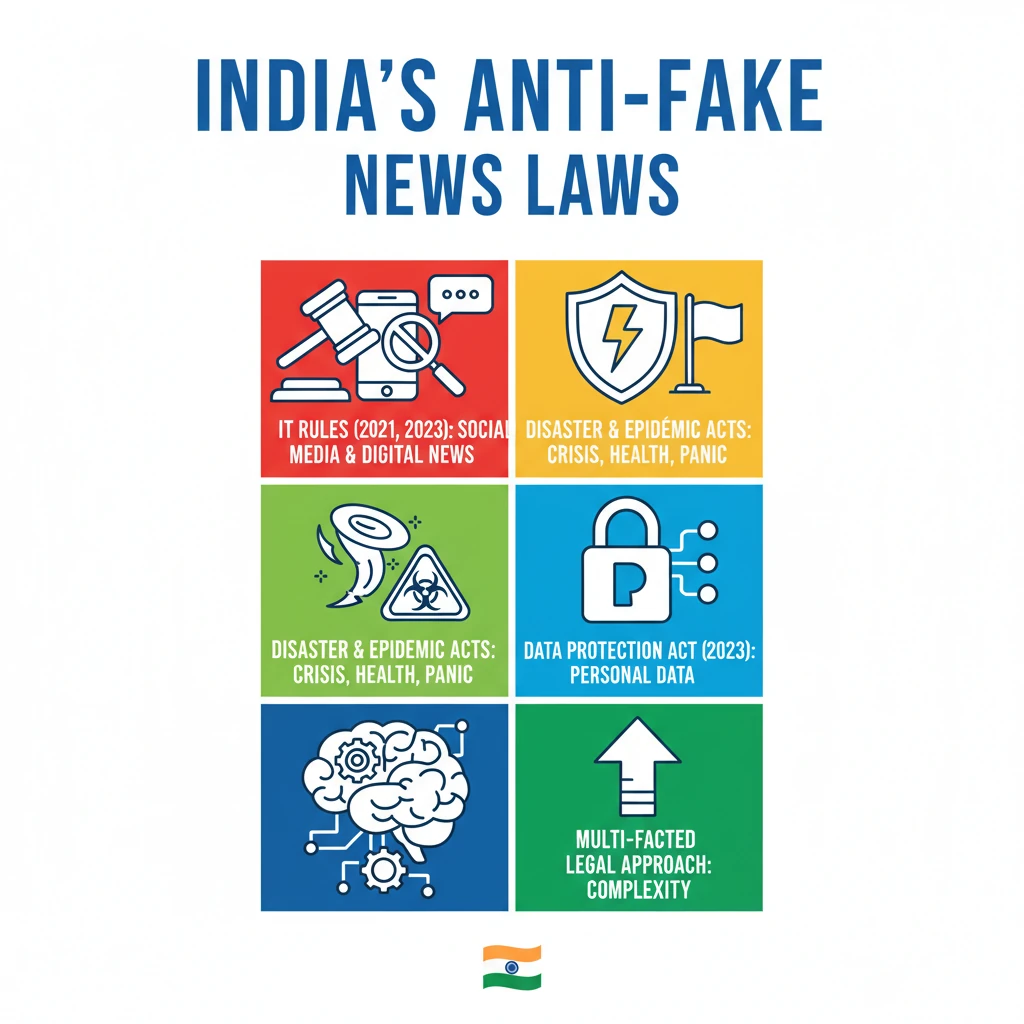
- •India employs a multi-faceted legal approach to combat misinformation and disinformation, reflecting the complexity of the issue.
- •Key legislations include the IT Rules (2021, 2023 amendments), Disaster Management Act (2005), Epidemic Diseases Act (1897), and the Digital Personal Data Protection Act (2023).
- •The IT Rules primarily target social media intermediaries and digital news content, establishing grievance mechanisms and due diligence requirements.
- •The Disaster Management Act and Epidemic Diseases Act are crucial during crises to counter false alarms and health-related misinformation, preventing panic and ensuring public safety.
- •The Digital Personal Data Protection Act indirectly helps by regulating data misuse, which is often a foundational element for creating and spreading targeted disinformation campaigns.
- •The proposed Fact Check Unit (under IT Amendment Rules, 2023) represents a significant, albeit debated, step towards official government-led fact-checking.
- •A continuous challenge for policymakers is balancing the fundamental right to freedom of speech with the imperative need to curb the spread of harmful and false content.
🧠 Memory Techniques
95% Verified Content
📚 Reference Sources
•The Information Technology (Intermediary Guidelines and Digital Media Ethics Code) Rules, 2021
•The Disaster Management Act, 2005
•The Epidemic Diseases Act, 1897
•The Information Technology (Intermediary Guidelines and Digital Media Ethics Code) Second Amendment Rules, 2023
•The Digital Personal Data Protection Act, 2023