India-Bangladesh Relations Amid Political Turmoil in Bangladesh - International Relations | UPSC Learning
Topics
0 topics • 0 completed
🔍
No topics match your search
India-Bangladesh Relations Amid Political Turmoil in Bangladesh
Medium⏱️ 7 min read
international relations
📖 Introduction
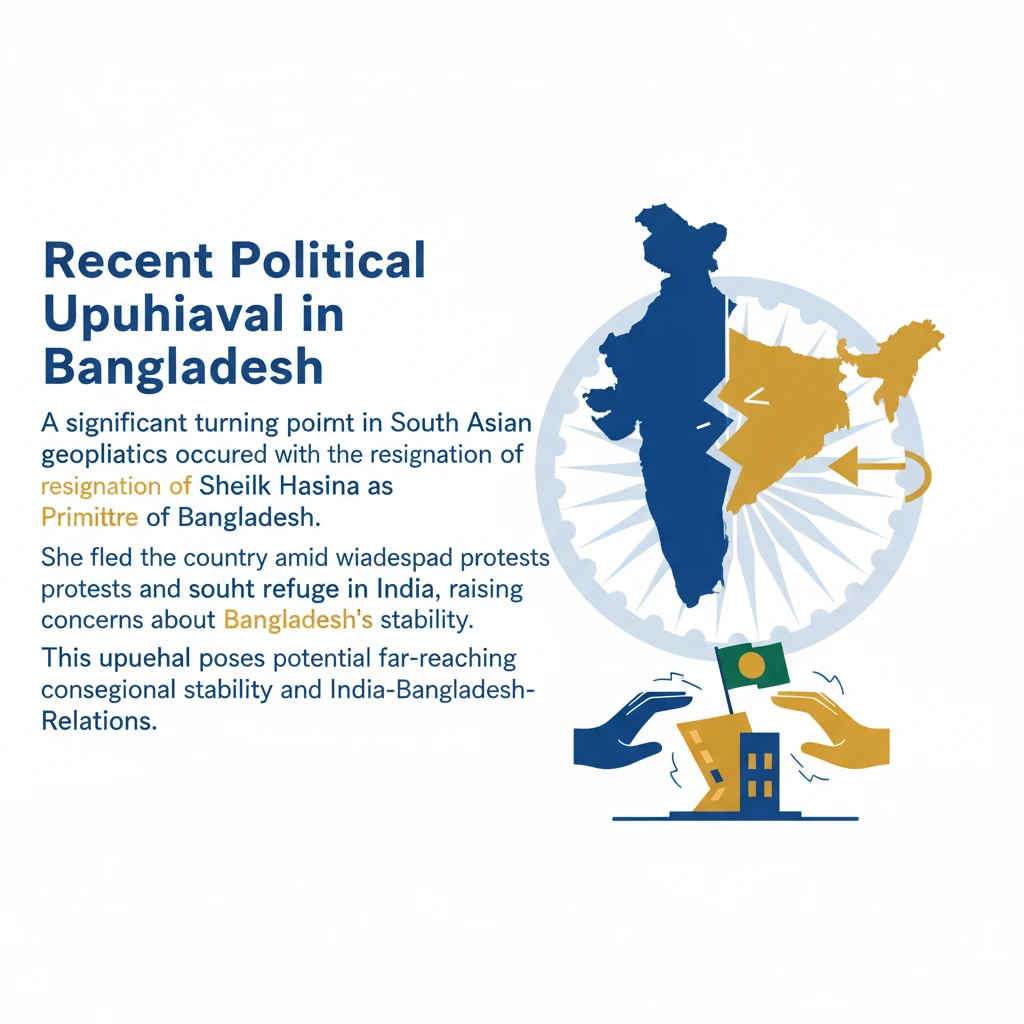
<h4>Recent Political Upheaval in Bangladesh</h4><p>A significant turning point in <strong>South Asian geopolitics</strong> occurred with the resignation of <strong>Sheikh Hasina</strong> as Prime Minister of <strong>Bangladesh</strong>.</p><p>She fled the country amid widespread protests and sought refuge in <strong>India</strong>, raising concerns about <strong>Bangladesh's stability</strong>.</p><p>This upheaval poses potential far-reaching consequences for regional stability and <strong>India's national security</strong>.</p><h4>Foundational Ties: The 1971 Liberation War</h4><p>The bedrock of <strong>India's relationship with Bangladesh</strong> was established during the <strong>1971 Bangladesh Liberation War</strong>.</p><p><strong>India</strong> provided crucial <strong>military and material support</strong>, aiding <strong>Bangladesh</strong> in its struggle for independence from <strong>Pakistan</strong>.</p><h4>Challenges and Deterioration Post-1975</h4><p>Despite the initial strong ties, relations between the two nations soured within a few years after the war.</p><p>The rise of <strong>military regimes</strong> in <strong>Bangladesh</strong> led to an increase in <strong>anti-India sentiment</strong> by the <strong>mid-1970s</strong>.</p><p>Key issues that strained relations included <strong>boundary disputes</strong>, cross-border <strong>insurgency</strong>, and disagreements over <strong>water sharing</strong>.</p><h4>Economic Impediments to Bilateral Growth</h4><p>One significant challenge is the <strong>limited cross-border investment</strong>. Political tensions and security concerns actively discourage joint ventures and investments between businesses in both countries.</p><div class='info-box'><p><strong>Limited Cross-border Investment:</strong> Political tensions and security concerns hinder joint ventures and investments between businesses in <strong>India</strong> and <strong>Bangladesh</strong>.</p></div><p>Both economies also face challenges due to <strong>dependence on third-party trade routes</strong>. Relying on routes outside the immediate region increases operational costs and reduces overall efficiency.</p><div class='info-box'><p><strong>Third-Party Trade Routes:</strong> Reliance on non-regional trade routes escalates costs and diminishes efficiency for both <strong>Indian</strong> and <strong>Bangladeshi</strong> economies.</p></div><h4>Regional Geopolitical Dynamics</h4><p>The increasing presence and investment of <strong>China</strong> in <strong>Pakistan</strong> significantly impact regional geopolitics.</p><p>Projects like the <strong>China-Pakistan Economic Corridor (CPEC)</strong> raise concerns for <strong>India</strong> regarding strategic alliances and the regional <strong>balance of power</strong>.</p><div class='key-point-box'><p><strong>China's Role in Pakistan:</strong> Increased <strong>Chinese investment</strong> and projects like <strong>CPEC</strong> in <strong>Pakistan</strong> are a strategic concern for <strong>India</strong>, influencing the regional balance of power.</p></div><h4>Related Geopolitical Context: India-Pakistan Dynamics</h4><p>In <strong>2019</strong>, following the <strong>Pulwama terrorist incident</strong>, <strong>India</strong> revoked <strong>Pakistan's Most Favored Nation (MFN)</strong> designation.</p><p>Concurrently, <strong>India</strong> imposed a substantial <strong>200% tariff</strong> on imports originating from <strong>Pakistan</strong>.</p><div class='info-box'><p><strong>Pulwama Incident (2019):</strong> <strong>India</strong> removed <strong>Pakistan's MFN</strong> status and imposed a <strong>200% tariff</strong> on Pakistani imports after the <strong>Pulwama terrorist attack</strong>.</p></div>
💡 Key Takeaways
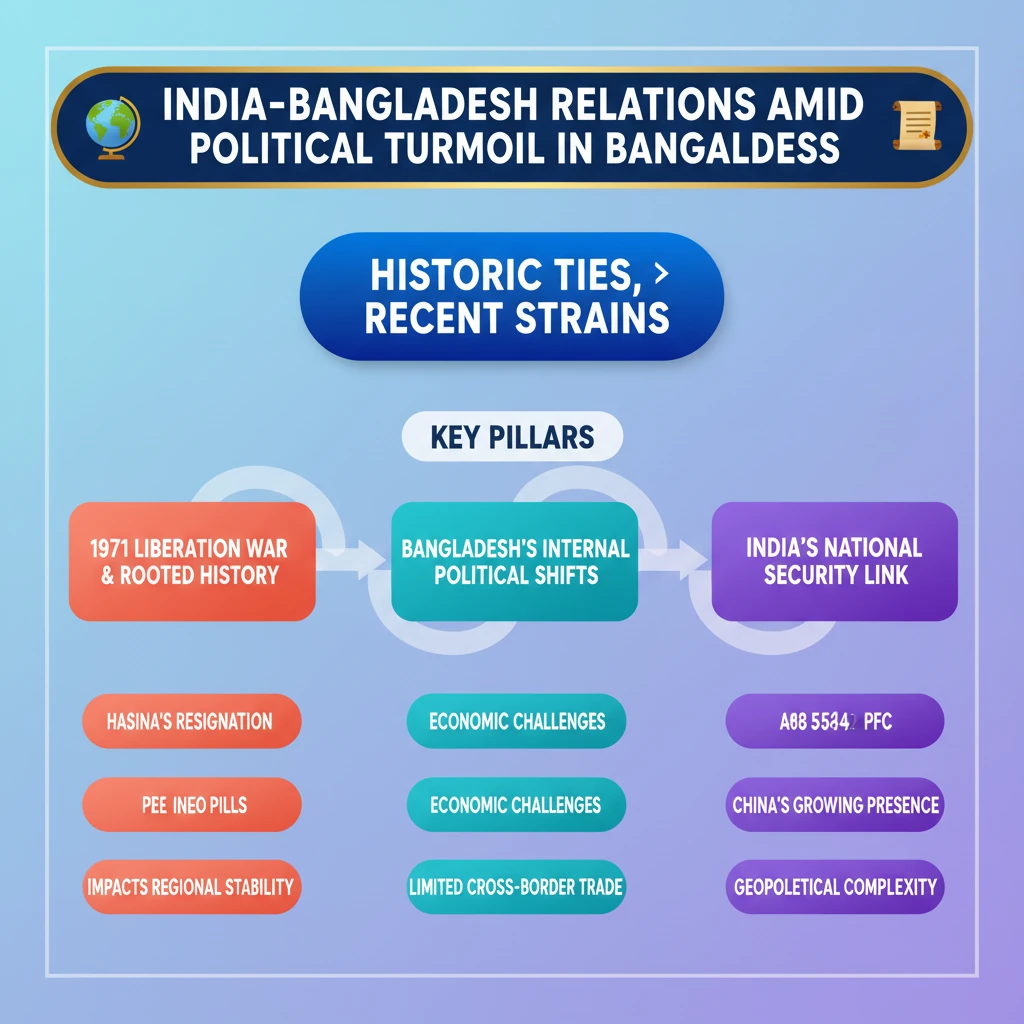
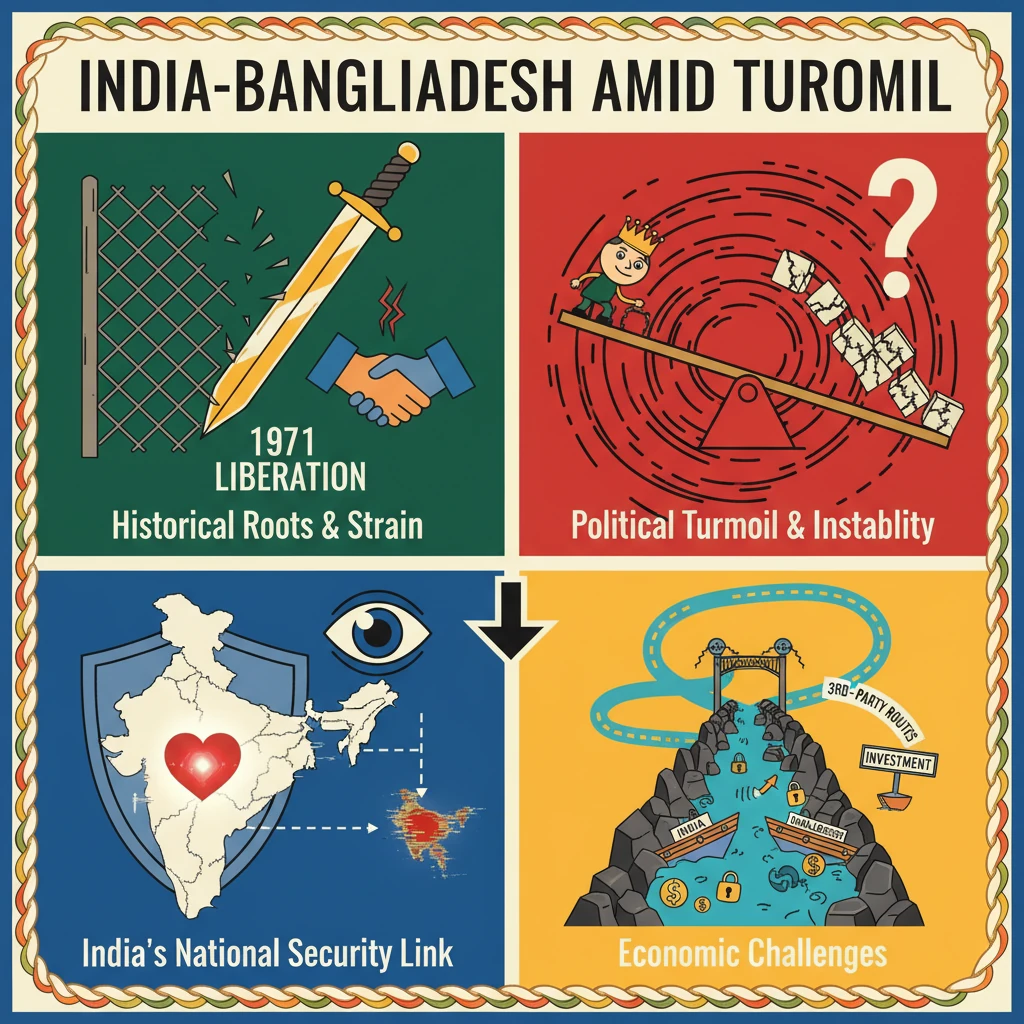
- •India-Bangladesh relations are historically rooted in the 1971 Liberation War but have faced periods of strain.
- •Recent political turmoil in Bangladesh, including Sheikh Hasina's resignation, significantly impacts regional stability.
- •India's national security is directly linked to Bangladesh's internal political situation.
- •Economic challenges like limited cross-border investment and reliance on third-party trade routes hinder bilateral growth.
- •China's increasing presence in Pakistan and the broader region adds a complex geopolitical dimension to India-Bangladesh ties.
🧠 Memory Techniques
95% Verified Content