Free Movement Regime - International Relations | UPSC Learning
Topics
0 topics • 0 completed
🔍
No topics match your search
Free Movement Regime
Medium⏱️ 8 min read
international relations
📖 Introduction
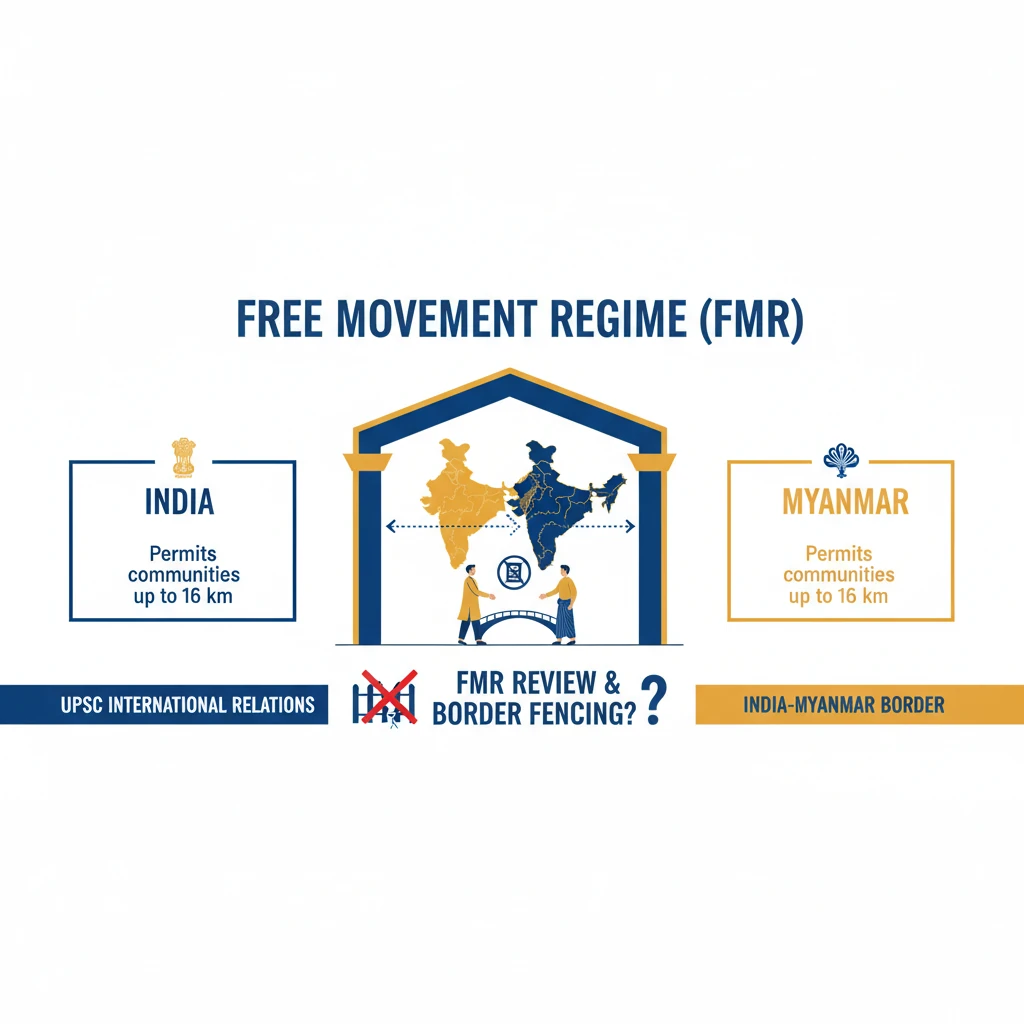
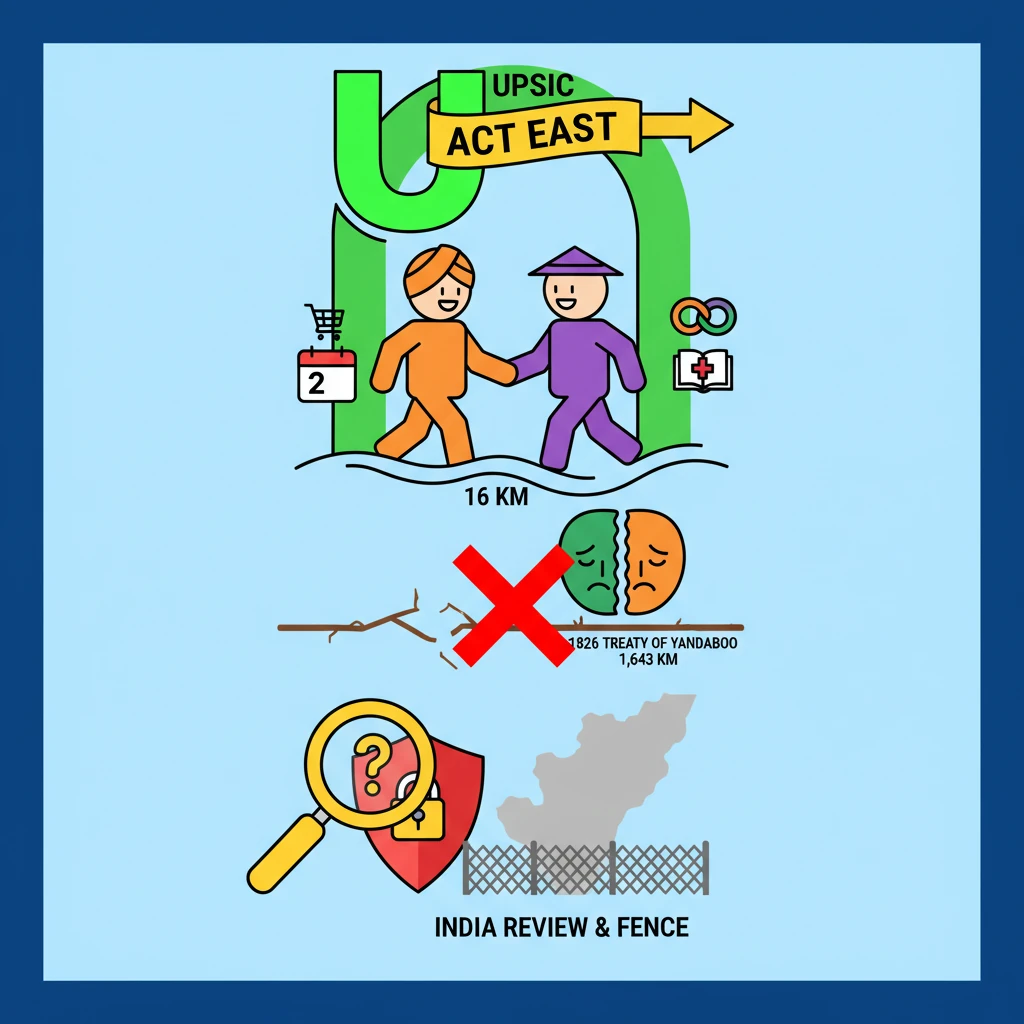
<h4>Introduction to Free Movement Regime (FMR)</h4><p>The <strong>Free Movement Regime (FMR)</strong> is a unique arrangement between <strong>India</strong> and <strong>Myanmar</strong>. It permits communities residing along the shared border to travel up to <strong>16 km</strong> into the neighbouring country without a visa.</p><p>Recently, <strong>India’s</strong> decision to review the <strong>FMR agreement</strong> and fence the <strong>India-Myanmar border</strong> has sparked significant discussions, particularly within the <strong>northeastern states</strong>.</p><div class='key-point-box'><p>This review aims to address a complex interplay of <strong>historical, cultural, and security considerations</strong> along the sensitive border region.</p></div><h4>Historical Context of the India-Myanmar Border</h4><p>Historically, a significant portion of <strong>India’s northeast region</strong> was under <strong>Burmese occupation</strong> for an extended period.</p><p>The current <strong>India-Myanmar boundary</strong> was formally established by the <strong>Treaty of Yandaboo</strong> in <strong>1826</strong>. This treaty marked a pivotal moment in the region's geopolitical landscape.</p><div class='info-box'><ul><li><strong>Treaty of Yandaboo (1826)</strong>: Signed by <strong>General Sir Archibald Campbell</strong> (representing the British) and <strong>Governor of Legaing Maha Min Hla Kyaw Htin</strong> (representing the Burmese).</li><li>It officially concluded the <strong>First Anglo-Burmese War (1824-1826)</strong>.</li></ul></div><p>Despite the treaty, the newly drawn border inadvertently separated various ethnic communities with shared heritage. This included the <strong>Nagas</strong> in <strong>Nagaland</strong> and <strong>Manipur</strong>, and the <strong>Kuki-Chin-Mizo</strong> communities across <strong>Manipur</strong> and <strong>Mizoram</strong>, often without their direct consent.</p><h4>Understanding the Free Movement Regime (FMR)</h4><p>The <strong>FMR</strong> was officially established in <strong>2018</strong>. It was conceptualized as a key component of <strong>India’s Act East policy</strong>, aiming to foster closer ties and facilitate cross-border interactions.</p><div class='info-box'><p>Under the <strong>FMR</strong>, individuals residing within the border areas are allowed to move up to <strong>16 km</strong> into the adjacent country. They are required to possess a <strong>one-year border pass</strong>, which permits stays of up to <strong>two weeks</strong>.</p></div><p>The primary objectives behind implementing the <strong>FMR</strong> were multifaceted, focusing on enhancing the well-being and connectivity of border populations.</p><ul><li>Facilitate <strong>local border trade</strong>, supporting economic activities for communities.</li><li>Improve access to essential services like <strong>education</strong> and <strong>healthcare</strong> for border residents.</li><li>Strengthen <strong>diplomatic ties</strong> and people-to-people connectivity between <strong>India</strong> and <strong>Myanmar</strong>.</li></ul><h4>India-Myanmar Border: Current Scenario</h4><p><strong>India</strong> and <strong>Myanmar</strong> share an extensive land border stretching approximately <strong>1,643 km</strong>. This border traverses four <strong>Indian northeastern states</strong>.</p><div class='info-box'><ul><li><strong>Indian States Sharing Border</strong>: <strong>Manipur</strong>, <strong>Mizoram</strong>, <strong>Nagaland</strong>, and <strong>Arunachal Pradesh</strong>.</li><li><strong>Fencing Status</strong>: Currently, only about <strong>10 km</strong> of this long border is fenced, specifically in parts of <strong>Manipur</strong>.</li></ul></div><div class='exam-tip-box'><p><strong>UPSC Insight</strong>: The FMR's review highlights the delicate balance between <strong>security imperatives</strong> and <strong>people-to-people connectivity</strong>, a recurring theme in India's border management and foreign policy discussions (e.g., <strong>GS Paper 2: International Relations</strong>, <strong>GS Paper 3: Internal Security</strong>).</p></div><h4>Neighbourhood First Policy and FMR</h4><p>The <strong>Neighbourhood First policy</strong> is a cornerstone of <strong>India's foreign policy</strong>, prioritizing friendly relations with its immediate neighbours.</p><p>This policy aims to enhance various forms of connectivity across the region. This includes <strong>physical, digital, and people-to-people linkages</strong>, alongside boosting <strong>trade and commerce</strong>.</p><p>The <strong>FMR</strong>, while initially a tool for connectivity, is now being re-evaluated under the broader framework of this policy, considering its evolving challenges and benefits.
💡 Key Takeaways
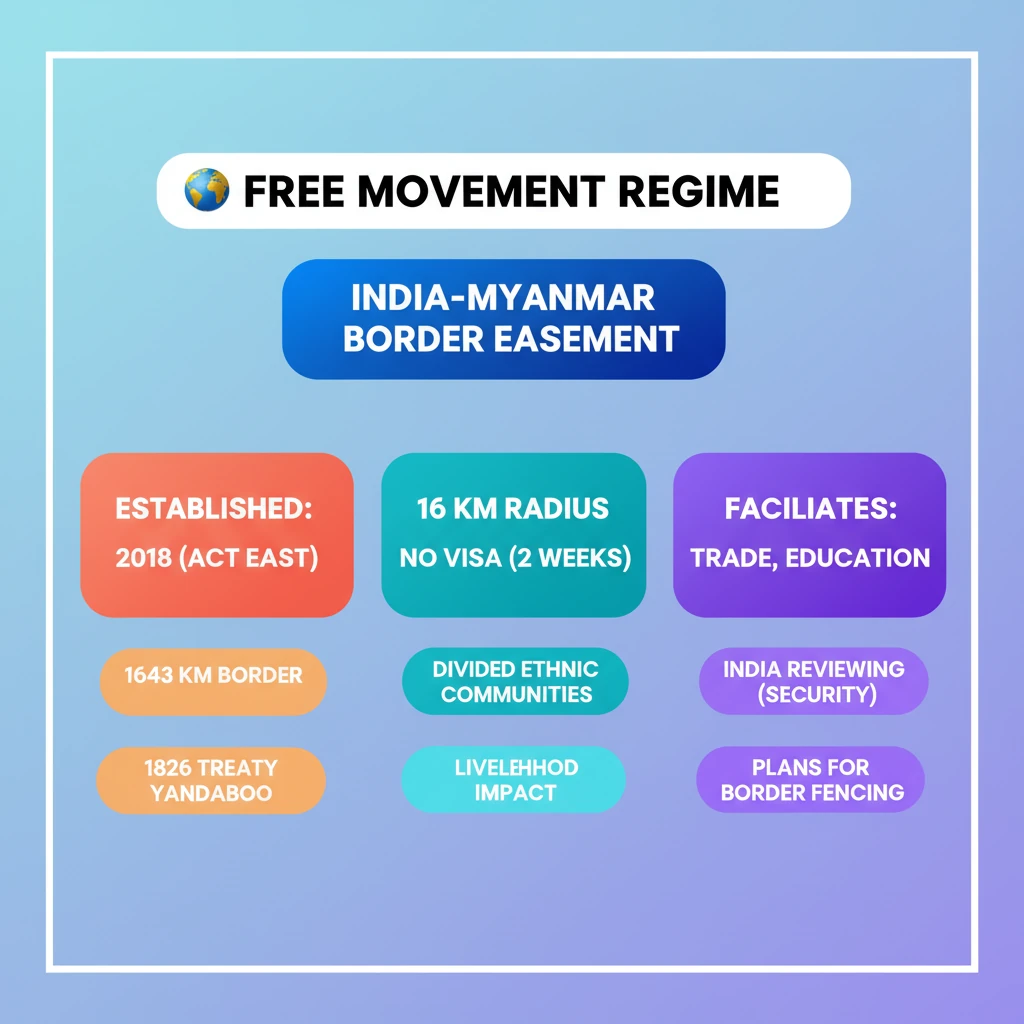
- •The Free Movement Regime (FMR) allows residents within 16 km of the India-Myanmar border to cross without a visa for up to two weeks.
- •Established in 2018 under India's Act East policy to facilitate local trade, education, healthcare, and diplomatic ties.
- •The India-Myanmar border (1,643 km) was established by the Treaty of Yandaboo in 1826, dividing ethnic communities.
- •India is reviewing the FMR and plans to fence the border due to security, cultural, and historical considerations.
- •The decision has significant implications for internal security, India-Myanmar relations, and the livelihoods of border communities.
🧠 Memory Techniques
98% Verified Content