India-Middle-East-Europe Corridor (IMEC) - International Relations | UPSC Learning
Topics
0 topics • 0 completed
🔍
No topics match your search
India-Middle-East-Europe Corridor (IMEC)
Medium⏱️ 7 min read
international relations
📖 Introduction
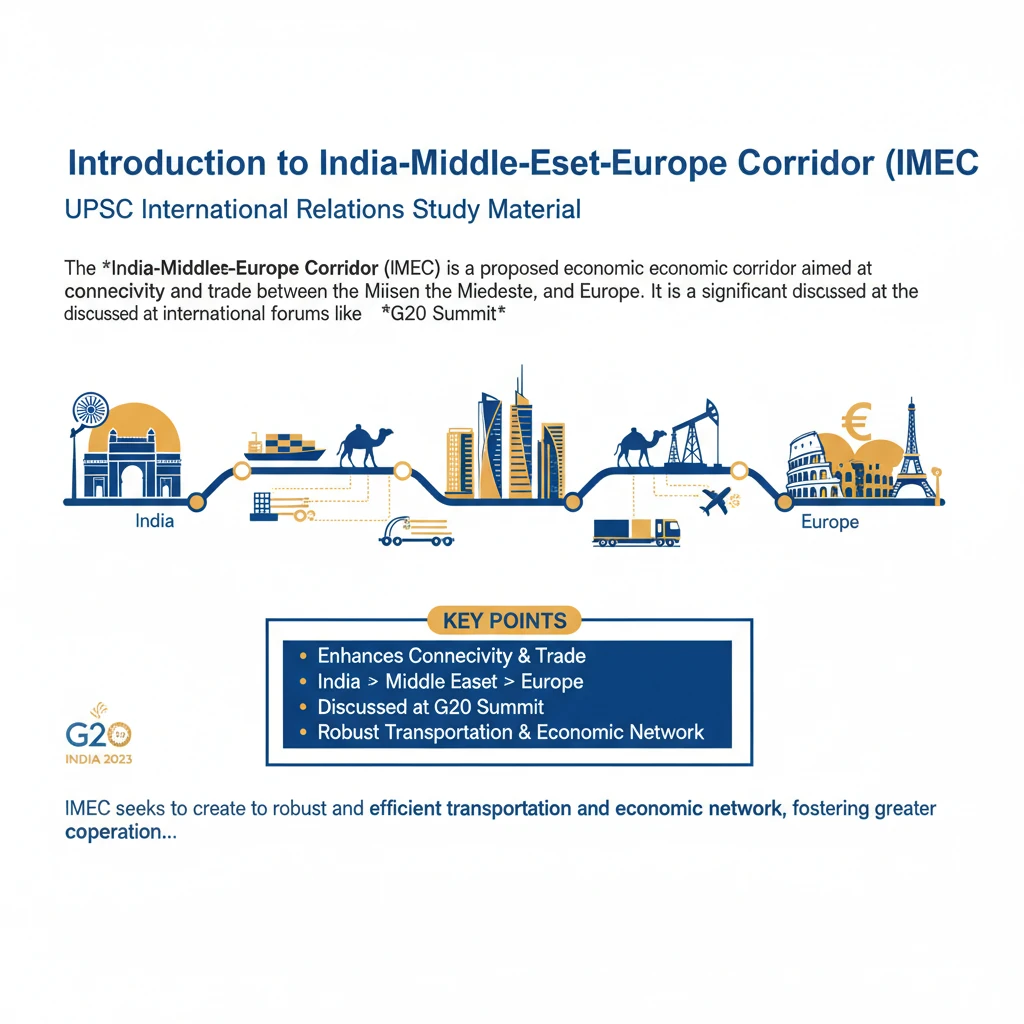
<h4>Introduction to the India-Middle-East-Europe Corridor (IMEC)</h4><p>The <strong>India-Middle-East-Europe Economic Corridor (IMEC)</strong> project was a landmark initiative announced at the <strong>G20 Summit</strong> in <strong>September 2023</strong>. This ambitious corridor aims to significantly enhance connectivity across three major regions.</p><p>It is designed to link <strong>India</strong>, the <strong>Middle East</strong>, and <strong>Europe</strong> through a robust network of infrastructure, fostering economic cooperation and regional integration.</p><h4>Core Objective of IMEC</h4><p>The primary objective of <strong>IMEC</strong> is to create a seamless trade and economic pathway. This will facilitate faster movement of goods, services, and energy, ultimately promoting greater prosperity among participating nations.</p><div class='key-point-box'><p><strong>Key Goal:</strong> To foster deep <strong>regional integration</strong> across <strong>Asia</strong>, <strong>Europe</strong>, and the <strong>Middle East</strong>, serving as a vital economic and strategic bridge.</p></div><h4>Components of the Corridor</h4><p>The <strong>IMEC</strong> project is envisioned as a multi-modal transport corridor. It will integrate various modes of transport to ensure efficient and effective connectivity.</p><p>The network will primarily consist of interconnected <strong>railways</strong>, <strong>roads</strong>, and crucial <strong>ship-to-rail links</strong>, ensuring a comprehensive logistics chain.</p><h4>The Two Main Corridors</h4><p>The <strong>IMEC</strong> is structured around two distinct yet interconnected corridors, each serving a critical geographical segment.</p><ul><li><strong>East Corridor:</strong> This segment is designed to link <strong>India</strong> directly to the <strong>Arabian Gulf</strong>. It forms the initial leg of the journey from the Indian subcontinent.</li><li><strong>Northern Corridor:</strong> This segment connects the <strong>Arabian Gulf</strong> to <strong>Europe</strong>. It extends the corridor's reach into the European continent, completing the trans-regional link.</li></ul><h4>Additional Infrastructure for Enhanced Integration</h4><p>Beyond traditional transport links, <strong>IMEC</strong> incorporates advanced infrastructure to support modern economic and energy needs.</p><p>The project will feature an <strong>electricity cable</strong>, a dedicated <strong>hydrogen pipeline</strong>, and a high-capacity <strong>high-speed data cable</strong>. These elements underscore a holistic approach to connectivity.</p><div class='info-box'><p><strong>Infrastructure Details:</strong> The inclusion of an <strong>electricity cable</strong> aims to enhance energy grid connectivity, while the <strong>hydrogen pipeline</strong> supports future clean energy ambitions. The <strong>high-speed data cable</strong> is critical for digital trade and communication.</p></div>
💡 Key Takeaways
- •IMEC was announced at the G20 Summit in September 2023.
- •It aims to connect India, the Middle East, and Europe through multi-modal transport (railways, roads, ship-to-rail links).
- •Comprises two corridors: East Corridor (India to Arabian Gulf) and Northern Corridor (Arabian Gulf to Europe).
- •Includes additional infrastructure like electricity cable, hydrogen pipeline, and high-speed data cable.
- •The project seeks to foster regional integration, enhance trade efficiency, and strengthen strategic partnerships.
🧠 Memory Techniques
95% Verified Content
📚 Reference Sources
•G20 Summit 2023 official statements (e.g., White House, European Commission)
•Ministry of External Affairs (MEA) reports and press releases