Shifting of Route of the Silk Road - International Relations | UPSC Learning
Topics
0 topics • 0 completed
🔍
No topics match your search
Shifting of Route of the Silk Road
Medium⏱️ 7 min read
international relations
📖 Introduction
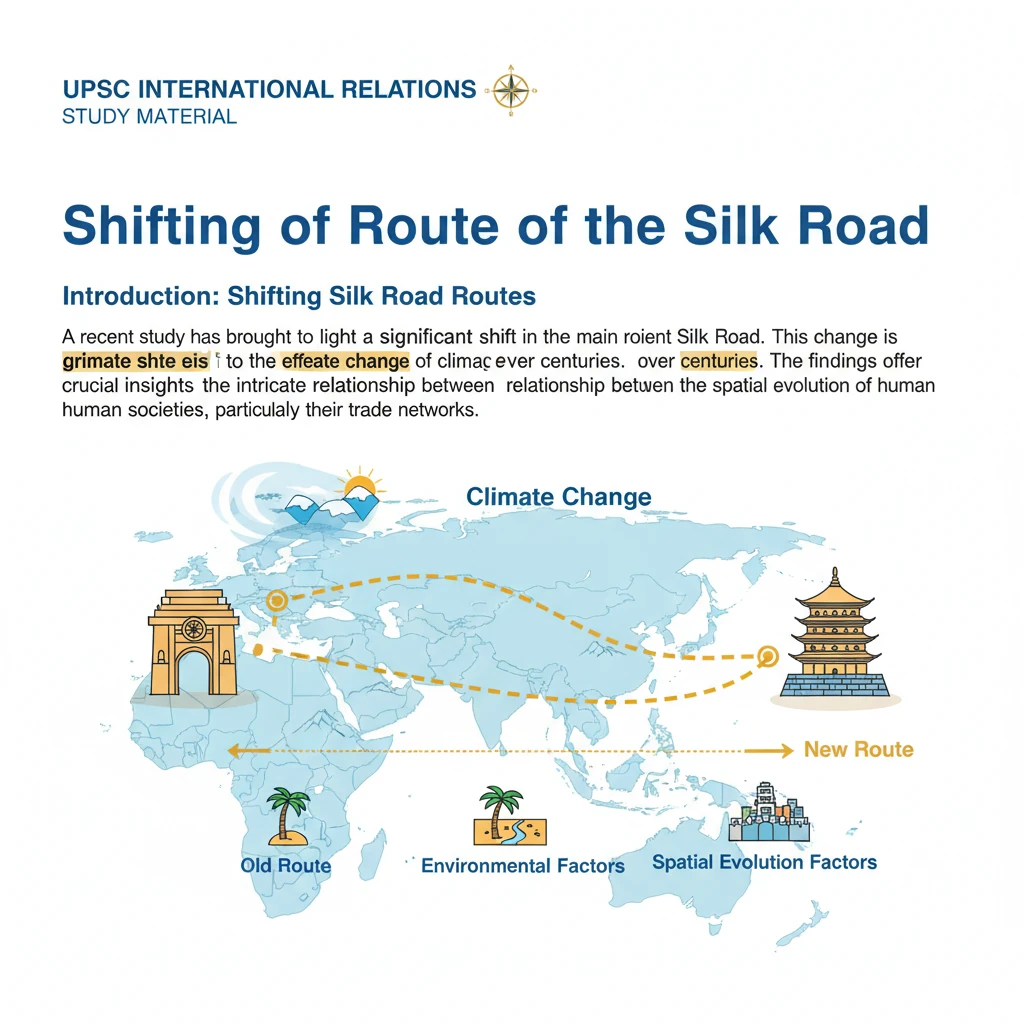
<h4>Introduction: Shifting Silk Road Routes</h4><p>A recent study has brought to light a significant shift in the <strong>main route of the ancient Silk Road</strong>. This change is primarily attributed to the effects of <strong>climate change</strong> over centuries.</p><p>The findings offer crucial insights into the intricate relationship between <strong>environmental factors</strong> and the <strong>spatial evolution of human societies</strong>, particularly their trade networks.</p><div class='info-box'><p><strong>Source:</strong> The study was conducted by <strong>Chinese scientists</strong> and published in the journal <strong>Science Bulletin</strong>.</p></div><h4>What was the Silk Road?</h4><p>The <strong>Silk Road</strong> was an extensive and complex network of <strong>ancient trade routes</strong>. It facilitated commercial, cultural, and technological exchange for over <strong>1,500 years</strong>.</p><p>Geographically, it connected the <strong>Atlantic seaboard of Europe</strong> with the <strong>Pacific coast of Asia (China)</strong>, forming a vital artery for ancient civilizations.</p><div class='key-point-box'><p><strong>Nomenclature:</strong> The route earned its name from the highly profitable <strong>silk trade</strong>, which originated in <strong>China</strong>, located at its easternmost terminus.</p></div><h4>Beyond Silk: Diverse Commodities and Key Hubs</h4><p>While <strong>silk</strong> was a primary commodity, the Silk Road was instrumental in transporting a wide array of other valuable goods. These included <strong>spices</strong>, <strong>gold</strong>, and various <strong>precious stones</strong>.</p><p>The network traversed numerous significant cities and powerful kingdoms. Notable hubs along its path included <strong>Samarkand</strong>, <strong>Babylon</strong>, and <strong>Constantinople</strong>, each playing a crucial role in trade and cultural diffusion.</p><h4>Historical Establishment of the Silk Road</h4><p>The foundational establishment of the Silk Road began in the <strong>2nd century BCE</strong>. This era saw <strong>Emperor Wu of the Chinese Han Dynasty</strong> initiate diplomatic outreach to the <strong>“Western Regions”</strong>.</p><p><strong>Zhang Qian</strong>, a distinguished diplomat, was dispatched by Emperor Wu to these regions, encompassing areas like <strong>Xinjiang</strong> and beyond. His expeditions were pivotal.</p><div class='info-box'><p><strong>Key Figure:</strong> <strong>Zhang Qian</strong> is widely revered as the <strong>“Father of the Silk Road”</strong> due to his pioneering explorations and diplomatic efforts.</p></div><p>His endeavors led to the gradual formation and consolidation of the <strong>Tarim Basin route</strong>, which became a primary artery of the Silk Road, linking East and West.</p>
💡 Key Takeaways
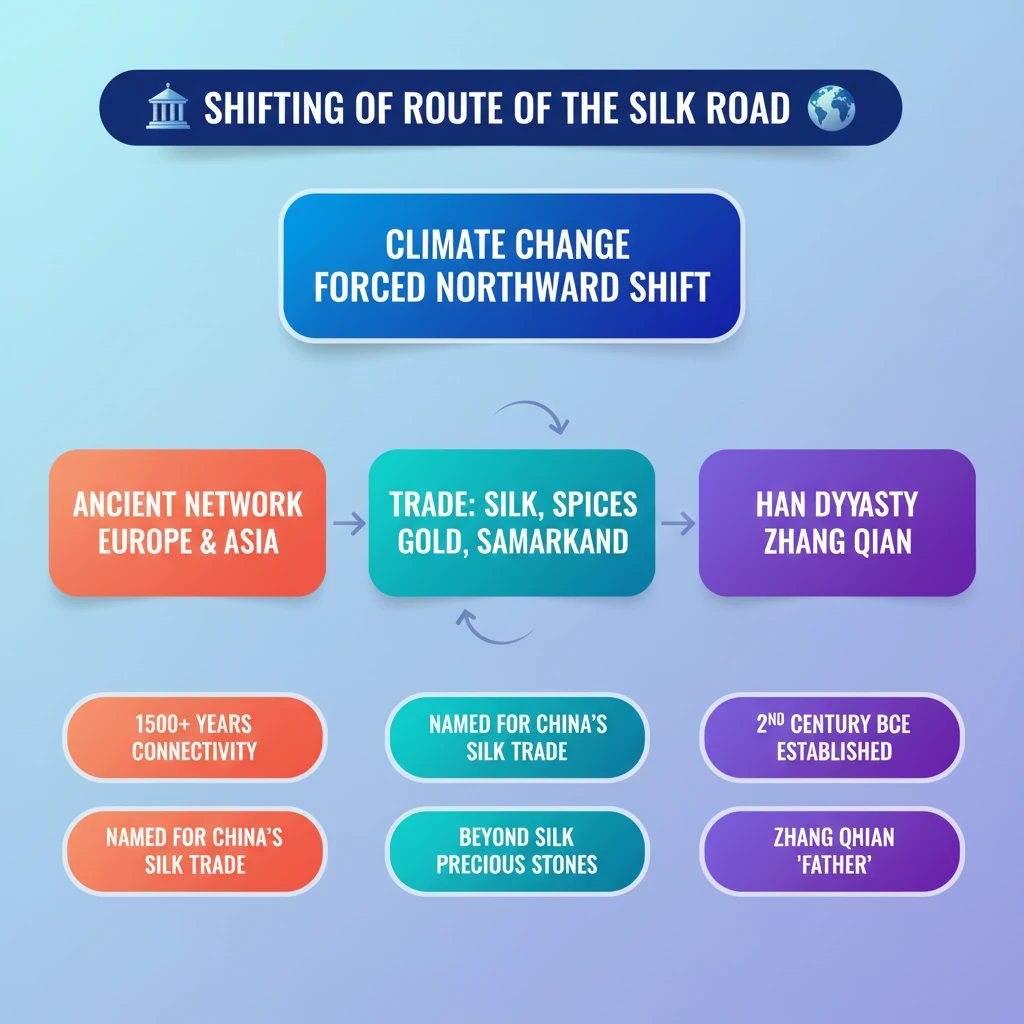
- •The Silk Road's main route shifted northward due to climate change, as per a recent study.
- •It was a vast network connecting Europe and Asia for over 1,500 years, named for China's silk trade.
- •Beyond silk, it transported spices, gold, and precious stones, passing through cities like Samarkand.
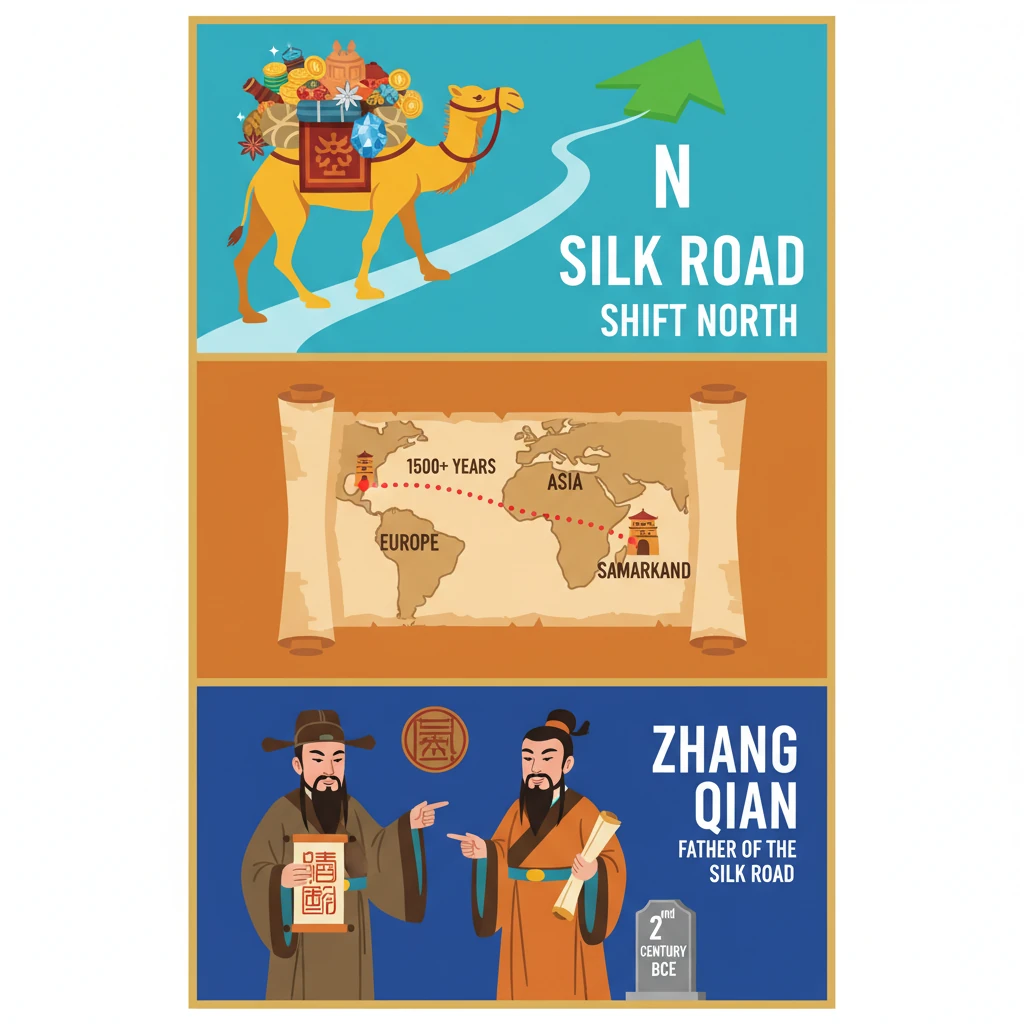
- •Established in the 2nd century BCE by China's Han Dynasty; diplomat Zhang Qian is the 'Father of the Silk Road'.
- •The Tarim Basin route was a key early segment, opened through Zhang Qian's expeditions.
- •Historical route shifts underscore the long-term impact of climate on human societies and trade.
🧠 Memory Techniques
95% Verified Content
📚 Reference Sources
•Science Bulletin (journal) - original study on Silk Road route shift
•Historical accounts of the Han Dynasty and Zhang Qian's expeditions
•Academic texts on the history and geography of the Silk Road