India Stands with the Philippines in the South China Sea - International Relations | UPSC Learning
Topics
0 topics • 0 completed
🔍
No topics match your search
India Stands with the Philippines in the South China Sea
Medium⏱️ 8 min read
international relations
📖 Introduction
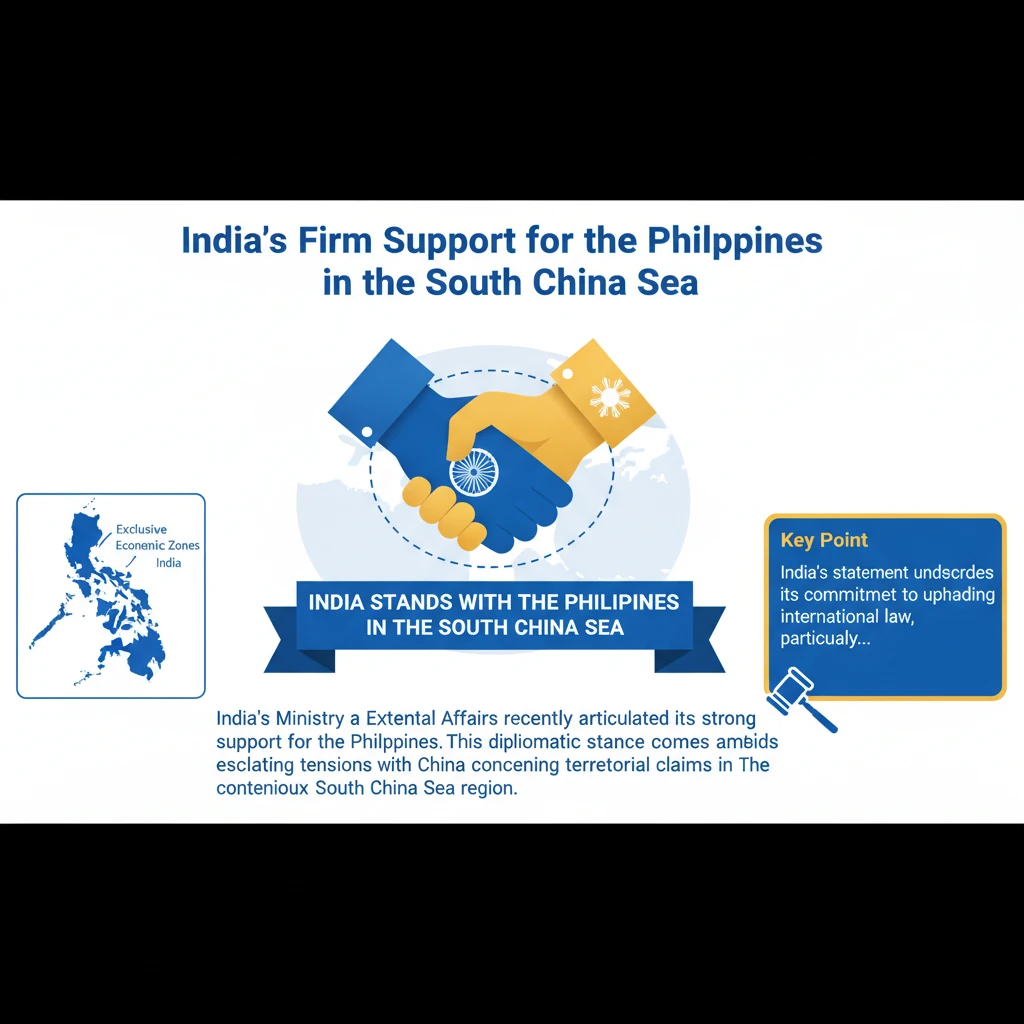
<h4>India's Firm Support for the Philippines in the South China Sea</h4><p>India's Ministry of External Affairs recently articulated its strong support for the <strong>Philippines</strong>. This diplomatic stance comes amidst escalating tensions with <strong>China</strong> concerning territorial claims in the contentious <strong>South China Sea</strong> region.</p><div class='key-point-box'><p>India's statement underscores its commitment to upholding <strong>international law</strong>, particularly the <strong>United Nations Convention on the Law of the Sea (UNCLOS)</strong>, and advocating for a rules-based order in the Indo-Pacific.</p></div><p>The support emphasizes the importance of <strong>national sovereignty</strong> and adherence to international legal frameworks in resolving maritime disputes.</p><h4>India-Philippines Diplomatic Relations: A Growing Partnership</h4><p>The diplomatic ties between <strong>India</strong> and the <strong>Philippines</strong> are poised to celebrate their <strong>75th anniversary</strong> in <strong>2024</strong>. This significant milestone highlights a deepening and transformative partnership between the two Asian nations.</p><div class='info-box'><ul><li><strong>Milestone:</strong> 75th year of diplomatic relations in <strong>2024</strong>.</li><li><strong>Nature of Partnership:</strong> Transformative and strengthening.</li></ul></div><p>This long-standing relationship provides a strong foundation for India's current diplomatic backing in the face of regional challenges.</p><h4>The South China Sea Dispute: An Overview</h4><p>The <strong>South China Sea</strong> is a crucial geopolitical hotspot, characterized by overlapping territorial and maritime claims. Several countries, including <strong>China</strong>, the <strong>Philippines</strong>, <strong>Vietnam</strong>, <strong>Malaysia</strong>, <strong>Brunei</strong>, and <strong>Taiwan</strong>, assert claims over various islands, reefs, and waters.</p><div class='info-box'><p>The dispute involves claims over strategically important features like the <strong>Spratly Islands</strong> and <strong>Paracel Islands</strong>, rich fishing grounds, and potential hydrocarbon reserves.</p></div><p><strong>China's expansive claims</strong>, often referred to as the <strong>"nine-dash line,"</strong> are largely contested by other claimants and have been ruled against by an international tribunal.</p><h4>India's Broader Regional Engagements: Afghanistan Context</h4><p>While the primary focus is on the South China Sea, India maintains diverse regional engagements. One such significant initiative involves its long-standing partnership with <strong>Afghanistan</strong>.</p><div class='info-box'><p><strong>Chabahar Port:</strong> This Iranian port serves as a vital alternative route for the <strong>duty-free movement of goods</strong> from India to <strong>Afghanistan</strong>, bypassing Pakistan. It enhances regional connectivity and trade.</p></div><p>India has consistently supported Afghanistan's economic development and stability through various projects and agreements.</p><ul><li><strong>SAFTA Tariff Concessions:</strong> <strong>Afghan traders</strong> continue to benefit from <strong>tariff concessions</strong> under the <strong>South Asian Free Trade Agreement (SAFTA)</strong>, facilitating cross-border commerce.</li><li><strong>Salma Dam (Afghan-India Friendship Dam - AIFD):</strong> This significant <strong>hydroelectric and irrigation dam project</strong> is located on the <strong>Hari River</strong> in <strong>Herat Province</strong>, western Afghanistan. India committed to funding its completion in <strong>2006</strong>.</li></ul><div class='key-point-box'><p>The <strong>Strategic Partnership Agreement (SPA)</strong>, signed between <strong>India</strong> and <strong>Afghanistan</strong> in <strong>October 2011</strong>, forms the bedrock of their political relations. It outlines comprehensive assistance for Afghanistan's rebuilding efforts.</p></div><p>The <strong>SPA</strong> specifically provides for aid in rebuilding Afghanistan’s <strong>infrastructure and institutions</strong>, alongside extensive <strong>education and technical assistance</strong> programs.</p><p>India has been a steadfast advocate for <strong>Afghan democracy</strong>, consistently promoting a vision of a <strong>stable, peaceful, and prosperous Afghanistan</strong>.</p>
💡 Key Takeaways
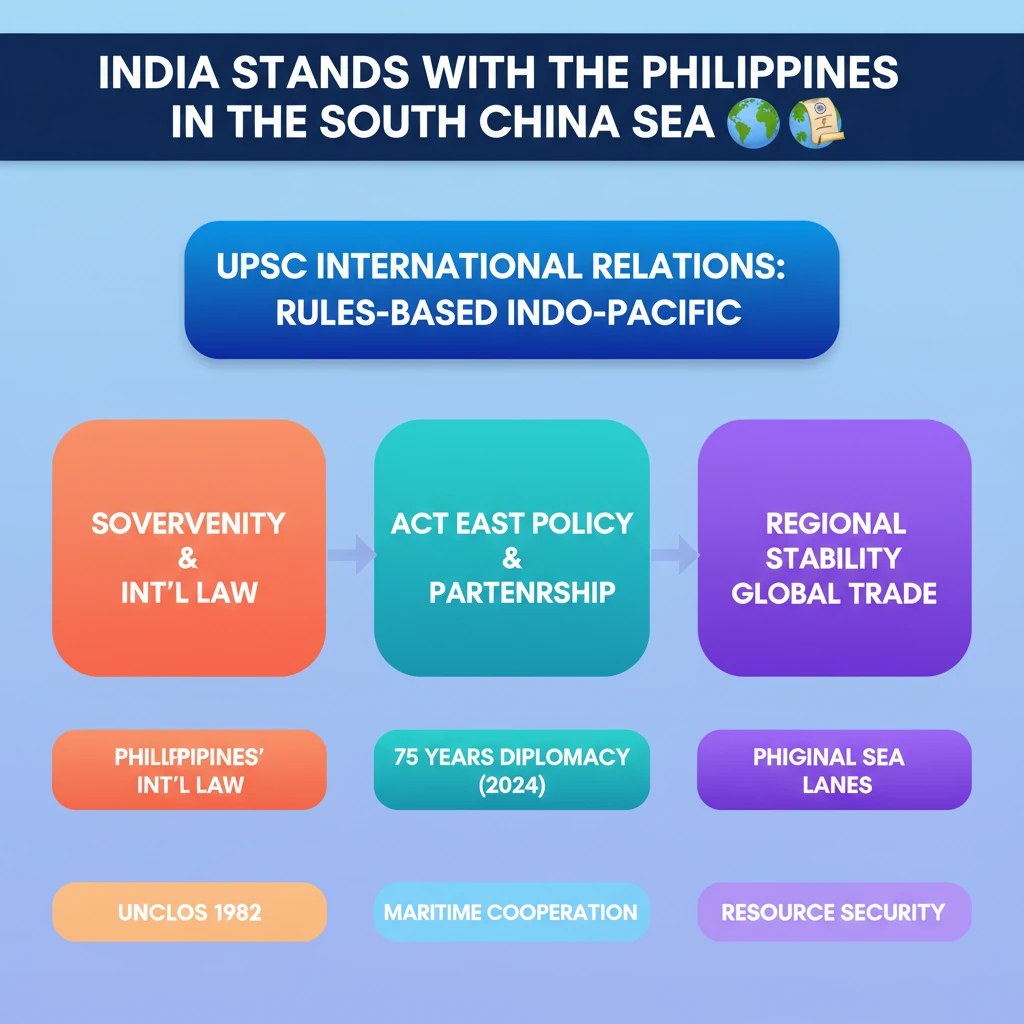
- •India firmly supports the Philippines' sovereignty in the South China Sea dispute against China's claims.
- •This support aligns with India's Act East Policy and commitment to a rules-based Indo-Pacific.
- •The India-Philippines diplomatic relations are nearing their 75th anniversary in 2024, signifying a strong partnership.
- •The South China Sea dispute involves multiple claimants and is crucial for global trade routes and resources.
- •India's historical engagement with Afghanistan (Chabahar, Salma Dam, SPA) highlights its broader regional connectivity and development initiatives.
🧠 Memory Techniques
90% Verified Content
📚 Reference Sources
•Ministry of External Affairs (MEA) statements (general knowledge)
•UNCLOS (general knowledge of international law)
•News reports on India-Philippines defense cooperation (general knowledge)