India Rejects China’s Claim Over Arunachal Pradesh - International Relations | UPSC Learning
Topics
0 topics • 0 completed
🔍
No topics match your search
India Rejects China’s Claim Over Arunachal Pradesh
Medium⏱️ 8 min read
international relations
📖 Introduction
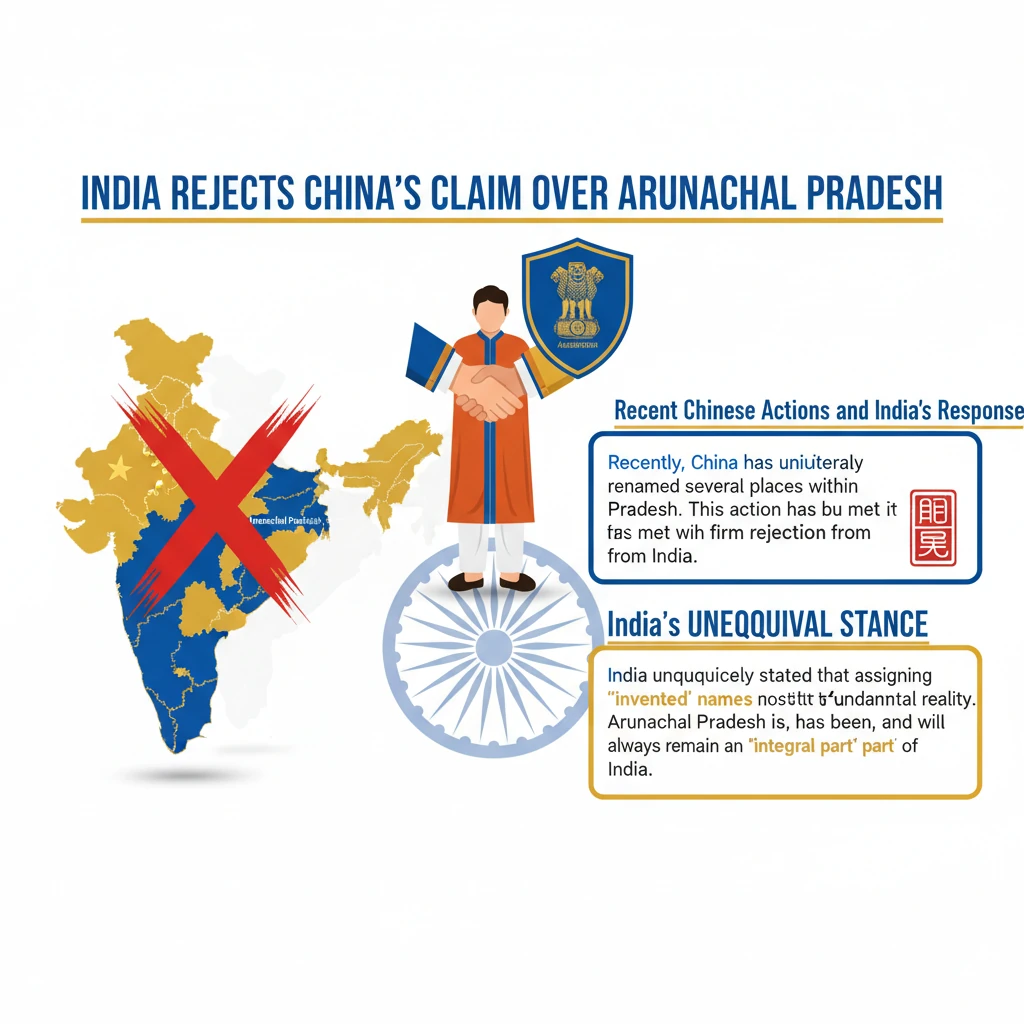
<h4>Recent Chinese Actions and India's Response</h4><p>Recently, <strong>China</strong> has unilaterally <strong>renamed several places</strong> within <strong>Arunachal Pradesh</strong>. This action has been met with a firm rejection from <strong>India</strong>.</p><p><strong>India</strong> unequivocally stated that assigning "<strong>invented</strong>" names does not alter the fundamental reality. <strong>Arunachal Pradesh</strong> is, has been, and will always remain an "<strong>integral part of India</strong>".</p><div class='info-box'><p>The <strong>Chinese Ministry of Civil Affairs</strong> released its <strong>fourth list</strong> of standardised geographical names. These names were for <strong>Zangnan</strong>, which is <strong>China's name for Arunachal Pradesh</strong>, a region <strong>Beijing claims as part of south Tibet</strong>.</p></div><h4>Understanding the India-China Border Dispute</h4><p>The <strong>India-China border dispute</strong> is a long-standing and complex issue. It involves territorial claims along their shared border, which stretches approximately <strong>3,488 kilometres</strong>.</p><p>The primary areas of contention are the <strong>Aksai Chin</strong> region in the <strong>western sector</strong> and the entire state of <strong>Arunachal Pradesh</strong> in the <strong>eastern sector</strong>.</p><div class='key-point-box'><p>There is <strong>no clear demarcation</strong> of the border throughout its length. Consequently, there is <strong>no mutually agreed Line of Actual Control (LAC)</strong> along certain stretches of this boundary.</p></div><h4>Key Disputed Regions</h4><ul><li><strong>Aksai Chin:</strong> This region is administered by <strong>China</strong> as part of its <strong>Xinjiang region</strong>. <strong>India</strong>, however, considers it an integral part of its <strong>Union Territory of Ladakh</strong>.</li><li><strong>Strategic Significance of Aksai Chin:</strong> The area holds immense <strong>strategic importance</strong>. It is close to the <strong>China-Pakistan Economic Corridor (CPEC)</strong> and serves as a potential <strong>military route</strong> for <strong>China</strong>.</li><li><strong>Arunachal Pradesh:</strong> <strong>China claims the entire state</strong>, referring to it as "<strong>South Tibet</strong>". <strong>India</strong> administers this region as a northeastern state and firmly considers it an <strong>integral part of its territory</strong>.</li></ul><h4>The Line of Actual Control (LAC)</h4><p>The concept of the <strong>Line of Actual Control (LAC)</strong> came into existence following the <strong>1962 Indo-China war</strong>. It is a de facto boundary but lacks mutual agreement on its precise alignment in many areas.</p><div class='exam-tip-box'><p>Understanding the distinction between the <strong>Line of Actual Control (LAC)</strong> and an internationally recognised border is crucial for <strong>UPSC Mains (GS Paper 2)</strong> questions on <strong>India-China relations</strong> and <strong>border management</strong>.</p></div><h4>Sectors of the India-China Border</h4><p>The <strong>India-China border</strong> is broadly divided into <strong>three sectors</strong> for administrative and strategic purposes:</p><ol><li><strong>Western Sector:</strong> This sector primarily encompasses the region of <strong>Ladakh</strong>.</li><li><strong>Middle Sector:</strong> This relatively less disputed sector covers areas like <strong>Himachal Pradesh</strong> and <strong>Uttarakhand</strong>.</li><li><strong>Eastern Sector:</strong> This sector covers <strong>Arunachal Pradesh</strong> and parts of <strong>Sikkim</strong>, with <strong>Arunachal Pradesh</strong> being the most contentious area.</li></ol>
💡 Key Takeaways
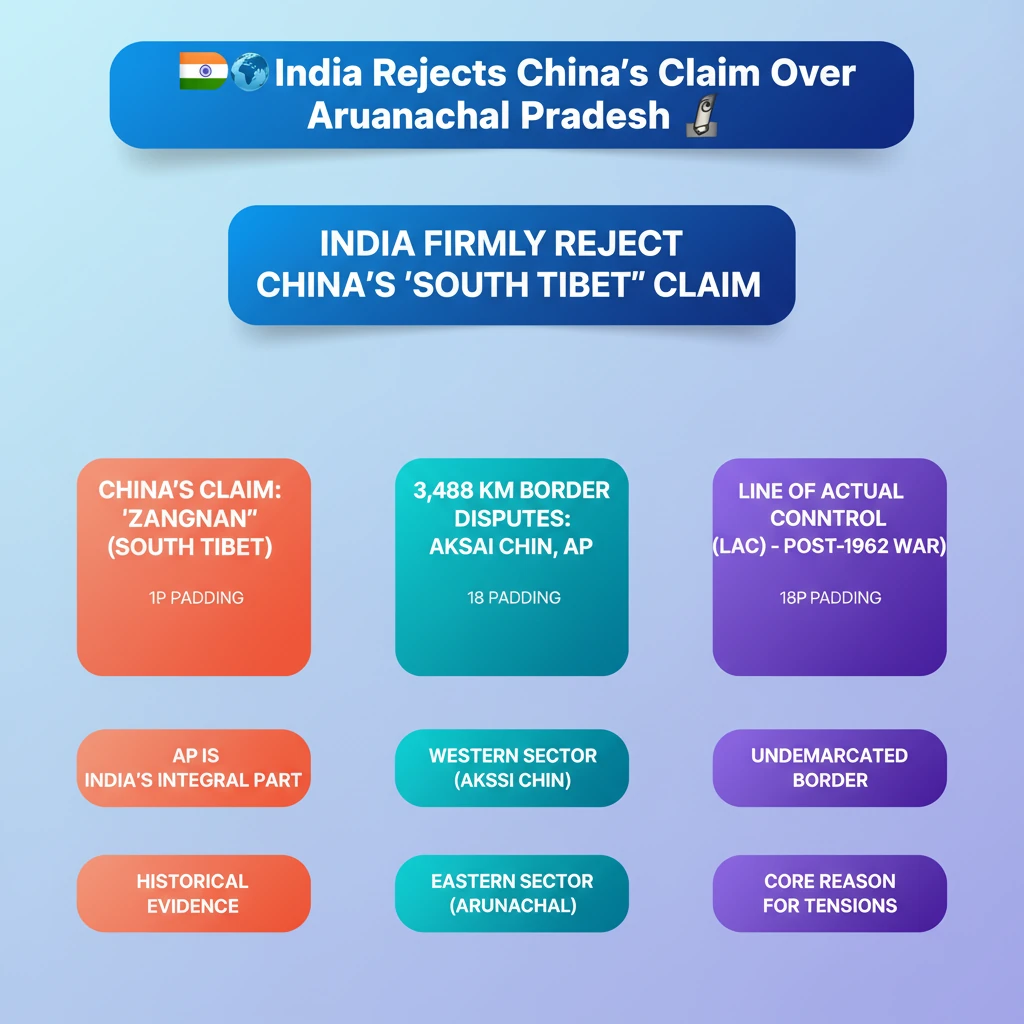
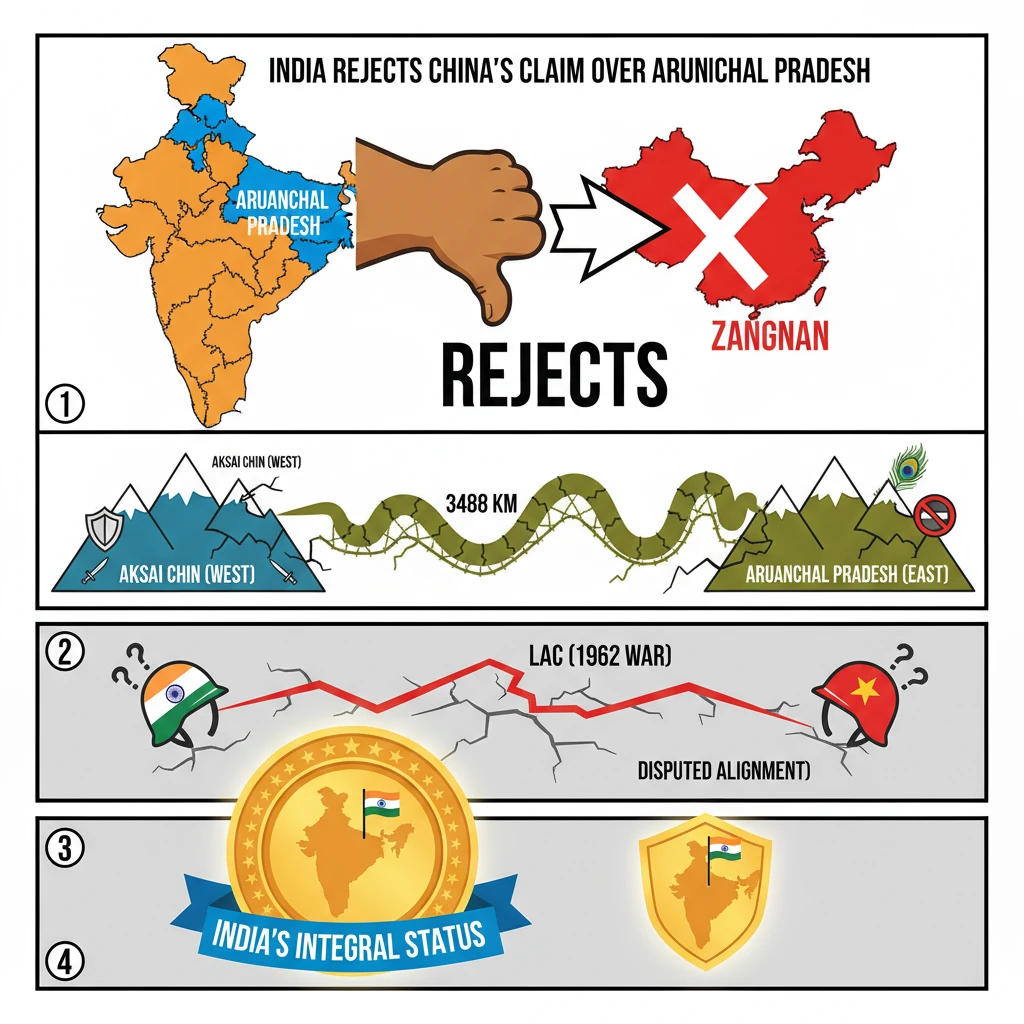
- •India firmly rejects China's claims over Arunachal Pradesh, asserting its integral status.
- •China refers to Arunachal Pradesh as 'Zangnan' and claims it as 'South Tibet'.
- •The India-China border is 3,488 km long, with major disputes in Aksai Chin (western) and Arunachal Pradesh (eastern).
- •The Line of Actual Control (LAC) emerged post-1962 war, but its alignment remains disputed.
- •Lack of clear border demarcation is a core reason for ongoing tensions and incidents.
🧠 Memory Techniques
95% Verified Content