19th NAM Summit and India-Uganda Relations - International Relations | UPSC Learning
Topics
0 topics • 0 completed
🔍
No topics match your search
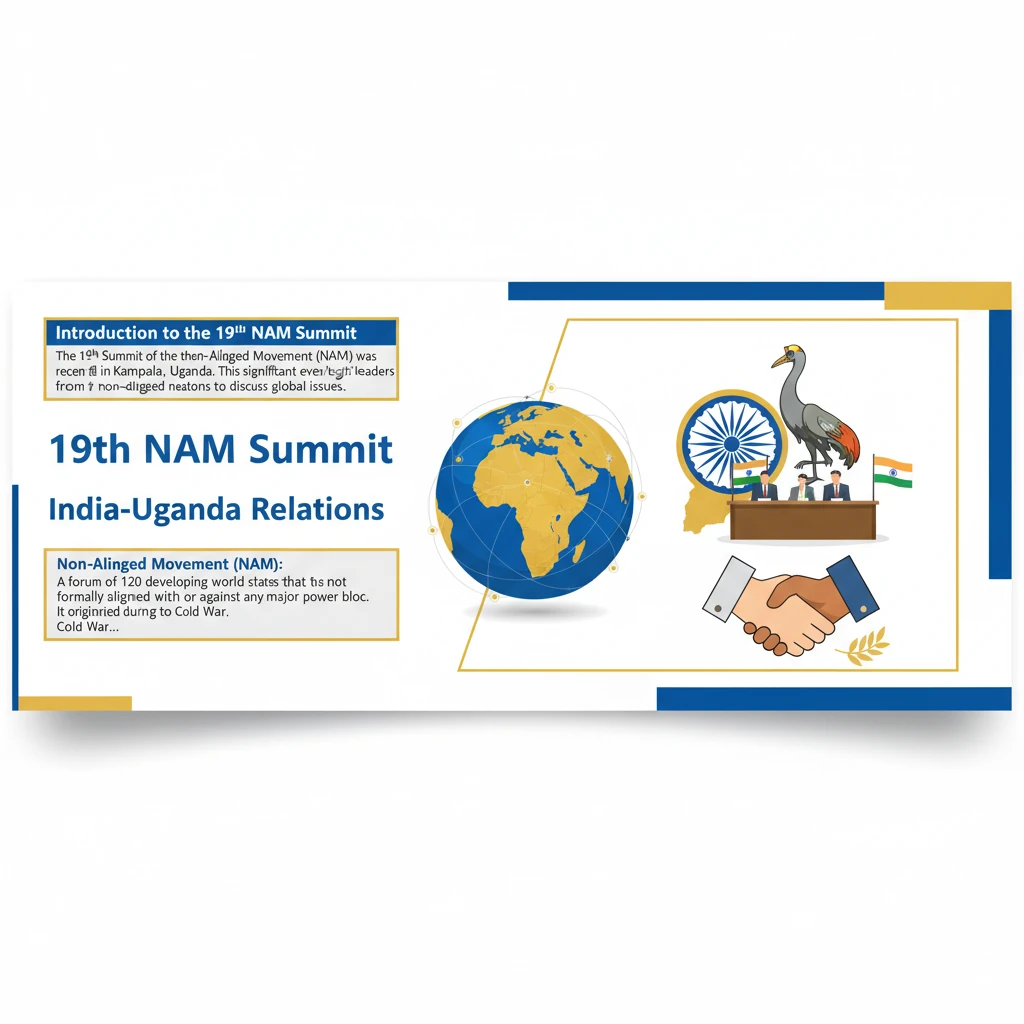
19th NAM Summit and India-Uganda Relations
Medium⏱️ 4 min read
international relations
📖 Introduction
<h4>Introduction to the 19th NAM Summit</h4><p>The <strong>19th Summit</strong> of the <strong>Non-Aligned Movement (NAM)</strong> was recently hosted in <strong>Kampala, Uganda</strong>. This significant event brought together leaders from various non-aligned nations to discuss global issues.</p><div class='info-box'><p><strong>Non-Aligned Movement (NAM):</strong> A forum of 120 developing world states that are not formally aligned with or against any major power bloc. It originated during the Cold War.</p></div><h4>Ugandan President's Diplomatic Gesture</h4><p>During the summit, <strong>Ugandan President Yoweri Museveni</strong> expressed profound regret over the <strong>expulsion of Indians</strong> by former dictator <strong>Idi Amin</strong> in the <strong>1970s</strong>. This statement marked a significant moment in India-Uganda bilateral relations.</p><p>President Museveni also commended the remarkable achievements of the <strong>Indian diaspora</strong> in <strong>Uganda</strong>. He further lauded <strong>India's pivotal role</strong> in supporting and leading the <strong>Global South</strong> on various international platforms.</p><div class='key-point-box'><p><strong>Significance of Museveni's Statement:</strong> It represents a diplomatic gesture of reconciliation and acknowledges the historical injustice faced by the Indian community, paving the way for stronger bilateral ties.</p></div><h4>Historical Context: Idi Amin's Expulsion Order</h4><p>In <strong>August 1972</strong>, <strong>Idi Amin</strong>, the then-dictator of <strong>Uganda</strong>, issued a decree ordering the expulsion of all <strong>Indians</strong> and other <strong>Asians</strong> residing and working in the country. This drastic measure led to a mass exodus.</p><p>The expulsion had a devastating and immediate impact on the <strong>Ugandan economy</strong>. The departing Asian community, largely comprising business owners and professionals, left a significant void in the country's commercial and administrative sectors.</p><div class='exam-tip-box'><p>Understanding such historical events is crucial for <strong>UPSC Mains GS Paper 2 (International Relations)</strong>, especially when discussing diaspora's role, diplomatic relations, and post-colonial challenges.</p></div>

💡 Key Takeaways
- •19th NAM Summit hosted in Kampala, Uganda.
- •Ugandan President Museveni regretted Idi Amin's 1972 expulsion of Indians.
- •Museveni praised Indian diaspora's achievements and India's Global South leadership.
- •Idi Amin's expulsion devastated Uganda's economy and led to mass exodus of Asians.
- •The event signifies diplomatic reconciliation and strengthened India-Uganda ties.
🧠 Memory Techniques

98% Verified Content
📚 Reference Sources
•General knowledge of Non-Aligned Movement (NAM)
•Historical accounts of Idi Amin's regime and the expulsion of Asians from Uganda