What is the Difference Between Look East Policy and Act East Policy? - International Relations | UPSC Learning
Topics
0 topics • 0 completed
🔍
No topics match your search
What is the Difference Between Look East Policy and Act East Policy?
Medium⏱️ 9 min read
international relations
📖 Introduction
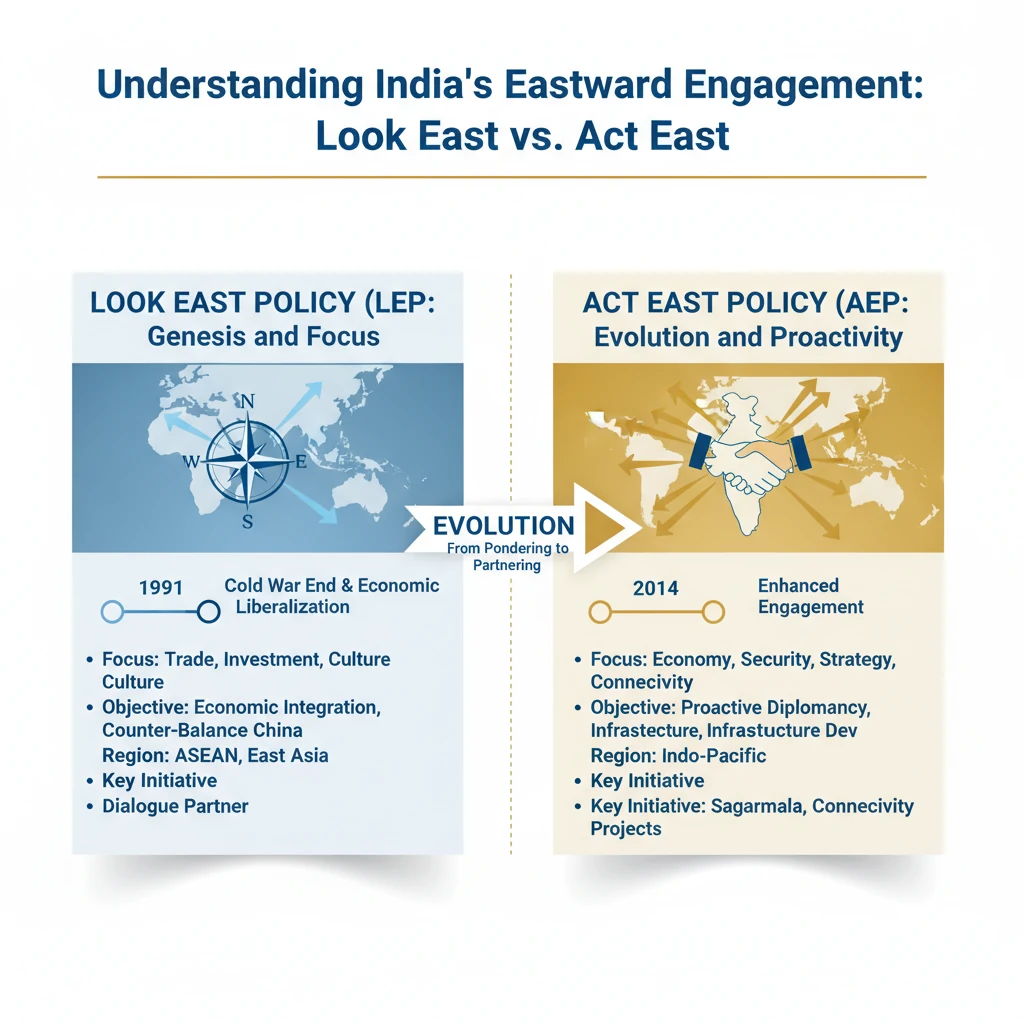
<h4>Understanding India's Eastward Engagement: Look East vs. Act East</h4><p>India's foreign policy towards its eastern neighbours has undergone a significant evolution, moving from the <strong>Look East Policy</strong> to the more proactive <strong>Act East Policy</strong>. Both policies aim to strengthen India's ties with the vibrant economies and strategic regions of Southeast and East Asia.</p><h4>The Look East Policy (LEP): Genesis and Focus</h4><p>The <strong>Look East Policy (LEP)</strong> was initiated by India in <strong>1992</strong>. Its primary objective was to forge stronger economic and strategic relations with the countries of Southeast Asia, particularly the <strong>Association of Southeast Asian Nations (ASEAN)</strong>.</p><p>The policy emerged in the post-Cold War era, driven by India's economic liberalisation and a desire to diversify its foreign relations beyond traditional partners. It marked a strategic shift towards greater engagement with dynamic Asian economies.</p><div class='key-point-box'><strong>Core Focus of Look East Policy:</strong> Primarily centred on <strong>economic integration</strong> with <strong>ASEAN countries</strong>.</div><h4>Key Milestones of Look East Policy</h4><ul><li><strong>1996:</strong> India became a <strong>Dialogue Partner</strong> of <strong>ASEAN</strong>, signifying a formal step towards deeper engagement.</li><li><strong>2002:</strong> The relationship was upgraded to a <strong>Summit Level Partner</strong>, allowing for greater high-level interactions.</li><li><strong>2012:</strong> India's engagement with <strong>ASEAN</strong> was further elevated to a <strong>Strategic Partnership</strong>, reflecting growing convergence of interests.</li></ul><div class='info-box'><strong>Economic Impact:</strong> India's trade with <strong>ASEAN</strong> grew from <strong>USD 2 billion</strong> in <strong>1992</strong> to <strong>USD 72 billion</strong> by <strong>2017-18</strong>, significantly boosted by the <strong>Free Trade Agreement (FTA)</strong> signed in <strong>2010</strong>.</div><p>India also actively participated in various regional forums under the LEP, such as the <strong>East Asia Summit (EAS)</strong> and the <strong>ASEAN Regional Forum (ARF)</strong>, solidifying its presence in the regional security and economic architecture.</p><h4>The Act East Policy (AEP): Evolution and Expansion</h4><p>The <strong>Act East Policy (AEP)</strong> was launched in <strong>November 2014</strong> by the <strong>Narendra Modi government</strong>, building upon the foundations laid by the <strong>Look East Policy</strong>. It represents a more dynamic and action-oriented approach to India's engagement with the Indo-Pacific region.</p><div class='key-point-box'><strong>Expanded Focus of Act East Policy:</strong> Encompasses <strong>ASEAN countries</strong>, <strong>East Asian countries</strong> (e.g., Japan, South Korea), and extends beyond mere economic integration to include robust <strong>security cooperation</strong>.</div><p>The AEP aims to promote economic cooperation, cultural ties, and develop strategic relationships with countries in the Indo-Pacific region, providing enhanced connectivity, trade, and defence partnerships.</p><h4>Key Differences: Look East vs. Act East</h4><p>While both policies share the common goal of enhancing India's engagement with the East, the <strong>Act East Policy</strong> is distinguished by its broader geographical scope, deeper sectoral engagement, and more proactive strategic dimension.</p><table class='info-table'><tr><th>Feature</th><th>Look East Policy (LEP)</th><th>Act East Policy (AEP)</th></tr><tr><td><strong>Initiation</strong></td><td><strong>1992</strong></td><td><strong>2014</strong></td></tr><tr><td><strong>Primary Focus</strong></td><td>Mainly <strong>economic integration</strong></td><td><strong>Economic integration</strong>, <strong>strategic cooperation</strong>, <strong>security cooperation</strong></td></tr><tr><td><strong>Geographical Scope</strong></td><td>Primarily <strong>ASEAN countries</strong></td><td><strong>ASEAN countries</strong> + broader <strong>East Asian countries</strong> (e.g., Japan, South Korea) + <strong>Pacific Island Countries</strong></td></tr><tr><td><strong>Nature of Engagement</strong></td><td>Reactive, largely economic</td><td>Proactive, multi-faceted (economic, strategic, security, cultural, people-to-people)</td></tr><tr><td><strong>Key Driver</strong></td><td>Economic liberalisation, post-Cold War reorientation</td><td>Indo-Pacific strategy, regional security, connectivity initiatives</td></tr></table><div class='exam-tip-box'>Understanding the evolution from <strong>Look East</strong> to <strong>Act East</strong> is crucial for Mains Paper 2 (International Relations). Focus on the 'why' behind the shift and the expanded dimensions of the AEP.</div>
💡 Key Takeaways
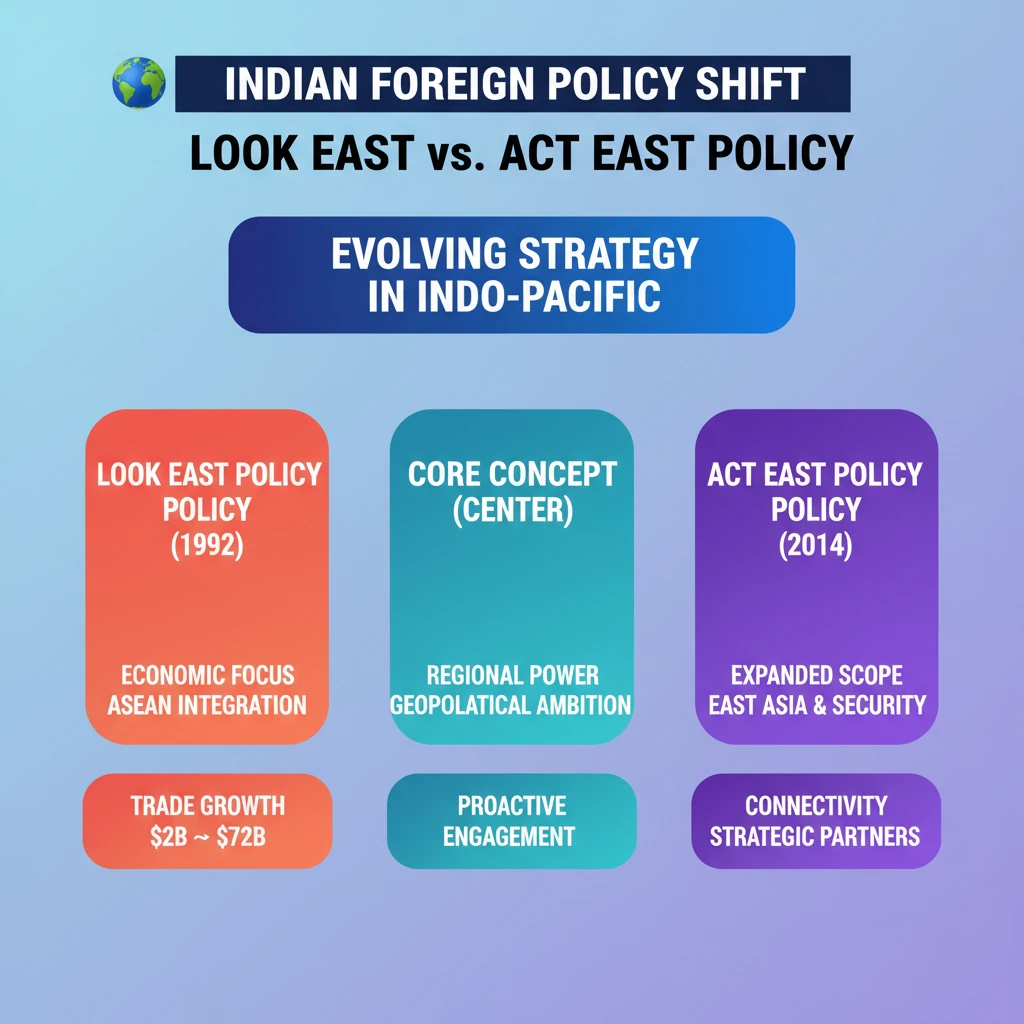
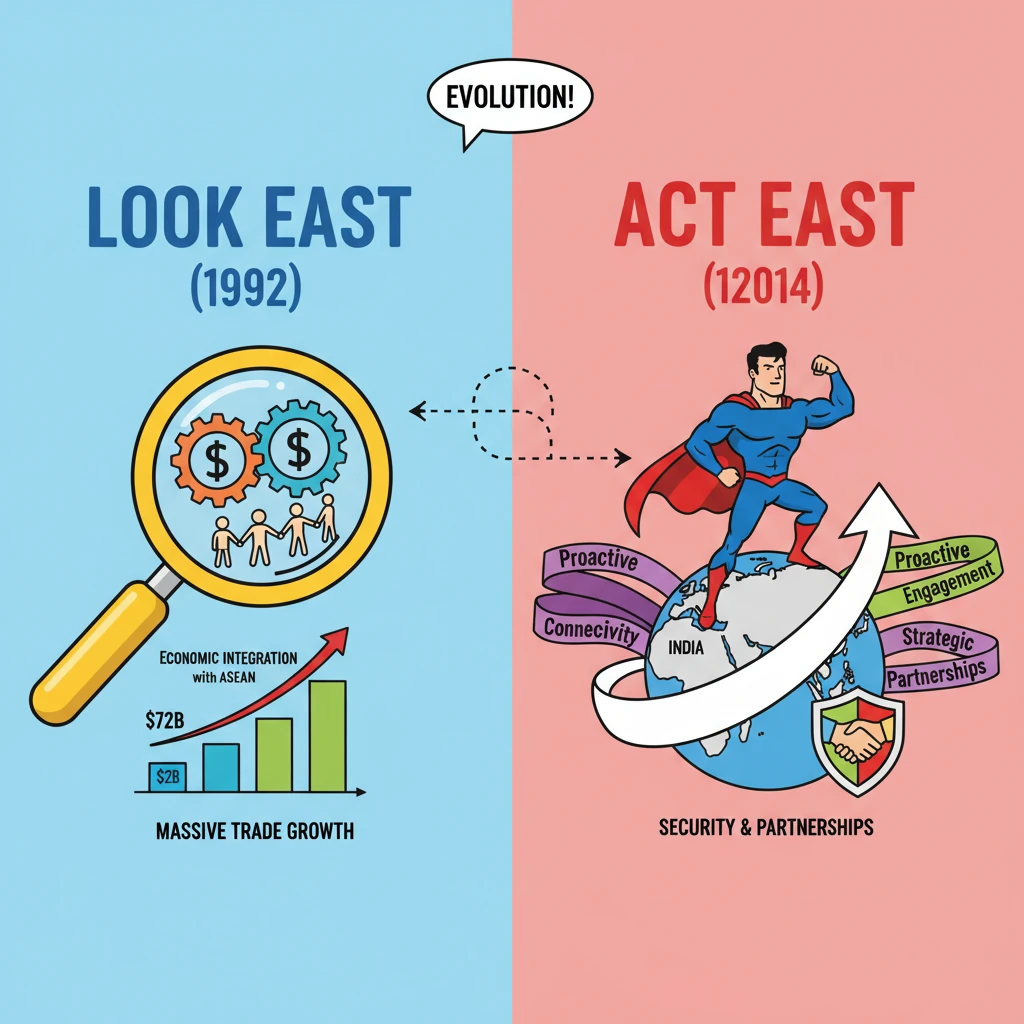
- •Look East Policy (1992) focused on economic integration with ASEAN.
- •Act East Policy (2014) expanded scope to include East Asia and security cooperation.
- •LEP's success: Trade with ASEAN grew from $2B to $72B (1992-2017).
- •AEP emphasizes proactive engagement, connectivity, and strategic partnerships in the Indo-Pacific.
- •The shift reflects India's evolving geopolitical ambitions and role as a regional power.
🧠 Memory Techniques
95% Verified Content
📚 Reference Sources
•Ministry of External Affairs (MEA), Government of India official website
•ASEAN official website
•Academic articles on India's foreign policy and Act East Policy