What is the Caribbean Community (CARICOM) - International Relations | UPSC Learning
Topics
0 topics • 0 completed
🔍
No topics match your search
What is the Caribbean Community (CARICOM)
Easy⏱️ 7 min read
international relations
📖 Introduction
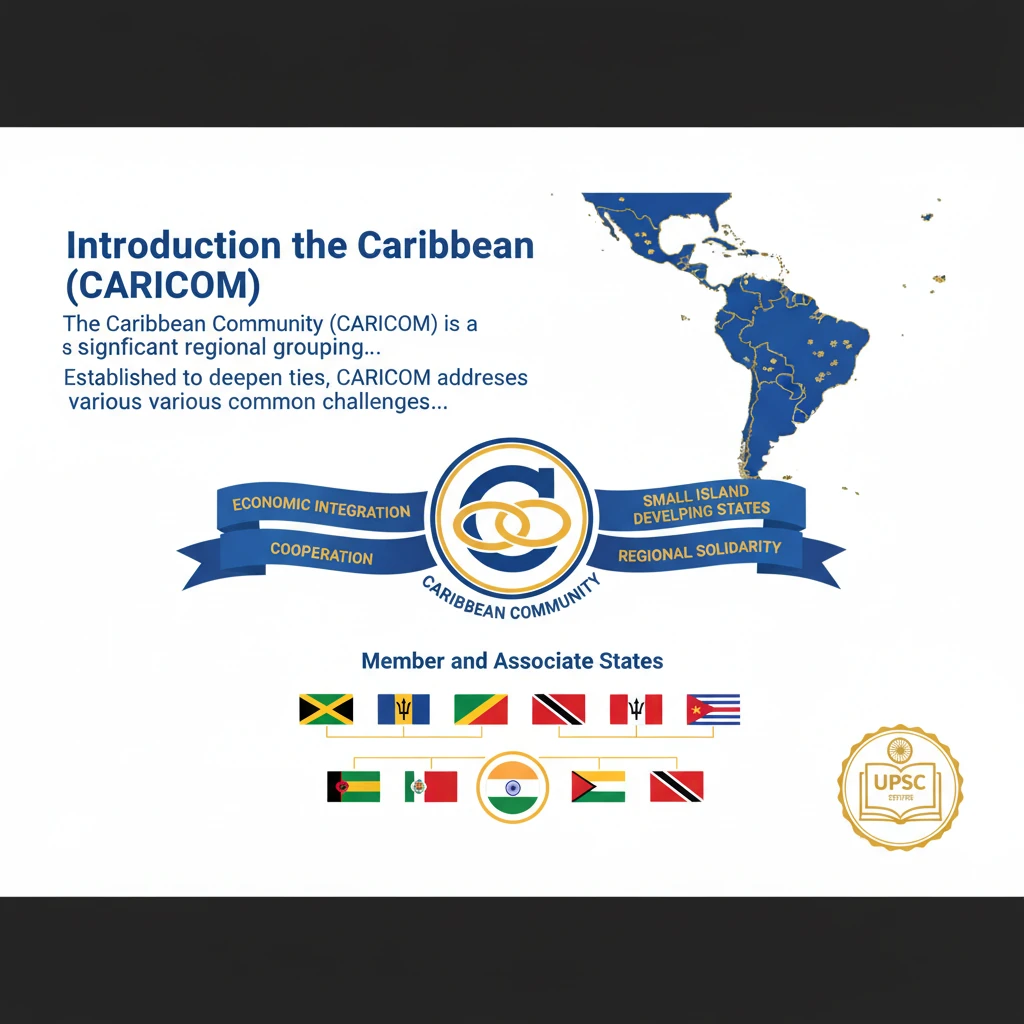
<h4>Introduction to CARICOM</h4><p>The <strong>Caribbean Community (CARICOM)</strong> is a significant regional grouping comprising countries primarily from the <strong>Caribbean Sea</strong>. It plays a crucial role in fostering economic integration and cooperation among its members.</p><p>Established to deepen ties, CARICOM addresses various common challenges faced by <strong>small island developing states</strong> and mainland territories in the region.</p><h4>Member and Associate States</h4><p>CARICOM is composed of a diverse set of nations, including both <strong>island states</strong> and <strong>mainland territories</strong>. This blend contributes to its unique geopolitical and economic character.</p><div class='info-box'><p><strong>Total Countries:</strong> 21</p><ul><li><strong>Member States:</strong> 15</li><li><strong>Associate Members:</strong> 6</li></ul><p>Notable mainland territories include <strong>Suriname</strong> and <strong>Guyana</strong>.</p></div><h4>Founding and Establishment</h4><p>The genesis of CARICOM dates back to <strong>1973</strong>, marking a pivotal moment in Caribbean regionalism. Its formation was a step towards stronger collective action.</p><div class='info-box'><p><strong>Founding Date:</strong> 1973</p><p><strong>Founding Document:</strong> Treaty of Chaguaramas</p><p><strong>Founding Members:</strong></p><ul><li><strong>Barbados</strong></li><li><strong>Guyana</strong></li><li><strong>Jamaica</strong></li><li><strong>Trinidad and Tobago</strong></li></ul></div><div class='key-point-box'><p>The <strong>Treaty of Chaguaramas</strong> is the foundational agreement that established the <strong>Caribbean Community and Common Market</strong>, setting the framework for regional integration.</p></div><h4>Demographics and Diversity</h4><p>CARICOM is characterized by its rich <strong>cultural and ethnic diversity</strong>, reflecting centuries of historical interactions. This multicultural fabric is a defining feature of the community.</p><div class='info-box'><p><strong>Population:</strong> Approximately 16 million</p><p><strong>Demographic Profile:</strong> Young, with <strong>60%</strong> of the population under the age of 30.</p><p><strong>Ethnic Backgrounds:</strong> People of African, Indian, European, Chinese, Portuguese, and Indigenous descent.</p></div><p>The region is also remarkably <strong>multilingual</strong>, showcasing a blend of colonial legacies and indigenous cultures. This linguistic variety adds to its unique identity.</p><div class='info-box'><p><strong>Primary Language:</strong> English</p><p><strong>Other Major Languages:</strong> French, Dutch</p><p><strong>Additional Languages:</strong> Various African and Asian languages spoken by diverse communities.</p></div><div class='exam-tip-box'><p>Understanding CARICOM's <strong>diversity</strong> and <strong>demographics</strong> is crucial for <strong>UPSC Mains</strong> answers on regional groupings, cultural diplomacy, and challenges faced by developing nations.</p></div>
💡 Key Takeaways
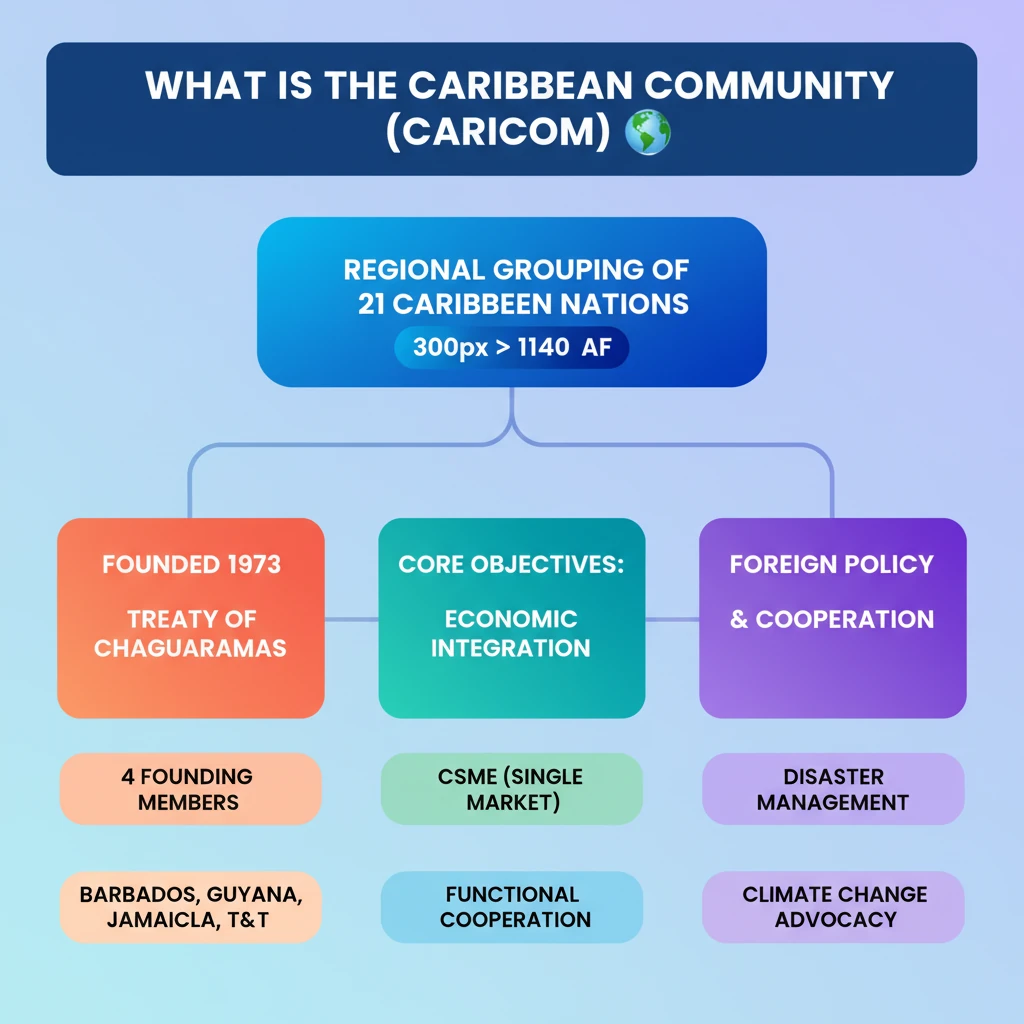
- •CARICOM is a regional grouping of 21 countries (15 Member States, 6 Associate Members) in the Caribbean.
- •It was founded in 1973 with the signing of the Treaty of Chaguaramas by Barbados, Guyana, Jamaica, and Trinidad and Tobago.
- •Its core objectives include economic integration (Caribbean Single Market and Economy - CSME), functional cooperation, and foreign policy coordination.
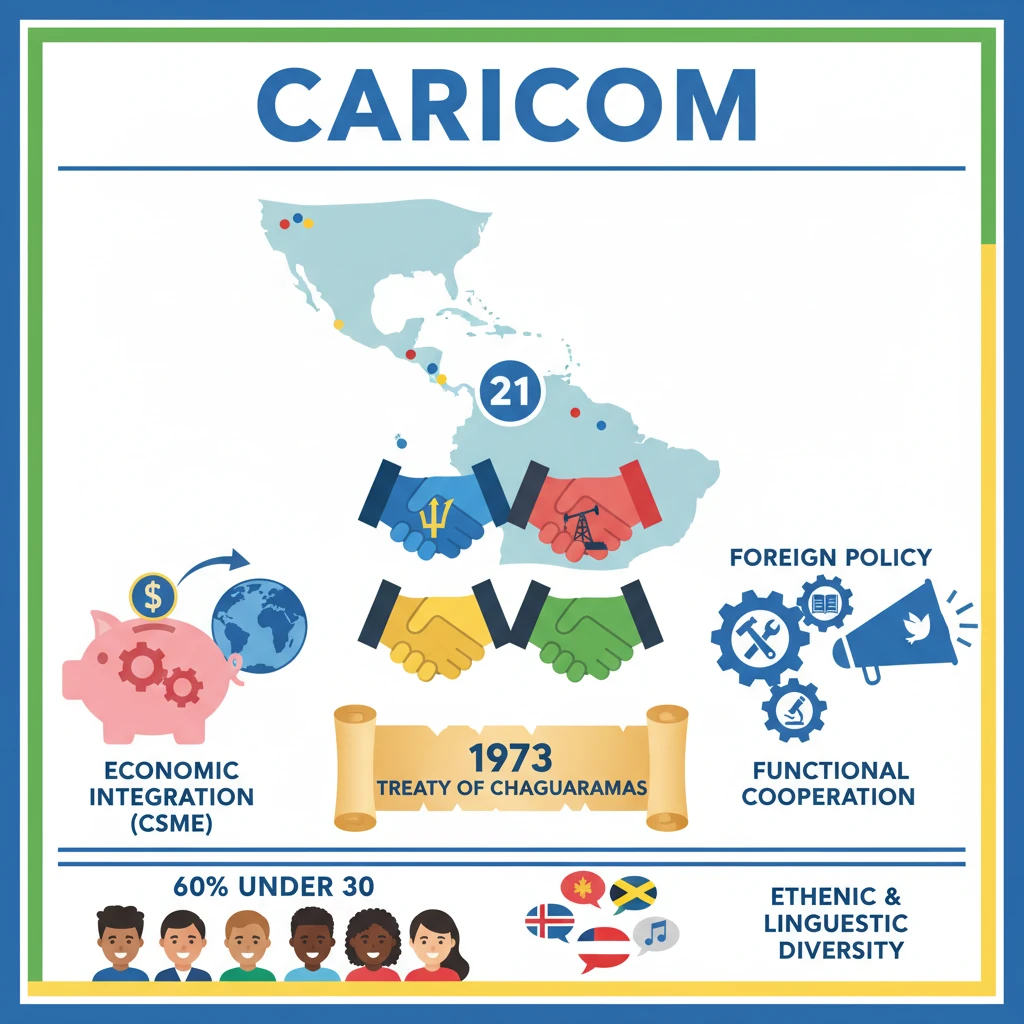
- •The community is characterized by significant ethnic and linguistic diversity, with a young demographic (60% under 30).
- •CARICOM plays a crucial role in disaster management, climate change advocacy, and promoting regional stability for its member SIDS.
🧠 Memory Techniques
95% Verified Content