IPEF Ministerial Meeting 2024 - International Relations | UPSC Learning
Topics
0 topics • 0 completed
🔍
No topics match your search
IPEF Ministerial Meeting 2024
Medium⏱️ 7 min read
international relations
📖 Introduction
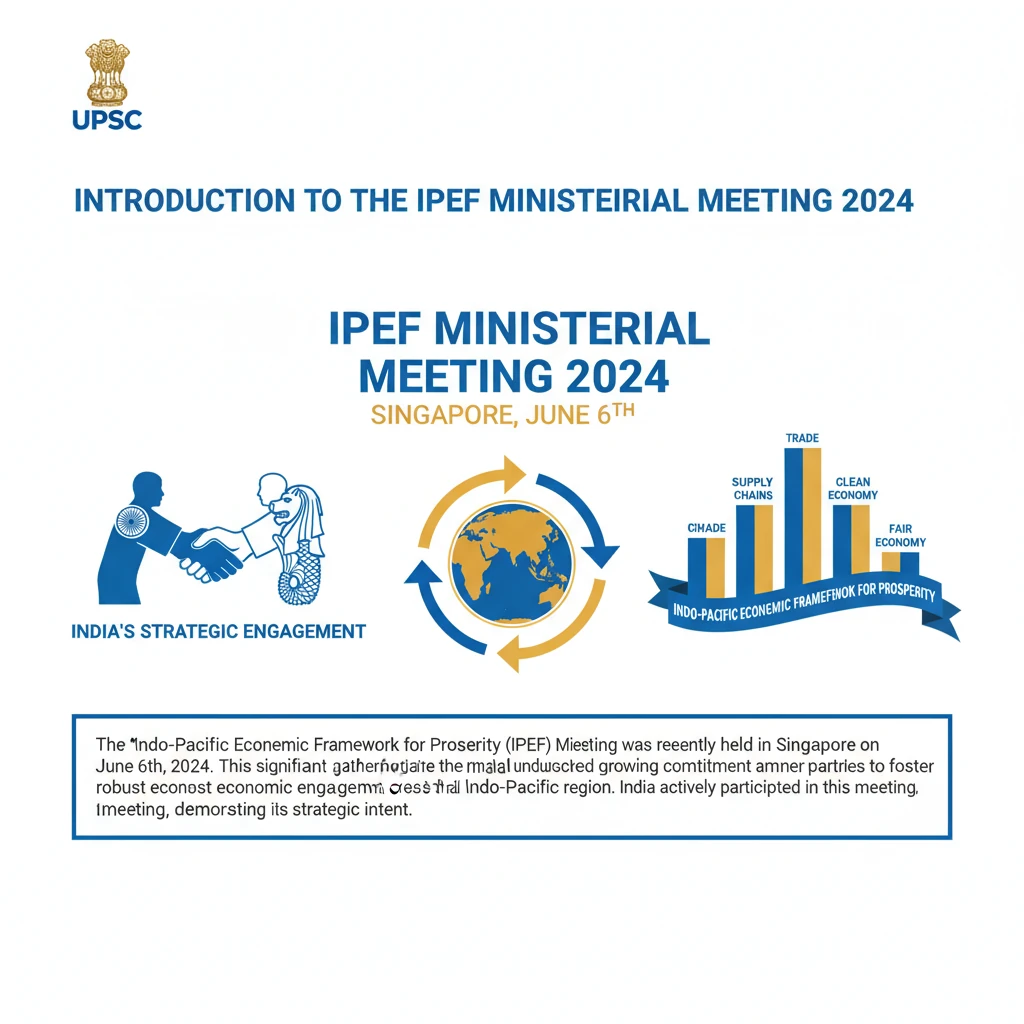
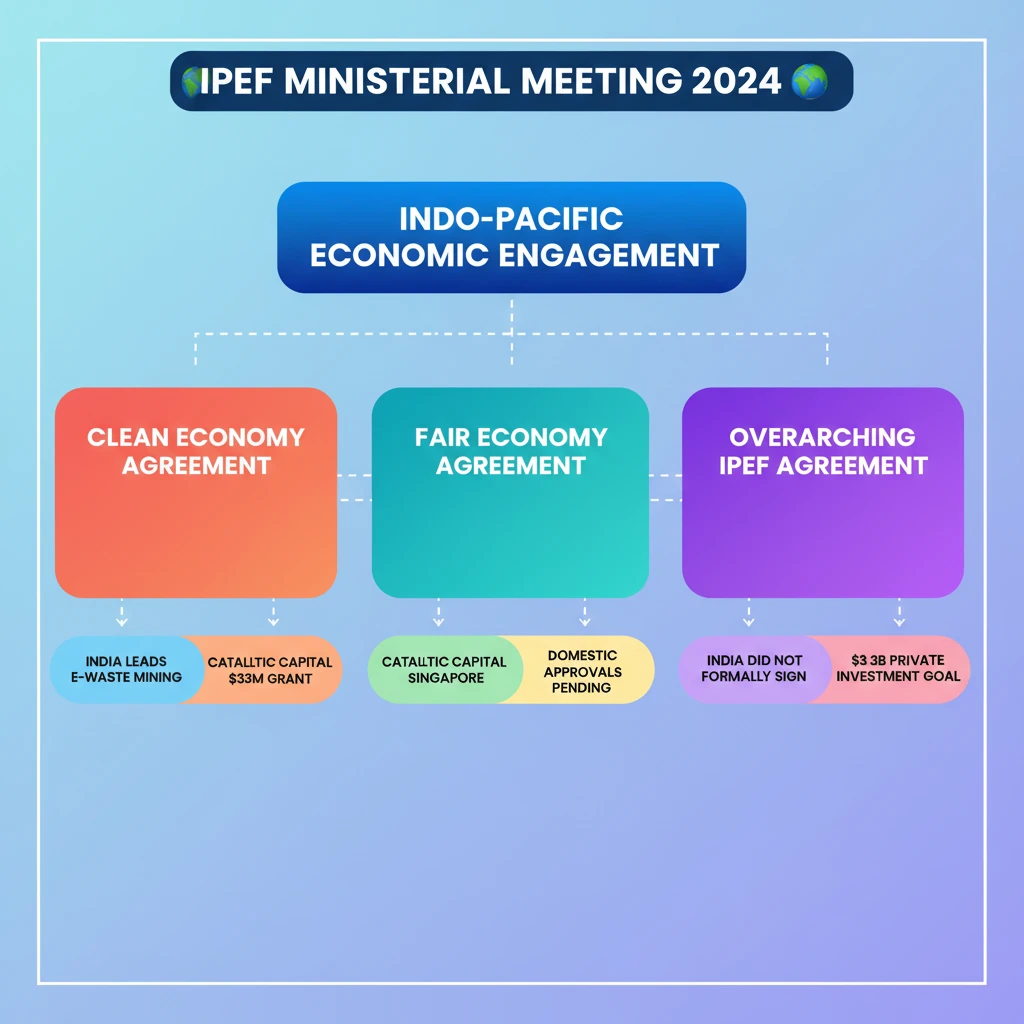
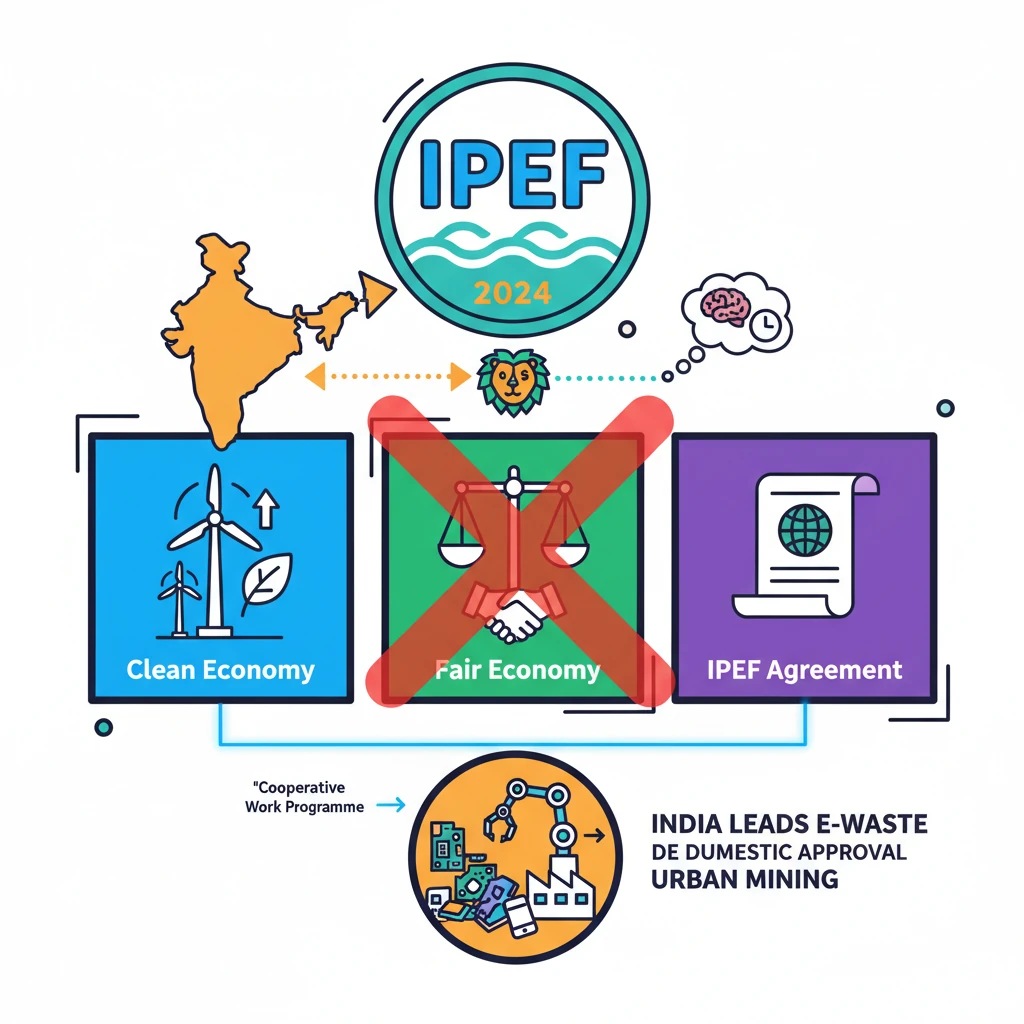
<h4>Introduction to the IPEF Ministerial Meeting 2024</h4><p>The <strong>Indo-Pacific Economic Framework for Prosperity (IPEF) Ministerial Meeting</strong> was recently held in <strong>Singapore</strong> on <strong>June 6th, 2024</strong>. This significant gathering underscored the growing commitment among partner countries to foster robust economic engagement across the vital <strong>Indo-Pacific region</strong>.</p><p>India actively participated in this meeting, demonstrating its strategic interest and proactive involvement in shaping regional economic architecture.</p><div class='info-box'><p><strong>Event:</strong> IPEF Ministerial Meeting 2024</p><p><strong>Location:</strong> Singapore</p><p><strong>Date:</strong> June 6th, 2024</p><p><strong>Key Participant:</strong> India</p></div><h4>Key Outcomes and Agreements</h4><p>During the meeting, <strong>IPEF members</strong> achieved a significant milestone by signing <strong>three crucial agreements</strong>. These agreements are centered around the <strong>Clean Economy</strong>, the <strong>Fair Economy</strong>, and an overarching <strong>IPEF Agreement</strong>, aiming to streamline economic cooperation.</p><div class='exam-tip-box'><p>It is important to note that <strong>India did not formally sign these agreements</strong> at the meeting. The reason cited was that the domestic approval process for these frameworks is still underway within India.</p></div><h4>The Clean Economy Agreement</h4><p>The <strong>Clean Economy Agreement</strong> is designed to accelerate collective efforts towards achieving crucial environmental and energy goals. Its primary objectives include enhancing <strong>energy security</strong>, bolstering <strong>climate resilience</strong>, and significantly reducing <strong>Greenhouse Gas (GHG) emissions</strong> across the region.</p><p>India has taken a leading role under this pillar by launching a new collaborative initiative. This initiative is called the <strong>“Cooperative Work Programme” (CWP)</strong>.</p><div class='key-point-box'><p>The <strong>Cooperative Work Programme (CWP)</strong> specifically focuses on <strong>recovering valuable resources from electronic waste</strong>. This process is commonly known as <strong>e-waste urban mining</strong>, highlighting a commitment to circular economy principles.</p></div><h4>IPEF Catalytic Capital Fund</h4><p>A major development under the Clean Economy pillar was the launch of the <strong>IPEF Catalytic Capital Fund</strong>. This fund is specifically designed to provide essential financial support for <strong>clean economy infrastructure projects</strong> in IPEF’s emerging and upper-middle-income economies.</p><p>The fund has garnered substantial backing from its <strong>founding supporters</strong>, which include <strong>Australia, Japan, Korea, and the United States</strong>. These nations have collectively provided an initial grant funding of <strong>USD 33 million</strong>.</p><div class='info-box'><p>The initial <strong>USD 33 million grant</strong> is strategically aimed at catalyzing a much larger sum: an estimated <strong>USD 3.3 billion in private investment</strong> for clean infrastructure projects.</p></div><h4>The Fair Economy Agreement</h4><p>The <strong>Fair Economy Agreement</strong> seeks to establish a more equitable and predictable business environment within the Indo-Pacific. Its core aims include fostering <strong>transparent business practices</strong>, promoting <strong>fair competition</strong>, and intensifying regional efforts against <strong>corruption</strong>.</p><p>Under this agreement, <strong>India</strong> has offered a significant contribution. It will provide a specialized training program to other IPEF partners.</p><div class='key-point-box'><p>India's training program is focused on <strong>Digital Forensics & Scam-Driven Risk Analysis</strong>. This initiative aims to enhance the capabilities of partner countries in combating financial fraud and cybercrime.</p></div><h4>IPEF Upskilling Initiative</h4><p>The <strong>IPEF Upskilling Initiative</strong> is a vital program focused on human capital development. It provides crucial <strong>digital skills training</strong>, with a particular emphasis on empowering <strong>women and girls</strong> in IPEF partner countries.</p><p>Over the past two years, this initiative has made remarkable progress, providing approximately <strong>10.5 million upskilling opportunities</strong> across the participating nations.</p><div class='info-box'><p>Of the 10.5 million upskilling opportunities generated by the IPEF Upskilling Initiative, a substantial portion, approximately <strong>4 million</strong>, were provided to beneficiaries within <strong>India</strong>.</p></div>
💡 Key Takeaways
- •India participated in the IPEF Ministerial Meeting 2024 in Singapore, demonstrating Indo-Pacific economic engagement.
- •IPEF members signed three agreements: Clean Economy, Fair Economy, and an overarching IPEF Agreement.
- •India did not formally sign these agreements, citing ongoing domestic approval processes.
- •Under the Clean Economy Agreement, India leads a 'Cooperative Work Programme' on e-waste urban mining.
- •The IPEF Catalytic Capital Fund was launched with USD 33 million initial grant to catalyze USD 3.3 billion in private investment for clean projects.
- •Under the Fair Economy Agreement, India offered a training program in Digital Forensics & Scam-Driven Risk Analysis.
- •The IPEF Upskilling Initiative provided 10.5 million opportunities, with 4 million in India, focusing on women and girls.
🧠 Memory Techniques
95% Verified Content