What are the Historical Efforts of Nuclear Disarmament Efforts? - International Relations | UPSC Learning
Topics
0 topics • 0 completed
🔍
No topics match your search
What are the Historical Efforts of Nuclear Disarmament Efforts?
Medium⏱️ 10 min read
international relations
📖 Introduction
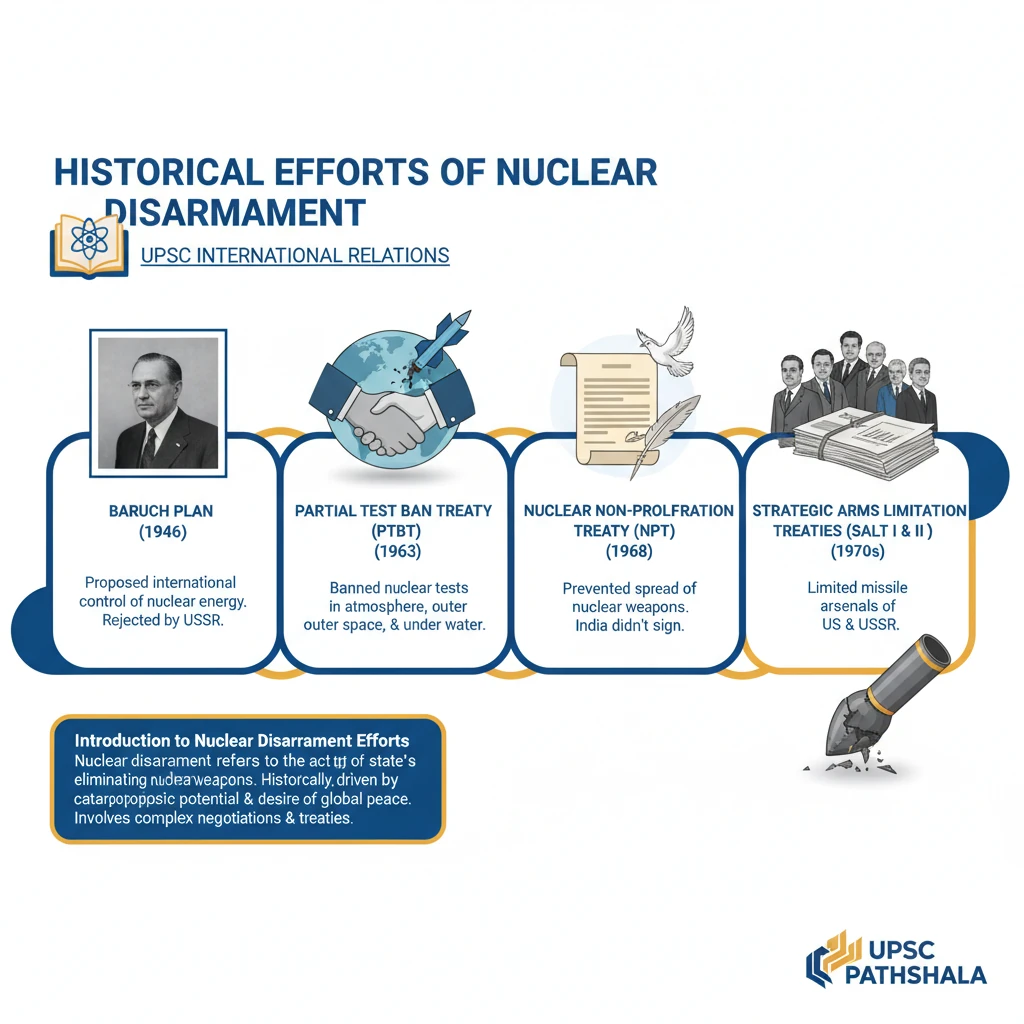
<h4>Introduction to Nuclear Disarmament Efforts</h4><p><strong>Nuclear disarmament</strong> refers to the act of reducing or eliminating a state's nuclear weapons. It encompasses various measures, from arms control agreements to complete abolition.</p><p>Historically, efforts towards nuclear disarmament have been driven by the catastrophic potential of nuclear weapons and the desire for global peace and security. These efforts often involve complex negotiations and international treaties.</p><div class='key-point-box'><p>The primary goal is to prevent the spread of nuclear weapons (<strong>non-proliferation</strong>) and to ultimately achieve a world free of these destructive devices (<strong>disarmament</strong>).</p></div><h4>The Treaty on the Non-Proliferation of Nuclear Weapons (NPT)</h4><p>The <strong>Treaty on the Non-Proliferation of Nuclear Weapons (NPT)</strong> is a landmark international treaty aimed at preventing the spread of nuclear weapons and weapons technology.</p><p>It also promotes cooperation in the peaceful uses of nuclear energy and furthers the goal of achieving nuclear disarmament. It is considered the cornerstone of the global nuclear non-proliferation regime.</p><div class='info-box'><p>The <strong>NPT</strong> entered into force in <strong>1970</strong>. It has been signed by <strong>191 states</strong>, making it one of the most widely adhered-to arms control agreements.</p></div><div class='key-point-box'><p>The NPT is based on a three-pillar system: <strong>non-proliferation</strong>, <strong>disarmament</strong>, and the <strong>right to peacefully use nuclear technology</strong>.</p></div><h4>Strategic Arms Limitation Treaties (SALT)</h4><p>The <strong>Strategic Arms Limitation Treaties (SALT)</strong> were two rounds of bilateral conferences and corresponding treaties between the United States and the Soviet Union.</p><p>These treaties aimed to curb the arms race in strategic ballistic missiles armed with nuclear weapons. They represented a significant step in managing Cold War tensions.</p><div class='info-box'><p><strong>SALT I</strong> (signed <strong>1972</strong>) froze the number of strategic ballistic missile launchers at existing levels and limited anti-ballistic missile (ABM) systems.</p><p><strong>SALT II</strong> (signed <strong>1979</strong>) set limits on strategic launchers and placed restrictions on the development of new types of strategic offensive weapons.</p></div><h4>Strategic Arms Reduction Treaties (START)</h4><p>The <strong>Strategic Arms Reduction Treaties (START)</strong> were a series of bilateral treaties between the United States and the Soviet Union (later Russia) designed to reduce and limit strategic offensive arms.</p><p>These treaties went beyond simply limiting growth, aiming for actual reductions in deployed nuclear warheads and delivery vehicles.</p><div class='info-box'><p><strong>START I</strong> (signed <strong>1991</strong>) significantly reduced the number of deployed strategic nuclear warheads and bombs. It entered into force in <strong>1994</strong>.</p><p><strong>New START</strong> (signed <strong>2010</strong>) further limited the number of deployed strategic nuclear warheads and bombs, as well as intercontinental ballistic missiles (ICBMs) and submarine-launched ballistic missiles (SLBMs).</p></div><h4>Comprehensive Nuclear-Test-Ban Treaty (CTBT)</h4><p>The <strong>Comprehensive Nuclear-Test-Ban Treaty (CTBT)</strong> is a multilateral treaty that bans all nuclear explosions, for both civilian and military purposes, in all environments.</p><p>It aims to halt the development of new nuclear weapons and the qualitative improvement of existing ones, thereby contributing to nuclear disarmament and non-proliferation.</p><div class='info-box'><p>The <strong>CTBT</strong> was adopted by the United Nations General Assembly in <strong>1996</strong>. It has been signed by <strong>187 states</strong> and ratified by <strong>178</strong>, but has not yet entered into force.</p></div><div class='exam-tip-box'><p>India has not signed or ratified the <strong>CTBT</strong>, citing concerns about its discriminatory nature and lack of a time-bound disarmament framework. This is a crucial point for <strong>UPSC Mains GS-II</strong>.</p></div><h4>Treaty on the Prohibition of Nuclear Weapons (TPNW)</h4><p>The <strong>Treaty on the Prohibition of Nuclear Weapons (TPNW)</strong>, also known as the <strong>Nuclear Ban Treaty</strong>, is the first legally binding international agreement to comprehensively prohibit nuclear weapons.</p><p>It aims to achieve a total ban on nuclear weapons, leading towards their complete elimination. It was adopted by the UN General Assembly in <strong>2017</strong>.</p><div class='info-box'><p>The <strong>TPNW</strong> entered into force on <strong>January 22, 2021</strong>. It prohibits states parties from developing, testing, producing, manufacturing, otherwise acquiring, possessing, or stockpiling nuclear weapons or other nuclear explosive devices.</p></div><div class='key-point-box'><p>Notably, none of the <strong>nuclear-weapon states</strong> recognized under the NPT, nor any NATO members, have signed or ratified the <strong>TPNW</strong>.</p></div>
💡 Key Takeaways
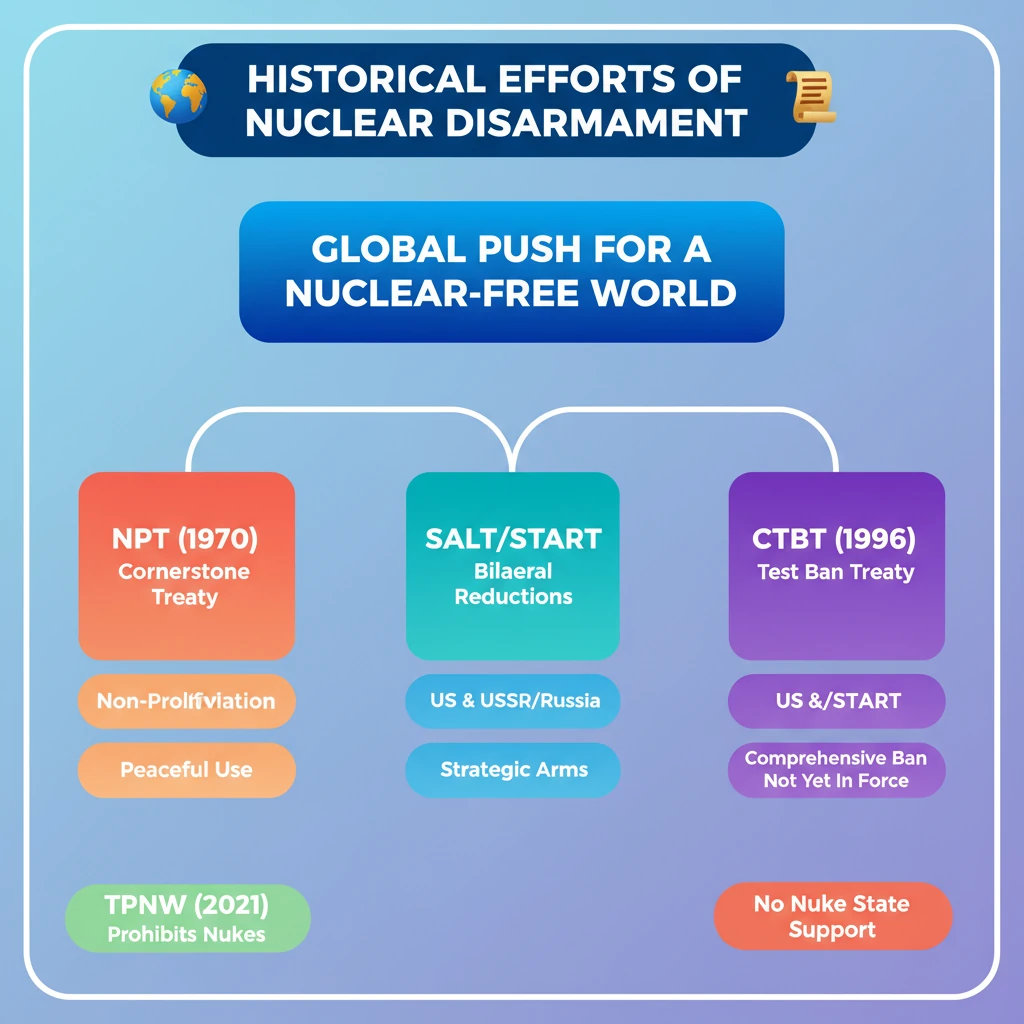
- •Nuclear disarmament aims to eliminate nuclear weapons, while non-proliferation prevents their spread.
- •The NPT (1970) is the cornerstone, balancing non-proliferation, disarmament, and peaceful nuclear use.
- •SALT and START treaties were key bilateral efforts between the US and USSR/Russia to limit and reduce strategic arms.
- •The CTBT (1996) bans all nuclear tests but is not yet in force due to non-ratification by key states, including India.
- •The TPNW (2021) comprehensively prohibits nuclear weapons, but lacks support from nuclear-weapon states.
- •India advocates for universal, non-discriminatory disarmament and maintains a 'No First Use' nuclear doctrine.
🧠 Memory Techniques
95% Verified Content
📚 Reference Sources
•International Atomic Energy Agency (IAEA)
•Arms Control Association
•Stockholm International Peace Research Institute (SIPRI)
•Official websites of NPT, CTBT, TPNW