What are the Key Highlights of the BIMSTEC Foreign Ministers’ Retreat? - International Relations | UPSC Learning
Topics
0 topics • 0 completed
🔍
No topics match your search
What are the Key Highlights of the BIMSTEC Foreign Ministers’ Retreat?
Medium⏱️ 7 min read
international relations
📖 Introduction
<h4>Introduction to the BIMSTEC Foreign Ministers’ Retreat</h4><p>The recent <strong>BIMSTEC Foreign Ministers’ Retreat</strong> brought together top diplomats from member nations to discuss pressing regional and global issues. This informal gathering aimed to foster deeper understanding and cooperation among the <strong>Bay of Bengal Initiative for Multi-Sectoral Technical and Economic Cooperation</strong> countries.</p><div class='info-box'><p><strong>BIMSTEC</strong> is a regional organization comprising seven member states lying in the littoral and adjacent areas of the Bay of Bengal. These include <strong>Bangladesh, Bhutan, India, Myanmar, Nepal, Sri Lanka, and Thailand</strong>.</p></div><h4>Global and Regional Developments: Urgent Need for Cooperation</h4><p>The retreat highlighted the critical need to address long-standing challenges through enhanced <strong>capacity building</strong> and robust <strong>economic cooperation</strong>. This urgency stems from the prevailing global and regional developments impacting the member states.</p><p>Discussions underscored that current geopolitical shifts and economic pressures necessitate a united front. Strengthening internal mechanisms is crucial for BIMSTEC to navigate these complex scenarios effectively.</p><div class='key-point-box'><p>The Ministers emphasized leveraging existing tools and frameworks within BIMSTEC to confront shared challenges, promoting collective resilience and regional stability.</p></div><h4>The Myanmar Crisis and Regional Stability</h4><p>A significant portion of the discussions focused on the ongoing <strong>Myanmar crisis</strong> and its profound impact on <strong>regional stability</strong>. The internal situation in Myanmar poses considerable challenges to the entire BIMSTEC region.</p><p>This instability directly affects various <strong>developmental and connectivity projects</strong> designed to strengthen ties among member states. Projects involving <strong>Nepal, Bhutan, India, Bangladesh, Myanmar, and Thailand</strong> face significant hurdles due to the volatile environment.</p><div class='exam-tip-box'><p>The <strong>Myanmar crisis</strong> is a recurring theme in UPSC exams, particularly concerning regional security and India's 'Act East' policy. Understand its multifaceted impact on organizations like BIMSTEC for <strong>GS Paper 2</strong>.</p></div><h4>Humanitarian Assistance Discussions</h4><p>The retreat also included conversations regarding the potential for broader <strong>humanitarian aid</strong> within the region. This reflects a growing concern for populations affected by crises, including those in Myanmar.</p><p>Currently, <strong>India's assistance</strong> in this context has been primarily limited. It has focused on providing support to <strong>displaced populations</strong> and <strong>military personnel</strong> who have sought refuge in <strong>Mizoram</strong>, a northeastern Indian state bordering Myanmar.</p>
💡 Key Takeaways
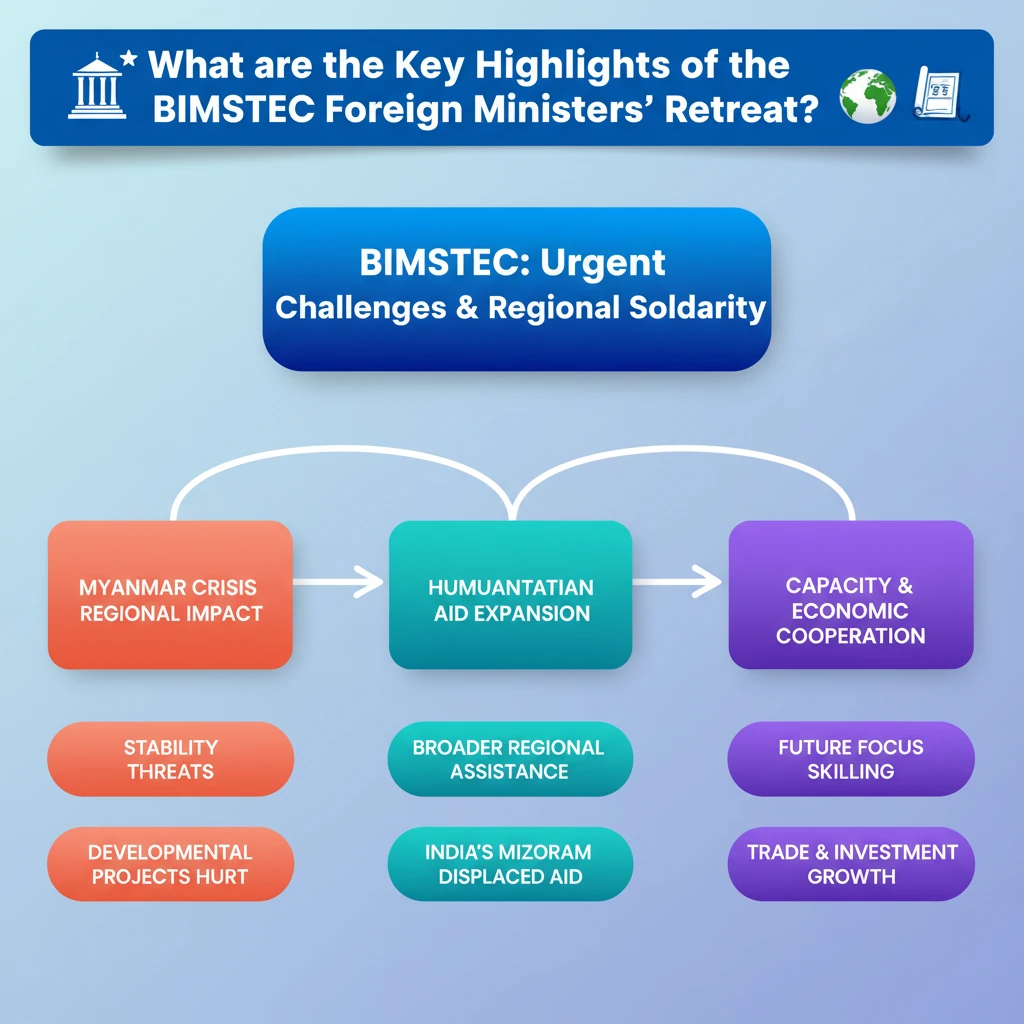
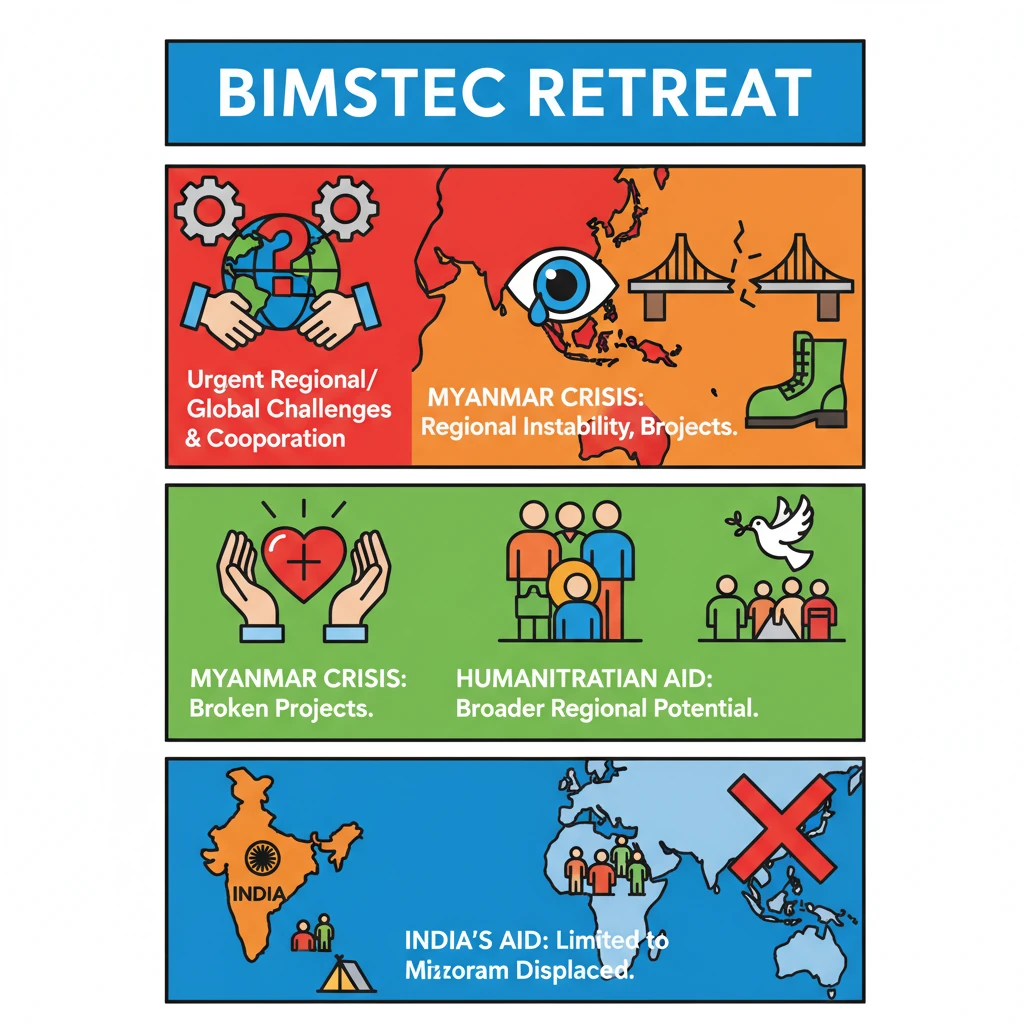
- •BIMSTEC retreat focused on urgent regional/global challenges and cooperation.
- •The Myanmar crisis significantly impacts regional stability and developmental projects.
- •Discussions included potential for broader humanitarian aid within the region.
- •India's current humanitarian assistance is limited to displaced populations in Mizoram.
- •Emphasis on capacity building and economic cooperation is crucial for BIMSTEC's future.
🧠 Memory Techniques
95% Verified Content