New Non-Permanent Members of UNSC - International Relations | UPSC Learning
Topics
0 topics • 0 completed
🔍
No topics match your search
New Non-Permanent Members of UNSC
Medium⏱️ 8 min read
international relations
📖 Introduction
<h4>Understanding the UN Security Council (UNSC)</h4><p>The <strong>United Nations Security Council (UNSC)</strong> is one of the six principal organs of the <strong>United Nations (UN)</strong>. It holds the primary responsibility for the maintenance of <strong>international peace and security</strong>. Its decisions are binding on all member states.</p><div class='info-box'><p>The <strong>UNSC</strong> is composed of <strong>15 members</strong>: <strong>5 permanent members (P5)</strong> and <strong>10 non-permanent members</strong>. The <strong>P5</strong> are <strong>China, France, Russia, the United Kingdom, and the United States</strong>, each holding <strong>veto power</strong>.</p></div><h4>Election of New Non-Permanent Members for 2025-2026</h4><p>Recently, five nations were elected to serve as <strong>non-permanent members</strong> of the <strong>UN Security Council</strong>. These countries will commence their two-year term on <strong>January 1, 2025</strong>, and conclude on <strong>December 31, 2026</strong>.</p><div class='info-box'><p>The newly elected <strong>non-permanent members</strong> for the <strong>2025-2026 term</strong> are:</p><ul><li><strong>Pakistan</strong></li><li><strong>Somalia</strong></li><li><strong>Denmark</strong></li><li><strong>Greece</strong></li><li><strong>Panama</strong></li></ul></div><p>These nations were chosen through a vote in the <strong>UN General Assembly</strong>, securing the required two-thirds majority of votes from member states present and voting.</p><h4>Role and Responsibilities of Non-Permanent Members</h4><p><strong>Non-permanent members</strong> play a crucial role in the <strong>UNSC's decision-making process</strong>. They participate in discussions, vote on resolutions, and contribute to the council's agenda on matters of peace and security.</p><div class='key-point-box'><p>Unlike the <strong>P5</strong>, non-permanent members <strong>do not possess veto power</strong>. However, their votes are essential, as resolutions require <strong>9 affirmative votes</strong> to pass, including the concurring votes of the <strong>P5</strong>.</p></div><p>Their presence ensures a broader representation of global perspectives and interests within the council, reflecting the diverse membership of the United Nations.</p><h4>Geographical Representation in the UNSC</h4><p>The <strong>10 non-permanent seats</strong> are allocated based on <strong>geographical distribution</strong> to ensure equitable representation across different regions of the world. This system aims to provide a voice to various regional blocs.</p><div class='info-box'><p>The distribution of non-permanent seats is as follows:</p><ul><li><strong>African States: 3 seats</strong></li><li><strong>Asia-Pacific States: 2 seats</strong></li><li><strong>Latin American and Caribbean States: 2 seats</strong></li><li><strong>Eastern European States: 1 seat</strong></li><li><strong>Western European and Other States: 2 seats</strong></li></ul></div><p>The recent elections saw countries from various regional groups successfully securing their positions, highlighting the ongoing cycle of regional representation.</p><h4>Significance for Global Diplomacy</h4><p>The election of new non-permanent members is a significant event in <strong>international relations</strong>. It allows more nations to directly influence global security policies and bring their regional concerns to the forefront.</p><div class='exam-tip-box'><p><strong>UPSC Mains (GS-II)</strong>: Understanding the election process and the role of non-permanent members is vital for questions on <strong>international institutions</strong> and <strong>India's foreign policy</strong>, especially regarding <strong>UNSC reform</strong>.</p></div><p>For the elected countries, it provides an opportunity to enhance their diplomatic standing, advocate for their national interests, and contribute to resolving global conflicts and challenges.</p>
💡 Key Takeaways
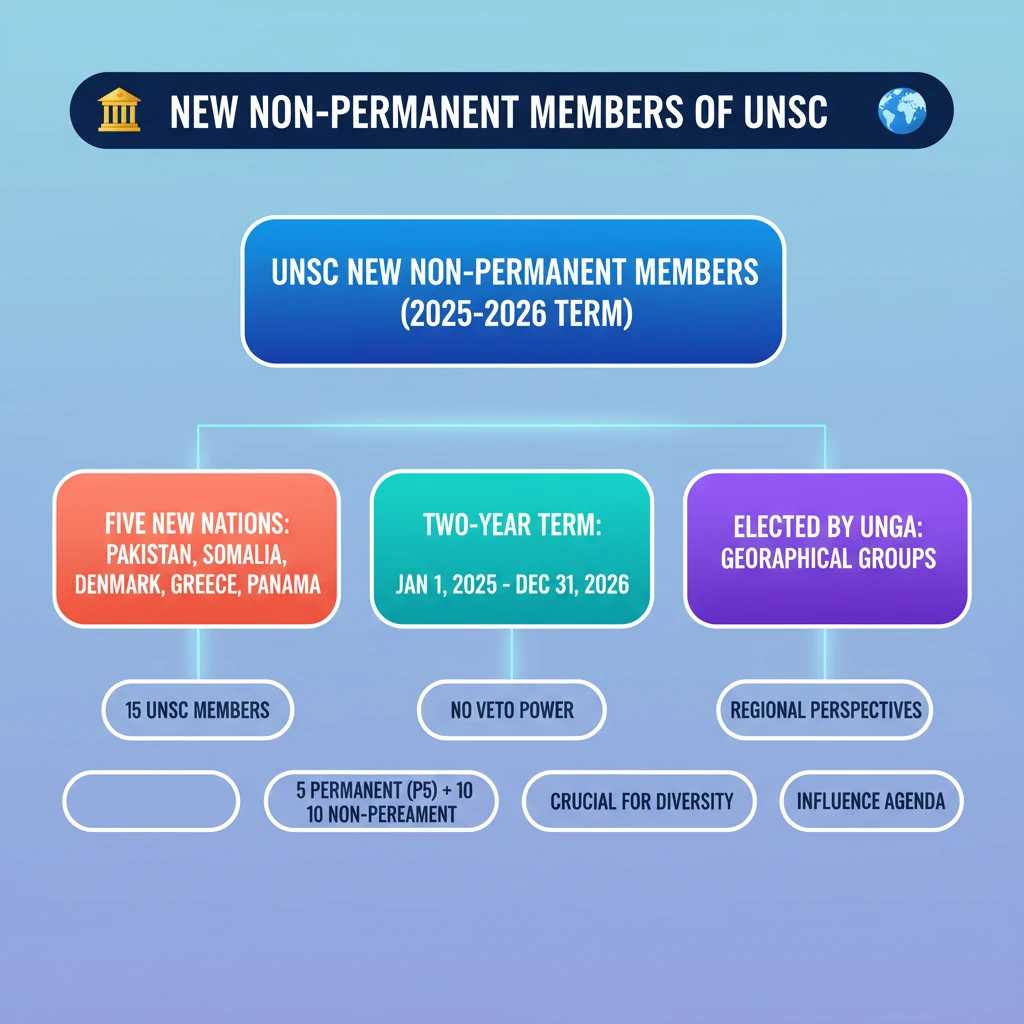
- •<strong>Pakistan, Somalia, Denmark, Greece, and Panama</strong> are the new non-permanent members of the UNSC.
- •They will serve a <strong>two-year term</strong> from <strong>January 1, 2025, to December 31, 2026</strong>.
- •The <strong>UNSC</strong> has <strong>15 members</strong>: 5 permanent (P5) with veto power and 10 non-permanent.
- •Non-permanent members are elected by the <strong>UN General Assembly</strong> based on <strong>geographical distribution</strong>.
- •Their role is crucial for bringing <strong>diverse regional perspectives</strong> and influencing the council's agenda, despite lacking veto power.
🧠 Memory Techniques
95% Verified Content
📚 Reference Sources
•UN Security Council Handbook
•Drishti IAS Current Affairs