LOBITO CORRIDOR - International Relations | UPSC Learning
Topics
0 topics • 0 completed
🔍
No topics match your search
LOBITO CORRIDOR
Medium⏱️ 7 min read
international relations
📖 Introduction
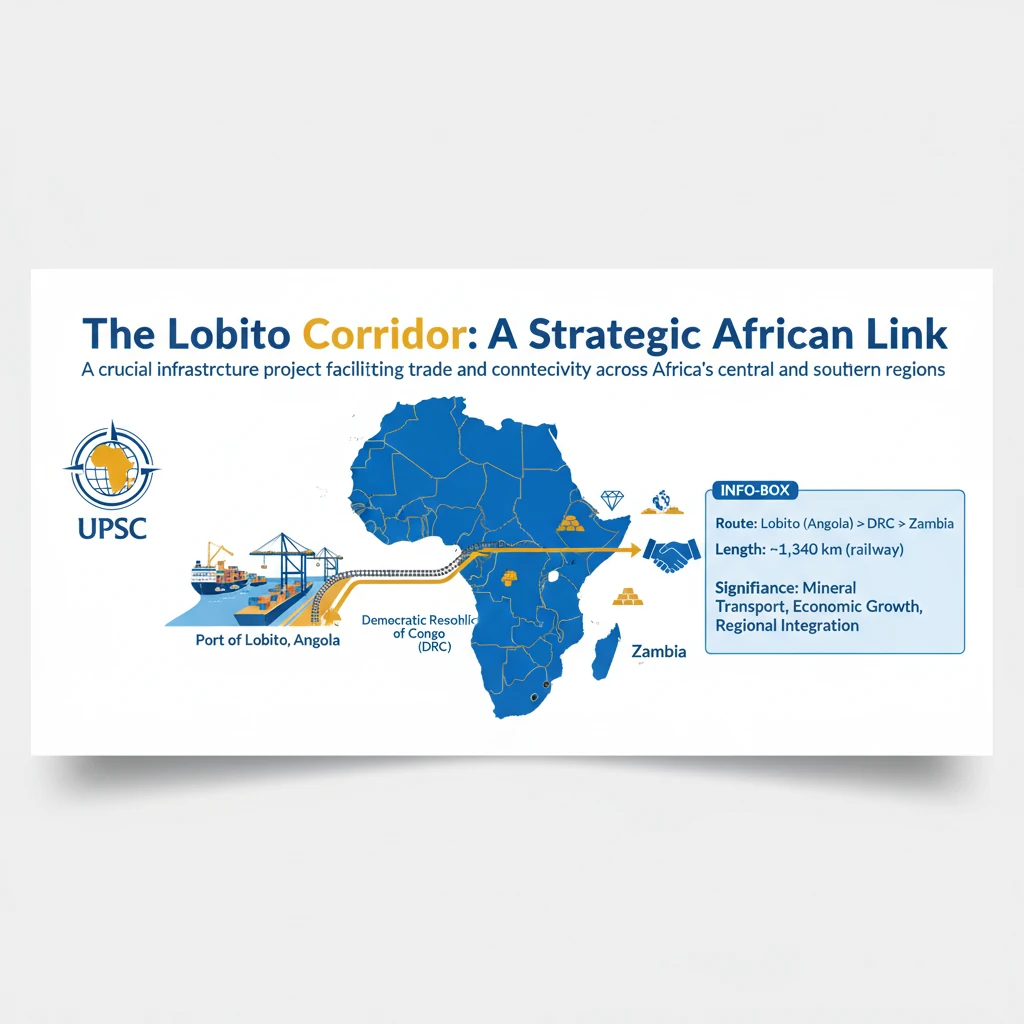
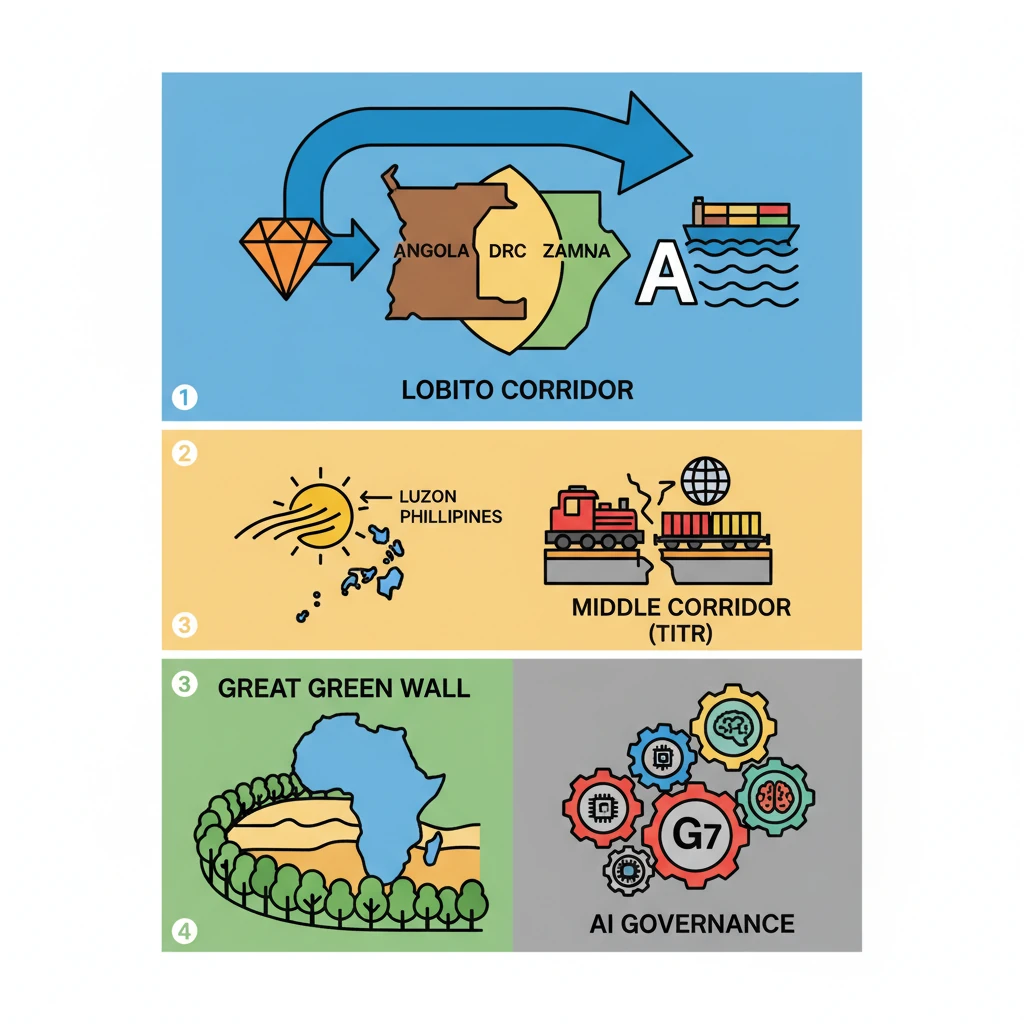
<h4>The Lobito Corridor: A Strategic African Link</h4><p>The <strong>Lobito Corridor</strong> represents a crucial infrastructure project in <strong>Africa</strong>. It is designed to facilitate trade and connectivity across the continent's central and southern regions.</p><div class='info-box'><p><strong>Route:</strong> The corridor originates from the <strong>port city of Lobito</strong> on the <strong>Atlantic coast of Angola</strong>. It then extends eastward, traversing through the <strong>Democratic Republic of the Congo (DRC)</strong> and ultimately reaching <strong>Zambia</strong>.</p></div><p>This corridor is pivotal for unlocking the vast mineral resources of the <strong>DRC</strong> and <strong>Zambia</strong>, providing them with a direct and efficient access route to the <strong>Atlantic Ocean</strong> for exports.</p><div class='key-point-box'><p><strong>Significance:</strong> It aims to enhance <strong>regional economic integration</strong>, reduce transportation costs, and boost the overall economic development of the participating nations.</p></div><h4>Other Significant Global Corridors</h4><p>Beyond Lobito, several other strategic corridors are shaping global trade and connectivity:</p><div class='info-box'><p><strong>Luzon Corridor:</strong> This is a key <strong>economic and infrastructure corridor</strong> situated on the island of <strong>Luzon</strong> in the <strong>Philippines</strong>. <strong>Luzon</strong> is recognized as the largest and most populous island within the archipelago.</p></div><p>The <strong>Luzon Corridor</strong> plays a vital role in the economic development of the <strong>Philippines</strong>, connecting major urban centers and facilitating internal and external trade.</p><div class='info-box'><p><strong>Middle Corridor (Trans-Caspian International Transport Route - TITR):</strong> Also known as the <strong>Trans-Caspian International Transport Route (TITR)</strong>, this network is a critical logistics and transportation artery linking <strong>Europe and Asia</strong>.</p></div><p>The <strong>Middle Corridor</strong> offers a strategic alternative to traditional northern and southern transport routes. It aims to bolster <strong>trade and economic cooperation</strong> across the regions it connects, including the <strong>Caucasus</strong> and <strong>Central Asia</strong>.</p><div class='exam-tip-box'><p><strong>UPSC Insight:</strong> Understanding the routes and geopolitical significance of these various corridors (<strong>Lobito, Luzon, Middle Corridor</strong>) is crucial for questions on <strong>international relations</strong> and <strong>economic geography</strong>. Focus on their strategic importance and impact on regional economies.</p></div><h4>The Great Green Wall Initiative: Combating Desertification</h4><p>The <strong>Great Green Wall Initiative</strong> is an ambitious environmental project focused on combating <strong>desertification</strong> and <strong>land degradation</strong> across the <strong>Sahel region of Africa</strong>.</p><div class='info-box'><p><strong>Objective:</strong> Its primary goal is to establish a massive "wall" of trees, stretching from <strong>west to east across Africa</strong>. This green barrier is intended to halt the expansion of the <strong>Sahara Desert</strong>.</p></div><p>Beyond desertification, the initiative also aims to enhance <strong>biodiversity</strong>, improve agricultural productivity, and create sustainable <strong>economic opportunities</strong> for local communities residing in the <strong>Sahel</strong>.</p><h4>G7 Initiatives: AI Governance and Ukraine Funding</h4><p>The <strong>Group of Seven (G7)</strong> nations are actively engaged in addressing contemporary global challenges, including the regulation of <strong>Artificial Intelligence (AI)</strong> and international financial support.</p><div class='info-box'><p><strong>Enhancing Interoperability of AI Governance:</strong> <strong>G7 leaders</strong> have committed to collaborative efforts to improve the <strong>interoperability</strong> among their respective <strong>AI governance approaches</strong>. This aims to foster greater <strong>certainty, transparency, and accountability</strong> in AI development and deployment.</p></div><p>The focus of these <strong>AI governance</strong> efforts is to effectively manage risks associated with AI while simultaneously supporting <strong>innovation</strong>. The goal is to promote healthy, inclusive, and sustainable <strong>economic growth</strong> driven by AI technologies.</p><div class='info-box'><p><strong>Extraordinary Revenue Acceleration (ERA) Loans for Ukraine:</strong> The <strong>G7</strong> has reached an agreement to provide substantial financial assistance to <strong>Ukraine</strong>. This includes approximately <strong>USD 50 billion</strong> in additional funding.</p></div><p>This significant financial package is slated to be disbursed to <strong>Ukraine</strong> by the end of <strong>2024</strong>, underscoring international support for the nation amidst ongoing conflict.</p>
💡 Key Takeaways
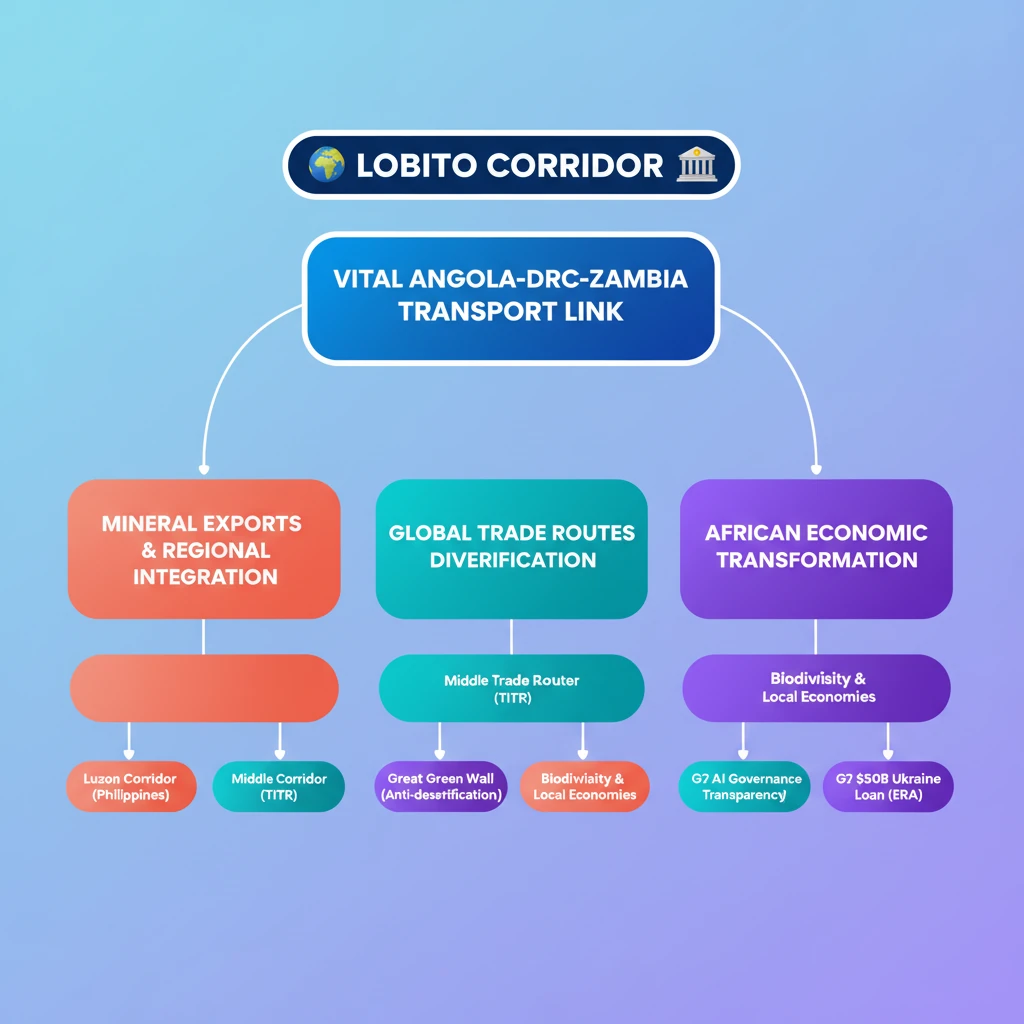
- •The Lobito Corridor is a vital Angolan-DRC-Zambia transport link to the Atlantic, crucial for mineral exports and regional integration.
- •Other key corridors include the Luzon Corridor (Philippines) and the Middle Corridor (TITR) connecting Europe and Asia, diversifying global trade routes.
- •The Great Green Wall Initiative is a major African project combating desertification in the Sahel, promoting biodiversity and local economies.
- •G7 nations are actively addressing global challenges: enhancing AI governance interoperability for transparency and accountability.
- •G7 also committed USD 50 billion in Extraordinary Revenue Acceleration (ERA) loans to Ukraine by end of 2024, highlighting international support.
🧠 Memory Techniques
95% Verified Content