What is Indus Water Treaty (IWT)? - International Relations | UPSC Learning
Topics
0 topics • 0 completed
🔍
No topics match your search
What is Indus Water Treaty (IWT)?
Medium⏱️ 8 min read
international relations
📖 Introduction
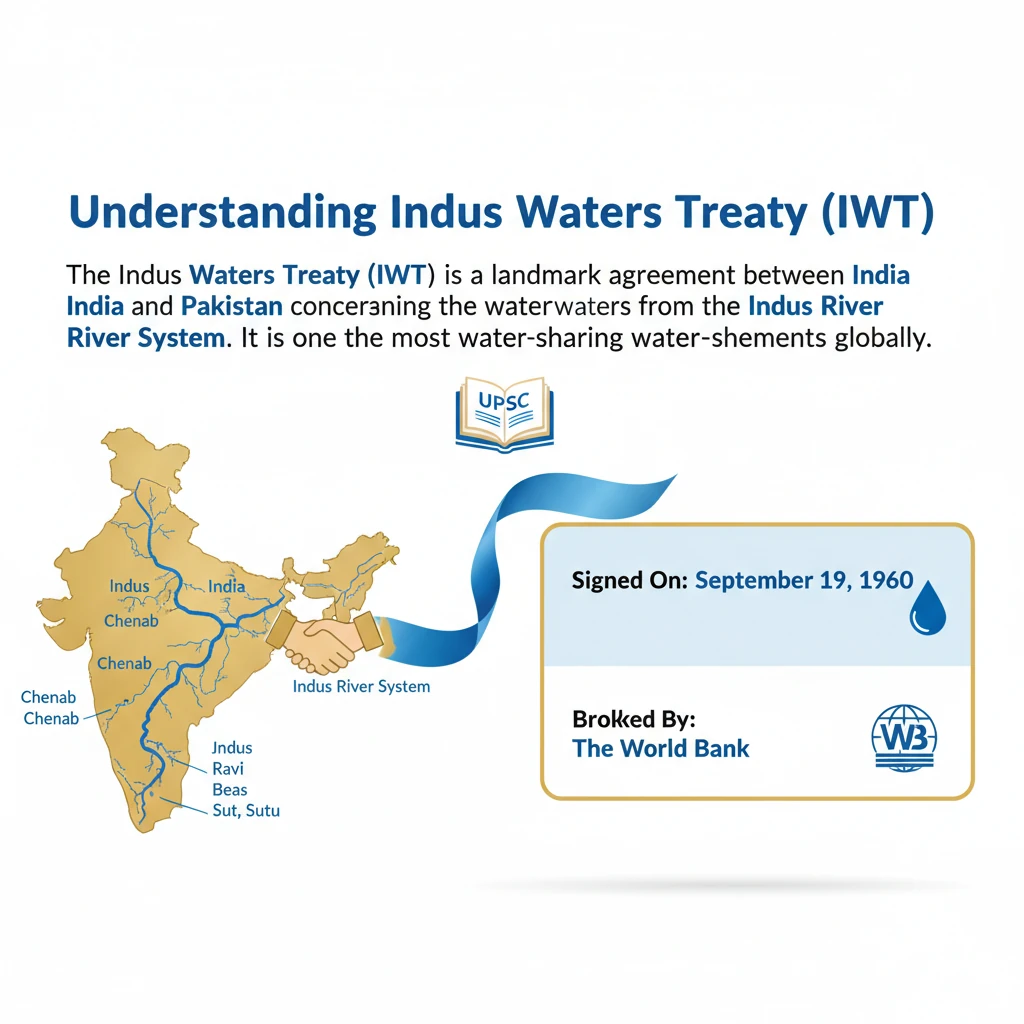
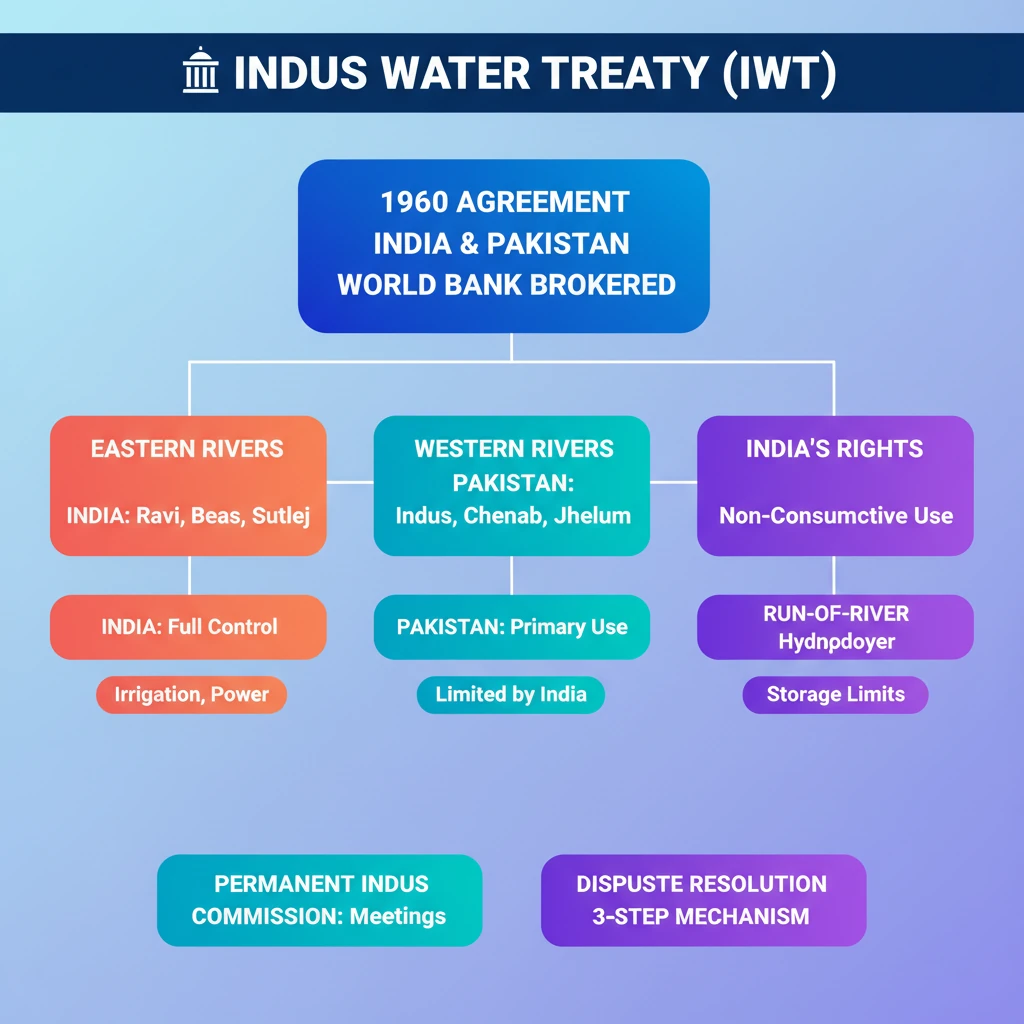
<h4>Understanding the Indus Waters Treaty (IWT)</h4><p>The <strong>Indus Waters Treaty (IWT)</strong> is a landmark agreement between <strong>India</strong> and <strong>Pakistan</strong> concerning the sharing of waters from the <strong>Indus River System</strong>. It is one of the most enduring water-sharing agreements globally.</p><div class='info-box'><p><strong>Signed On:</strong> <strong>September 19, 1960</strong></p><p><strong>Brokered By:</strong> The <strong>World Bank</strong></p><p><strong>Purpose:</strong> To establish a mechanism for cooperation and information exchange regarding the use of the <strong>Indus system's</strong> waters and its tributaries.</p></div><h4>Key Provisions of the IWT</h4><p>The <strong>IWT</strong> meticulously outlines how the waters from the six rivers of the <strong>Indus River System</strong> are to be shared between the two nations. This division aims to ensure equitable access while acknowledging historical usage patterns.</p><div class='key-point-box'><h5>Water Sharing Mechanism</h5><ul><li><strong>Western Rivers:</strong> <strong>Indus</strong>, <strong>Chenab</strong>, and <strong>Jhelum</strong> were allocated to <strong>Pakistan</strong> for unrestricted use.</li><li><strong>Eastern Rivers:</strong> <strong>Ravi</strong>, <strong>Beas</strong>, and <strong>Sutlej</strong> were allocated to <strong>India</strong> for unrestricted usage.</li></ul><p><strong>India</strong> retains certain non-consumptive agricultural and domestic uses on the <strong>Western Rivers</strong>. This allocation meant that approximately <strong>80%</strong> of the water share went to <strong>Pakistan</strong>, with <strong>India</strong> retaining <strong>20%</strong> for its use.</p></div><h4>Permanent Indus Commission (PIC)</h4><p>A crucial component of the <strong>Indus Waters Treaty</strong> is the establishment of the <strong>Permanent Indus Commission</strong>. This body is mandated to meet annually to discuss any issues related to the treaty's implementation and data exchange.</p><div class='info-box'><p><strong>Mandate:</strong> Annual meetings between <strong>India</strong> and <strong>Pakistan</strong> to resolve 'questions' and exchange information on river flows and projects.</p></div><h4>Dispute Resolution Mechanism</h4><p>The <strong>IWT</strong> incorporates a robust, <strong>three-step dispute resolution mechanism</strong> designed to address disagreements systematically and prevent escalation.</p><ol><li><strong>Step 1: Permanent Indus Commission:</strong> 'Questions' or minor issues are first addressed and resolved within the <strong>Permanent Indus Commission</strong>.</li><li><strong>Step 2: Inter-Governmental Level / Neutral Expert:</strong> Unresolved 'differences' can be taken up at the inter-governmental level. If still unresolved, a <strong>World Bank-appointed Neutral Expert (NE)</strong> can be engaged to address specific technical differences.</li><li><strong>Step 3: Court of Arbitration:</strong> More serious 'disputes' that cannot be resolved by a <strong>Neutral Expert</strong> can be referred to a <strong>Court of Arbitration</strong>, which is also set up by the <strong>World Bank</strong>.</li></ol><h4>Projects Under IWT Inspection</h4><p>Several projects are subject to inspection under the <strong>IWT</strong> to ensure compliance with its provisions, particularly concerning the use of <strong>Western Rivers</strong> by <strong>India</strong>.</p><ul><li><strong>Pakal Dul Hydro Electric Project:</strong> Built on the <strong>Marusudar River</strong>, a tributary of the <strong>Chenab</strong>.</li><li><strong>Lower Kalnai Project:</strong> Developed on the <strong>Chenab River</strong>.</li><li><strong>Kishanganga Hydroelectric Project:</strong> A <strong>run-of-the-river project</strong> located in <strong>Jammu & Kashmir</strong>.</li></ul>
💡 Key Takeaways
- •Signed in 1960, brokered by the World Bank, between India and Pakistan.
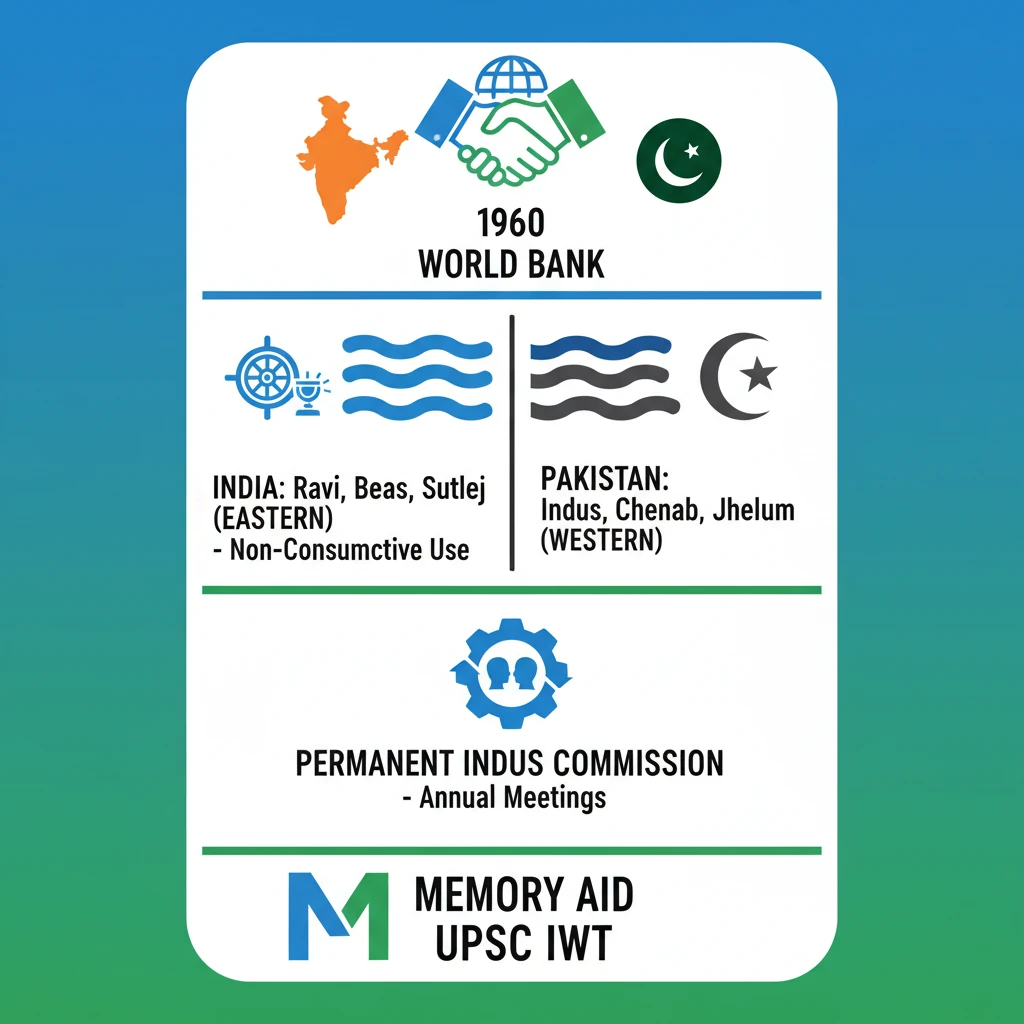
- •Allocates Eastern Rivers (Ravi, Beas, Sutlej) to India and Western Rivers (Indus, Chenab, Jhelum) to Pakistan.
- •India can use Western Rivers for non-consumptive purposes like run-of-the-river hydropower.
- •Established the Permanent Indus Commission for annual meetings and information exchange.
- •Features a three-step dispute resolution mechanism involving the Commission, Neutral Expert, and Court of Arbitration.
- •Remains a vital, albeit occasionally strained, framework for water cooperation despite bilateral tensions.
🧠 Memory Techniques
98% Verified Content
📚 Reference Sources
•World Bank official documents on Indus Waters Treaty
•Ministry of External Affairs (India) publications on IWT