What are the Other Conventions related to Seas - International Relations | UPSC Learning
Topics
0 topics • 0 completed
🔍
No topics match your search

What are the Other Conventions related to Seas
Medium⏱️ 6 min read
international relations
📖 Introduction
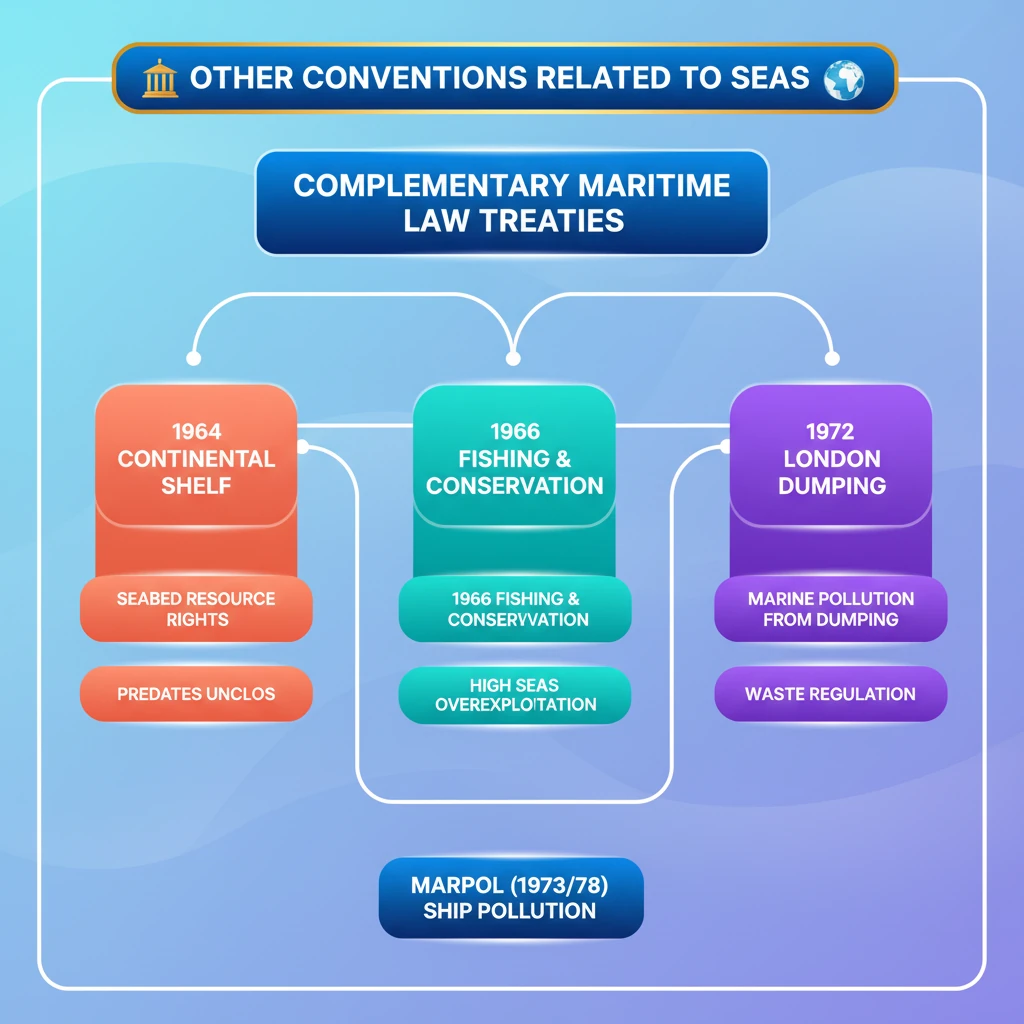
<h4>Introduction to International Maritime Conventions</h4><p>Beyond the comprehensive <strong>United Nations Convention on the Law of the Sea (UNCLOS)</strong>, several other crucial conventions govern specific aspects of maritime activities and the protection of the marine environment. These agreements address various challenges, from resource exploitation to pollution control.</p><div class='exam-tip-box'><p>Understanding these conventions is vital for <strong>UPSC Mains GS-II (International Relations)</strong> and <strong>GS-III (Environment & Disaster Management)</strong>. They demonstrate the evolution of international law concerning the seas.</p></div><h4>Convention on the Continental Shelf, 1964</h4><p>The <strong>Convention on the Continental Shelf, 1964</strong>, was one of the four Geneva Conventions on the Law of the Sea adopted in 1958. It aimed to clarify the rights of coastal states over their continental shelves.</p><div class='info-box'><p>This convention specifically defines and delimits the rights of <strong>States</strong> to explore and exploit the <strong>natural resources</strong> found within their <strong>continental shelf</strong> areas. These resources typically include minerals and sedentary species.</p></div><h4>Convention on Fishing and Conservation of Living Resources of the High Seas, 1966</h4><p>The <strong>Convention on Fishing and Conservation of Living Resources of the High Seas, 1966</strong>, addressed the growing concerns about overexploitation of marine life in international waters.</p><div class='info-box'><p>It was designed to solve problems related to the <strong>conservation of living resources</strong> in the <strong>high seas</strong>. The convention recognized that modern fishing technology posed a significant threat, potentially leading to the overexploitation of these vital resources.</p></div><h4>London Convention 1972 (Dumping Convention)</h4><p>The <strong>London Convention 1972</strong>, officially known as the Convention on the Prevention of Marine Pollution by Dumping of Wastes and Other Matter, is a key international treaty for marine pollution control.</p><div class='info-box'><p>Its primary objective is to promote the effective control of <strong>all sources of marine pollution</strong>. It mandates signatories to take all practicable steps to prevent pollution of the sea, particularly through the <strong>dumping of wastes and other matters</strong>.</p></div><h4>MARPOL Convention (1973/78)</h4><p>The <strong>International Convention for the Prevention of Pollution from Ships (MARPOL)</strong> is one of the most important international conventions addressing marine pollution from ships.</p><div class='info-box'><p><strong>MARPOL (1973)</strong>, as modified by the <strong>1978 Protocol</strong>, covers the prevention of pollution of the <strong>marine environment by ships</strong>, whether from operational discharges or accidental causes.</p></div><div class='key-point-box'><p>It categorizes and regulates various forms of marine pollution. These include pollution caused by <strong>oil</strong>, <strong>noxious liquid substances</strong>, <strong>harmful substances in packaged form</strong>, <strong>sewage</strong>, and <strong>garbage</strong> from ships.</p></div>
💡 Key Takeaways
- •Several conventions predate or complement UNCLOS, addressing specific aspects of maritime law.
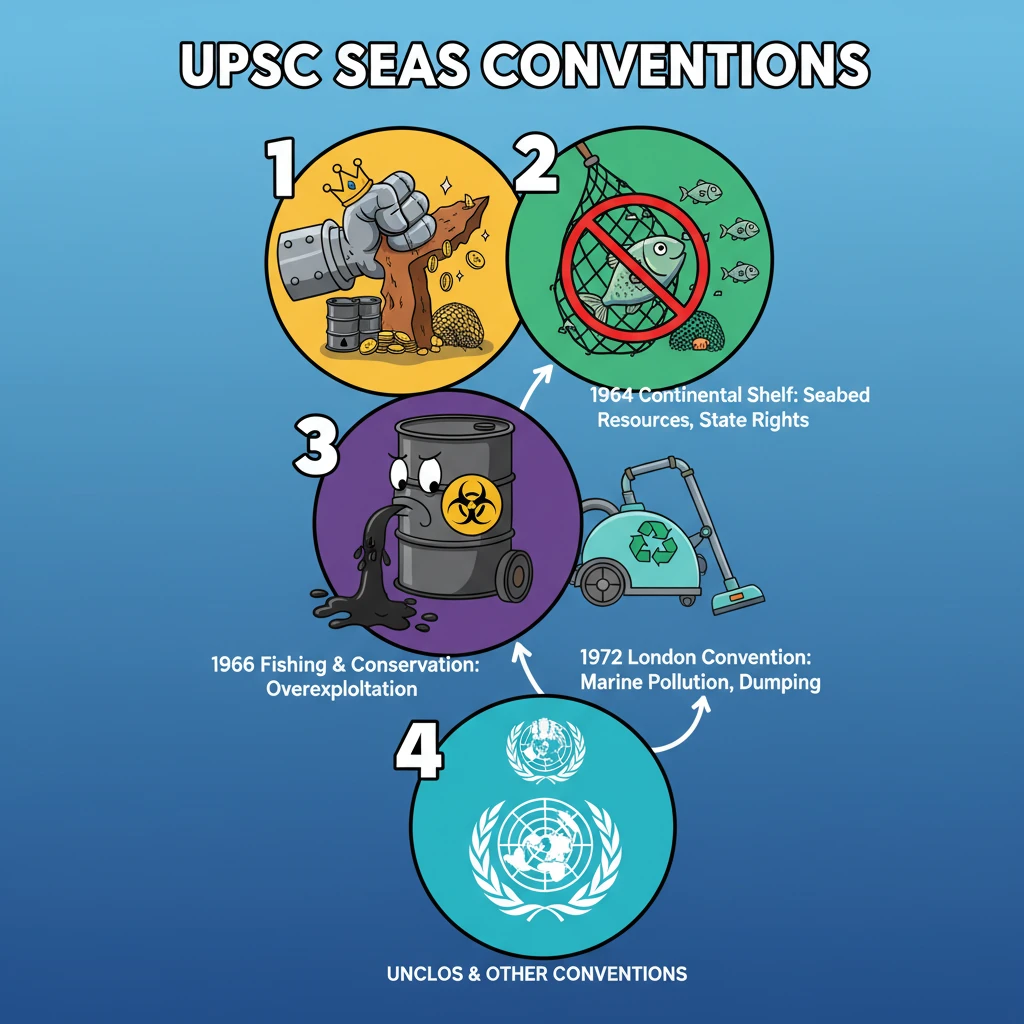
- •The 1964 Continental Shelf Convention defined state rights over seabed resources.
- •The 1966 Fishing and Conservation Convention tackled high seas overexploitation.
- •The 1972 London Convention targets marine pollution from dumping of wastes.
- •MARPOL (1973/78) is a comprehensive treaty for preventing ship-sourced marine pollution.
- •These conventions are foundational to current international maritime law and environmental protection efforts.
🧠 Memory Techniques
95% Verified Content
📚 Reference Sources
•United Nations (UN) Treaties Database
•International Maritime Organization (IMO) official website
•UNCLOS (United Nations Convention on the Law of the Sea) text