However, it has faced criticism for being discriminatory, creating a divide between nuclear- armed and non-nuclear states. - International Relations | UPSC Learning
Topics
0 topics • 0 completed
🔍
No topics match your search
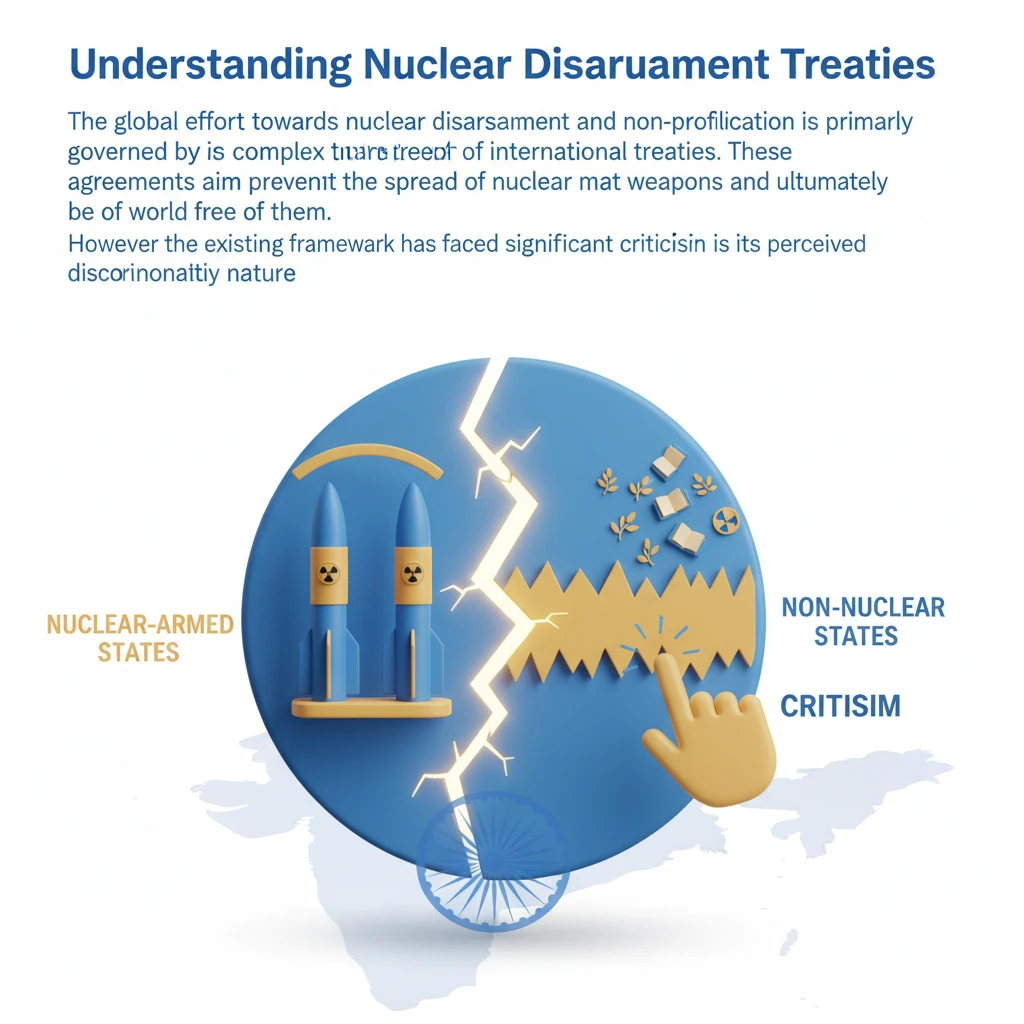
However, it has faced criticism for being discriminatory, creating a divide between nuclear- armed and non-nuclear states.
Medium⏱️ 8 min read
international relations
📖 Introduction
<h4>Understanding Nuclear Disarmament Treaties</h4><p>The global effort towards <strong>nuclear disarmament</strong> and <strong>non-proliferation</strong> is primarily governed by a complex web of international treaties. These agreements aim to prevent the spread of nuclear weapons and ultimately achieve a world free of them.</p><p>However, the existing framework has faced significant <strong>criticism</strong>. A central point of contention is its perceived <strong>discriminatory nature</strong>, which creates a stark divide between <strong>nuclear-armed states</strong> and <strong>non-nuclear states</strong>.</p><div class='key-point-box'><p>This criticism is most often directed at the <strong>Treaty on the Non-Proliferation of Nuclear Weapons (NPT)</strong>, which recognizes five states as legitimate nuclear weapon states while prohibiting others from acquiring them.</p></div><h4>Comprehensive Nuclear-Test-Ban Treaty (CTBT)</h4><p>The <strong>Comprehensive Nuclear-Test-Ban Treaty (CTBT)</strong> is a multilateral treaty that bans all <strong>nuclear explosions</strong>, whether for military or peaceful purposes, in any environment. Its primary objective is to curb the development of new nuclear weapons and the qualitative improvement of existing ones.</p><div class='info-box'><p><strong>CTBT Status:</strong> The treaty was adopted by the United Nations General Assembly in <strong>1996</strong>. However, it is <strong>not yet fully in force</strong> because it requires ratification by 44 specific states, eight of which (including <strong>India</strong>, <strong>Pakistan</strong>, <strong>China</strong>, <strong>Egypt</strong>, <strong>Iran</strong>, <strong>Israel</strong>, <strong>North Korea</strong>, and the <strong>United States</strong>) have not yet ratified it.</p></div><div class='exam-tip-box'><p><strong>UPSC Insight:</strong> Understanding the difference between 'signed' and 'ratified' is crucial for treaties like CTBT. India's stance on CTBT is important for IR questions.</p></div><h4>Treaty on the Prohibition of Nuclear Weapons (TPNW)</h4><p>The <strong>Treaty on the Prohibition of Nuclear Weapons (TPNW)</strong>, often referred to as the <strong>Nuclear Ban Treaty</strong>, represents a more radical approach to nuclear disarmament. It includes a comprehensive set of prohibitions on participating in any <strong>nuclear weapon activities</strong>.</p><div class='info-box'><p><strong>TPNW Prohibitions:</strong> The treaty undertakes for states parties not to:</p><ul><li><strong>Develop</strong>, <strong>test</strong>, <strong>produce</strong>, <strong>acquire</strong>, <strong>possess</strong>, or <strong>stockpile nuclear weapons</strong>.</li><li><strong>Use</strong> or <strong>threaten to use nuclear weapons</strong>.</li><li>Allow any nuclear weapons on their territory.</li><li>Assist, encourage, or induce anyone to engage in prohibited activities.</li></ul></div><p>The TPNW entered into force on <strong>January 22, 2021</strong>. It is supported by a large number of non-nuclear weapon states and civil society organizations, but it is opposed by all nuclear weapon states and their allies, who argue it is not an effective path to disarmament.</p>
💡 Key Takeaways
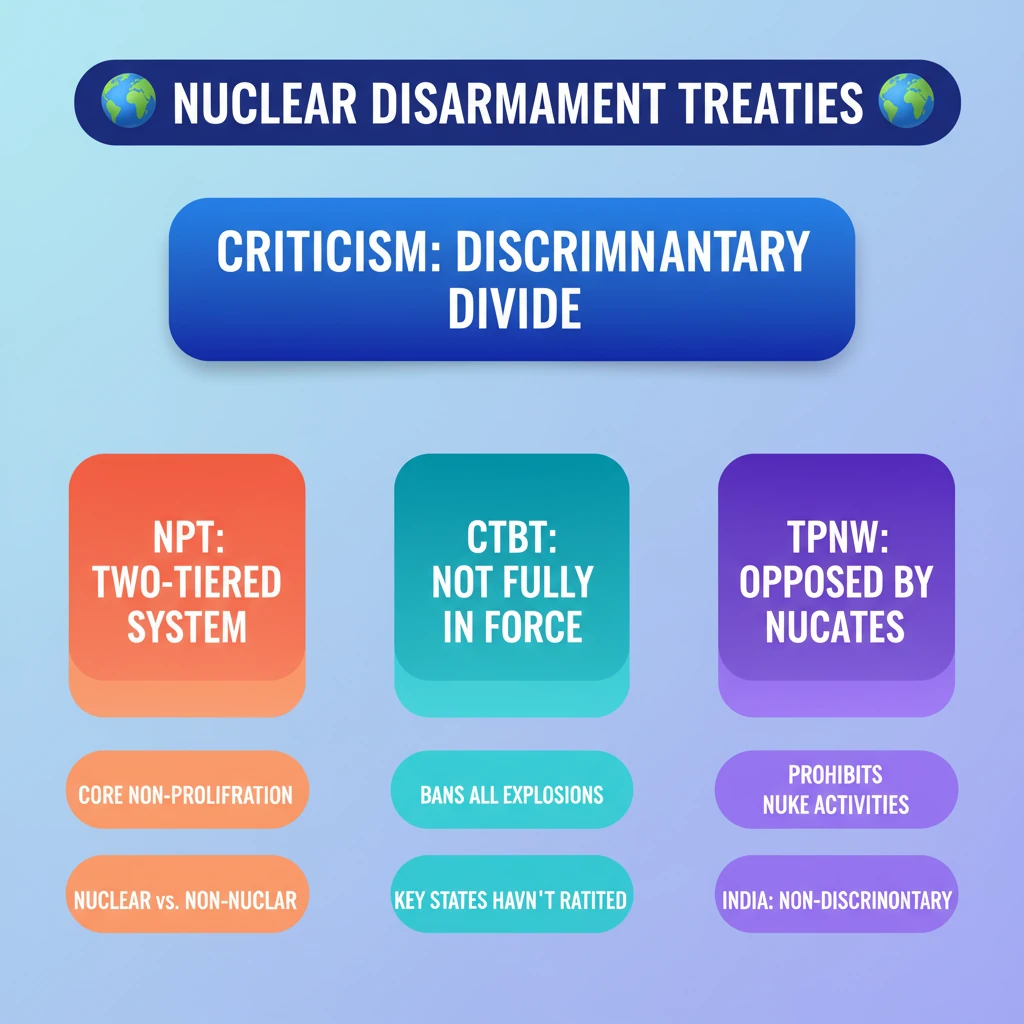
- •Nuclear disarmament treaties face criticism for being discriminatory, creating a divide between nuclear-armed and non-nuclear states.
- •The NPT is the cornerstone of non-proliferation but is criticized for its two-tiered system.
- •The CTBT aims to ban all nuclear explosions but is not yet fully in force due to non-ratification by key states.
- •The TPNW comprehensively prohibits nuclear weapons activities, but is opposed by nuclear-weapon states.
- •India advocates for universal, non-discriminatory, and verifiable nuclear disarmament, not signing NPT or CTBT.
- •Modernization of nuclear arsenals and regional proliferation risks remain significant challenges.
🧠 Memory Techniques

95% Verified Content
📚 Reference Sources
•International Atomic Energy Agency (IAEA) - Safeguards and Treaties
•Treaty on the Non-Proliferation of Nuclear Weapons (NPT) text
•Comprehensive Nuclear-Test-Ban Treaty (CTBT) text
•Treaty on the Prohibition of Nuclear Weapons (TPNW) text
•Council on Foreign Relations (CFR) - Nuclear Arms Control
•Stockholm International Peace Research Institute (SIPRI) - Nuclear Weapons