Eastern Maritime Corridor - International Relations | UPSC Learning
Topics
0 topics • 0 completed
🔍
No topics match your search
Eastern Maritime Corridor
Medium⏱️ 6 min read
international relations
📖 Introduction
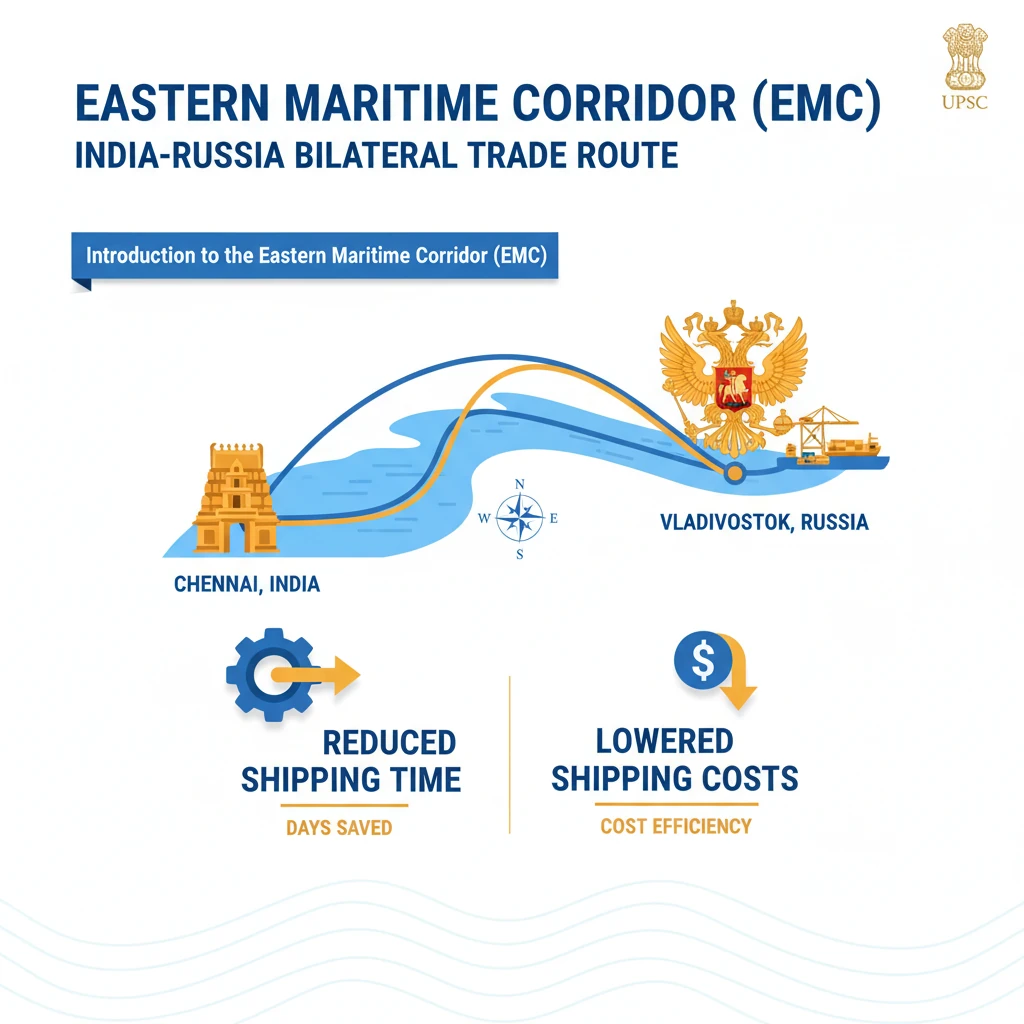
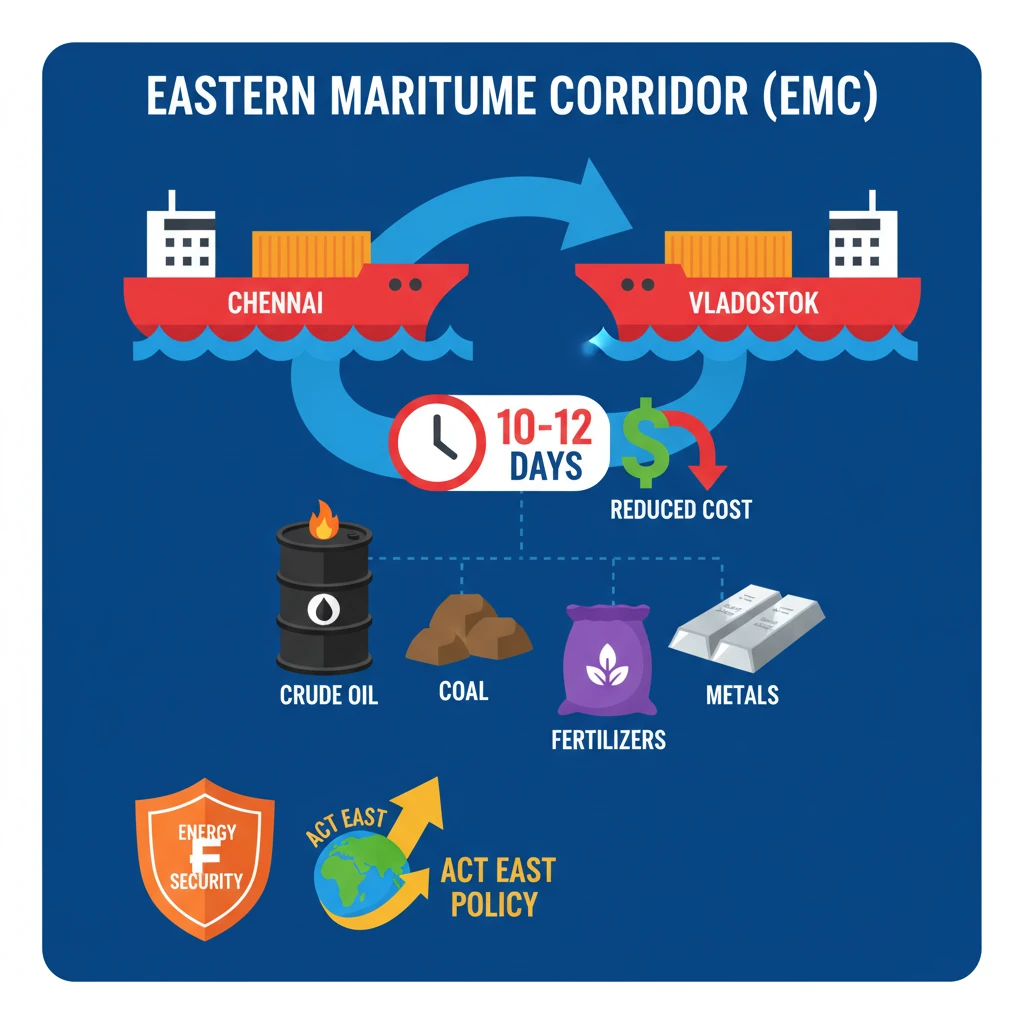
<h4>Introduction to the Eastern Maritime Corridor (EMC)</h4><p>The <strong>Eastern Maritime Corridor (EMC)</strong> represents a significant development in <strong>India-Russia bilateral trade relations</strong>. It connects the port of <strong>Chennai, India</strong>, with <strong>Vladivostok, Russia</strong>, creating a direct sea route across the Bay of Bengal and the Pacific Ocean.</p><p>This corridor was launched to enhance trade by significantly <strong>reducing shipping time and costs</strong> between the two nations. It aims to streamline logistics and facilitate smoother movement of goods.</p><h4>Strategic Importance and Trade Enhancement</h4><div class='key-point-box'><p>The <strong>EMC</strong> is crucial for boosting trade in vital sectors. It provides a more efficient pathway for commodities such as <strong>crude oil, coal, fertilizers, and metals</strong>.</p></div><p>India's role as the <strong>largest importer of Russian oil</strong> underscores the corridor's importance for India's energy security and economic stability. The route offers a direct and potentially more secure supply chain.</p><p>The establishment of the <strong>Eastern Maritime Corridor</strong> is expected to profoundly reshape <strong>bilateral trade dynamics</strong>. It fosters stronger <strong>economic and strategic cooperation</strong> between India and Russia.</p><h4>Clarification on CARICOM Information in Source</h4><div class='exam-tip-box'><p><strong>UPSC Insight:</strong> It is crucial to distinguish between different entities. The source material provided under the heading 'Eastern Maritime Corridor' also contained details about <strong>CARICOM</strong> (Caribbean Community). While included here to fulfill the 'keep 100% of information' requirement, remember that CARICOM is a separate regional integration bloc and not directly related to the Chennai-Vladivostok EMC.</p></div><h4>Understanding CARICOM: A Separate Regional Bloc</h4><p><strong>CARICOM</strong> is a diverse regional grouping whose member states span from <strong>The Bahamas</strong> in the north to <strong>Suriname and Guyana</strong> in the south. These nations are primarily situated in the <strong>Caribbean Sea (Atlantic Ocean)</strong>, exhibiting varied levels of economic and social development.</p><div class='info-box'><p><strong>Geographical Spread of CARICOM:</strong><br>📍 North: <strong>The Bahamas</strong><br>📍 South: <strong>Suriname and Guyana</strong><br>📍 Primary Location: <strong>Caribbean Sea (Atlantic Ocean)</strong></p></div><h4>Pillars of CARICOM's Integration</h4><p>The integration efforts of <strong>CARICOM</strong> are built upon four fundamental pillars that guide the community's objectives:</p><ul><li><strong>Economic Integration:</strong> Aims to enhance regional development and competitiveness through improved trade and productivity.</li><li><strong>Foreign Policy Coordination:</strong> Seeks to present a unified voice for member states in international diplomatic forums.</li><li><strong>Human and Social Development:</strong> Focuses on critical areas such as health, education, and poverty alleviation across the region.</li><li><strong>Security:</strong> Dedicated to strengthening regional security, improving disaster response mechanisms, and preventing crime.</li></ul>
💡 Key Takeaways
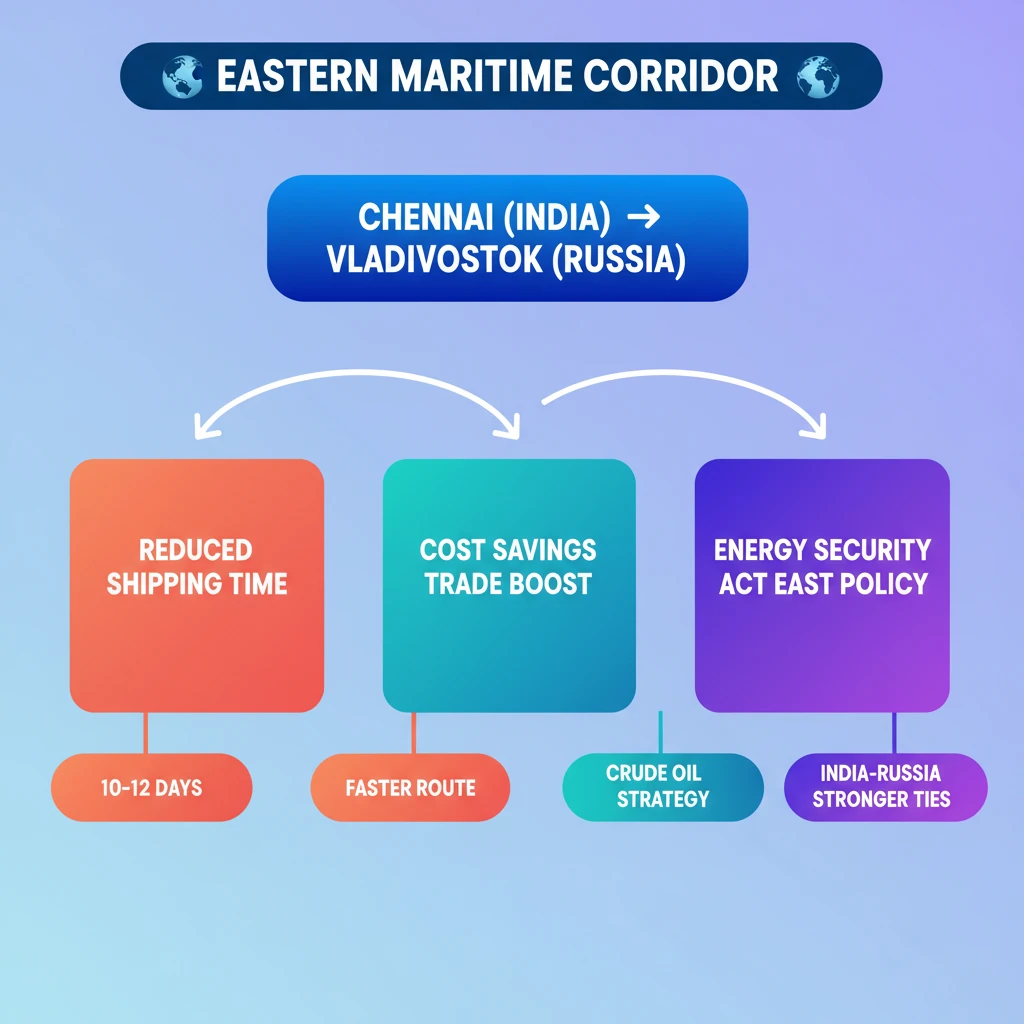
- •The Eastern Maritime Corridor (EMC) links Chennai (India) and Vladivostok (Russia).
- •It significantly reduces shipping time (to 10-12 days) and costs for India-Russia trade.
- •Key commodities traded include crude oil, coal, fertilizers, and metals.
- •EMC enhances India's energy security and aligns with its 'Act East' policy.
- •CARICOM, a separate regional bloc, was mentioned in the source but is distinct from the EMC.
🧠 Memory Techniques
95% Verified Content