Gulf Cooperation Council (GCC) - International Relations | UPSC Learning
Topics
0 topics • 0 completed
🔍
No topics match your search
Gulf Cooperation Council (GCC)
Medium⏱️ 7 min read
international relations
📖 Introduction
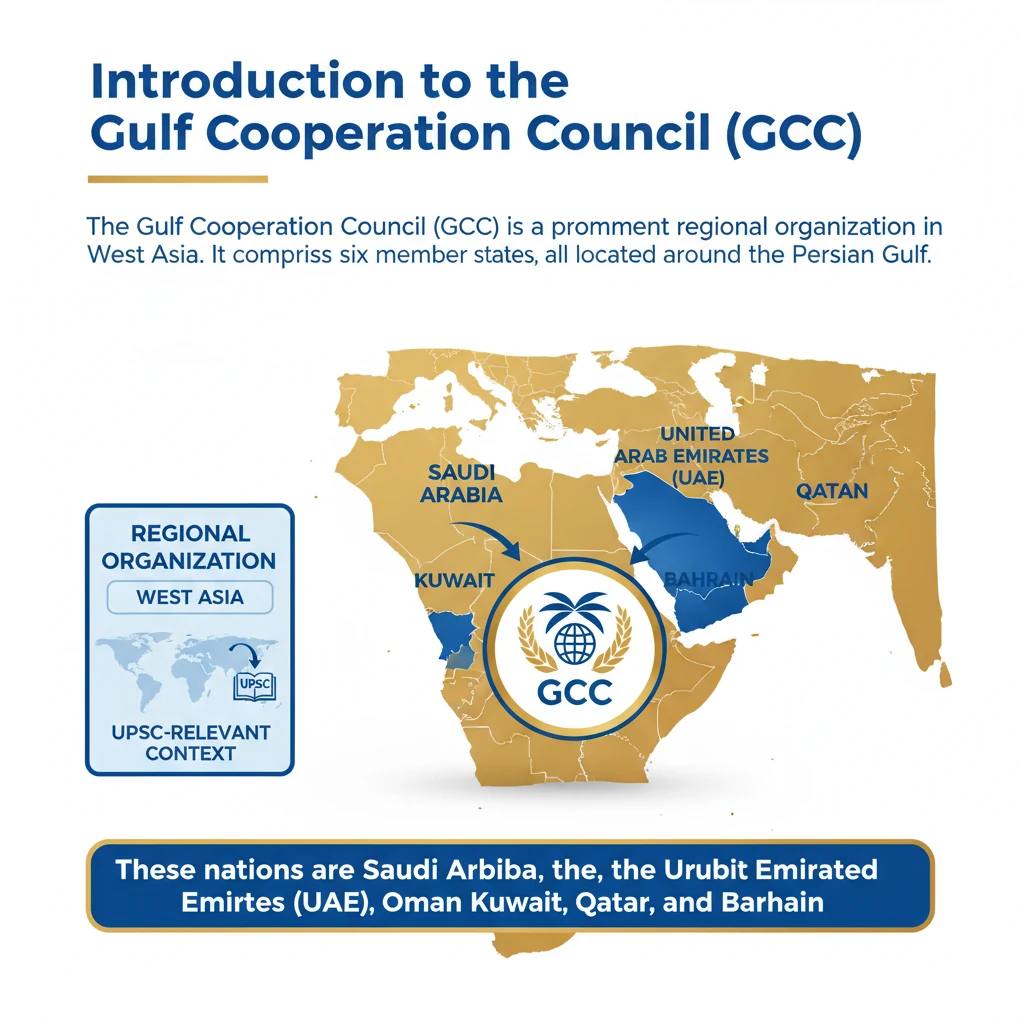
<h4>Introduction to the Gulf Cooperation Council (GCC)</h4><p>The <strong>Gulf Cooperation Council (GCC)</strong> is a prominent <strong>regional organization</strong> in West Asia. It comprises <strong>six member states</strong>, all located around the Persian Gulf.</p><p>These nations are <strong>Saudi Arabia</strong>, the <strong>United Arab Emirates (UAE)</strong>, <strong>Oman</strong>, <strong>Kuwait</strong>, <strong>Qatar</strong>, and <strong>Bahrain</strong>.</p><div class='info-box'><p><strong>Establishment:</strong> The <strong>GCC</strong> was founded in <strong>1981</strong>.</p><p><strong>Primary Aim:</strong> To foster <strong>cooperation</strong>, <strong>integration</strong>, and <strong>interconnectivity</strong> among its member states. This is based on their shared regional and cultural proximity.</p></div><h4>Economic Backbone: Oil and Gas Exports</h4><p>The <strong>GCC countries</strong> are significantly reliant on their vast <strong>oil resources</strong>. These have historically been the primary driver of their economies.</p><p>Currently, the main source of revenue for these nations is derived from the <strong>export of oil</strong> and <strong>natural gas</strong>.</p><div class='key-point-box'><p><strong>Economic Reliance:</strong> For decades, <strong>oil resources</strong> have served as the fundamental backbone of the <strong>GCC member states' economies</strong>.</p></div><h4>The Broader Persian Gulf Region</h4><p>The <strong>Persian Gulf region</strong> encompasses a wider geographical area than just the GCC. It is shared by <strong>eight countries</strong>, all of which are members of the <strong>United Nations</strong>.</p><p>These <strong>eight nations</strong> are <strong>Bahrain</strong>, <strong>Iran</strong>, <strong>Iraq</strong>, <strong>Kuwait</strong>, <strong>Oman</strong>, <strong>Qatar</strong>, <strong>Saudi Arabia</strong>, and the <strong>United Arab Emirates (UAE)</strong>.</p><ul><li><strong>GCC Members:</strong> <strong>UAE</strong>, <strong>Bahrain</strong>, <strong>Saudi Arabia</strong>, <strong>Oman</strong>, <strong>Qatar</strong>, <strong>Kuwait</strong>.</li><li><strong>OPEC Members from Persian Gulf:</strong> <strong>Iran</strong>, <strong>Iraq</strong>, <strong>Kuwait</strong>, <strong>UAE</strong>, and <strong>Saudi Arabia</strong> are also part of the <strong>Organization of the Petroleum Exporting Countries (OPEC)</strong>.</li></ul><h4>Strategic Importance of the Persian Gulf</h4><p>The <strong>Persian Gulf</strong> is globally recognized as one of the most <strong>strategically important regions</strong>. Its significance stems from two critical factors.</p><div class='key-point-box'><p><strong>Global Significance:</strong> The <strong>Persian Gulf</strong> plays a pivotal role in global geopolitics and energy security due to its immense natural resources and critical maritime routes.</p></div><h5>Vast Oil and Gas Reserves</h5><p>The region surrounding the <strong>Persian Gulf</strong> holds the <strong>world's largest proven reserves</strong> of both <strong>oil</strong> and <strong>natural gas</strong>.</p><div class='info-box'><p><strong>Energy Hub:</strong> This makes the <strong>Persian Gulf</strong> an indispensable source of energy, supplying a significant portion of the world's energy demands.</p></div><h5>Critical Shipping Lane and Chokepoint</h5><p>The <strong>Persian Gulf</strong> serves as a vital <strong>shipping lane</strong> for the global export of oil. This waterway facilitates the transportation of energy resources from the region to international markets.</p><div class='info-box'><p><strong>Strait of Hormuz:</strong> A particularly crucial segment is the <strong>Strait of Hormuz</strong>. This narrow waterway, situated between <strong>Iran</strong> and <strong>Oman</strong>, acts as a <strong>chokepoint</strong> through which a substantial volume of the world's oil transits daily.</p></div><div class='exam-tip-box'><p><strong>UPSC Insight:</strong> Understanding the <strong>strategic importance</strong> of the <strong>Persian Gulf</strong> and the <strong>Strait of Hormuz</strong> is crucial for topics like <strong>International Relations (GS-II)</strong>, <strong>Energy Security (GS-III)</strong>, and <strong>Geopolitics</strong>. Questions often relate to global trade routes and resource control.</p></div>

💡 Key Takeaways
- •The GCC is a 6-nation regional organization (Saudi Arabia, UAE, Oman, Kuwait, Qatar, Bahrain) established in 1981.
- •Its primary aim is to promote cooperation, integration, and interconnectivity based on regional and cultural proximity.
- •GCC economies are heavily reliant on oil and natural gas exports, making them crucial for global energy security.
- •The Persian Gulf region, home to GCC, holds the world's largest proven oil and gas reserves.
- •The Strait of Hormuz, a narrow chokepoint, is vital for global oil shipping from the Persian Gulf.
- •The GCC plays a significant role in regional stability and is a key partner for India's energy and economic interests.
🧠 Memory Techniques
95% Verified Content
📚 Reference Sources
•General knowledge of international relations and geography