India’s Nuclear Program - International Relations | UPSC Learning
Topics
0 topics • 0 completed
🔍
No topics match your search
India’s Nuclear Program
Medium⏱️ 8 min read
international relations
📖 Introduction
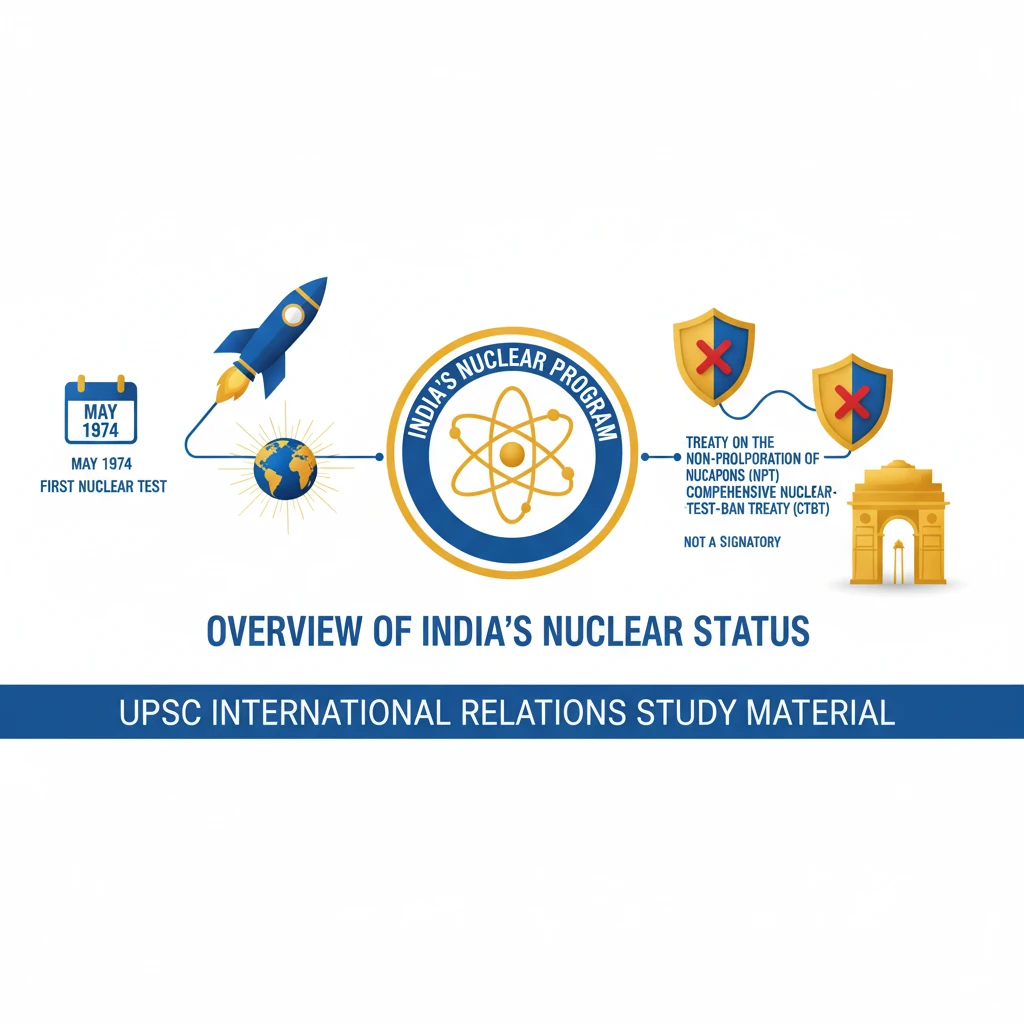
<h4>Overview of India's Nuclear Status</h4><p>India's journey as a nuclear power began with its first nuclear test in <strong>May 1974</strong>. This event marked its entry into the exclusive club of nuclear-armed states.</p><p>Despite its nuclear capabilities, India has consciously chosen to remain outside major international non-proliferation treaties. It is not a signatory to either the <strong>Treaty on the Non-Proliferation of Nuclear Weapons (NPT)</strong> or the <strong>Comprehensive Nuclear Test Ban Treaty (CTBT)</strong>.</p><div class='info-box'><p><strong>Key Fact:</strong> India conducted its first nuclear test in <strong>May 1974</strong>, codenamed <strong>Smiling Buddha</strong>, asserting its technological prowess.</p></div><h4>Engagement with International Nuclear Regimes</h4><p>While not part of the NPT or CTBT, India maintains a strong commitment to nuclear safety and non-proliferation. It has a <strong>facility-specific safeguards agreement</strong> with the <strong>International Atomic Energy Agency (IAEA)</strong>.</p><p>India actively seeks to participate in global civilian nuclear technology commerce. For this, it aims for an exemption from the <strong>Nuclear Suppliers Group (NSG)</strong>, which would allow it to engage in nuclear trade despite its non-NPT status.</p><div class='key-point-box'><p>India's approach is characterized by a commitment to <strong>responsible nuclear stewardship</strong> while maintaining its strategic autonomy.</p></div><h4>Membership in Export Control Regimes</h4><p>India has steadily gained entry into various multilateral export control regimes, signifying its growing integration into the global non-proliferation architecture. These memberships acknowledge India's robust export control systems.</p><ul><li>In <strong>2016</strong>, India was admitted as a member of the <strong>Missile Technology Control Regime (MTCR)</strong>.</li><li>In <strong>2017</strong>, it joined the <strong>Wassenaar Arrangement</strong>.</li><li>In <strong>2018</strong>, India became a member of the <strong>Australia Group</strong>.</li></ul><div class='exam-tip-box'><p>Understanding India's position on <strong>NPT</strong>, <strong>CTBT</strong>, and its membership in regimes like <strong>MTCR</strong>, <strong>Wassenaar</strong>, and <strong>Australia Group</strong> is crucial for UPSC Mains <strong>GS-II</strong> and <strong>GS-III</strong> questions on International Relations and National Security.</p></div><h4>Recent Milestones in India's Nuclear Program</h4><p>India's nuclear program continues to advance, focusing on indigenous development and energy security. A significant recent development highlights its progress in advanced nuclear technology.</p><p>In <strong>2023</strong>, India initiated the <strong>core loading</strong> of its <strong>Prototype Fast Breeder Reactor (PFBR)</strong> at <strong>Kalpakkam, Tamil Nadu</strong>. This marks a critical step towards achieving a closed nuclear fuel cycle and enhancing energy independence.</p><div class='info-box'><p>The <strong>PFBR</strong> at <strong>Kalpakkam</strong> is a key component of India's three-stage nuclear power program, designed to utilize thorium, of which India has vast reserves.</p></div><h4>India's Nuclear Doctrine</h4><p>India maintains a clear and consistent nuclear doctrine. Its official commitment is to a policy of <strong>no-first-use of nuclear weapons</strong>.</p><p>This doctrine underscores India's defensive posture and its commitment to using nuclear weapons solely for deterrence and retaliation, not for initiating conflict.</p>
💡 Key Takeaways
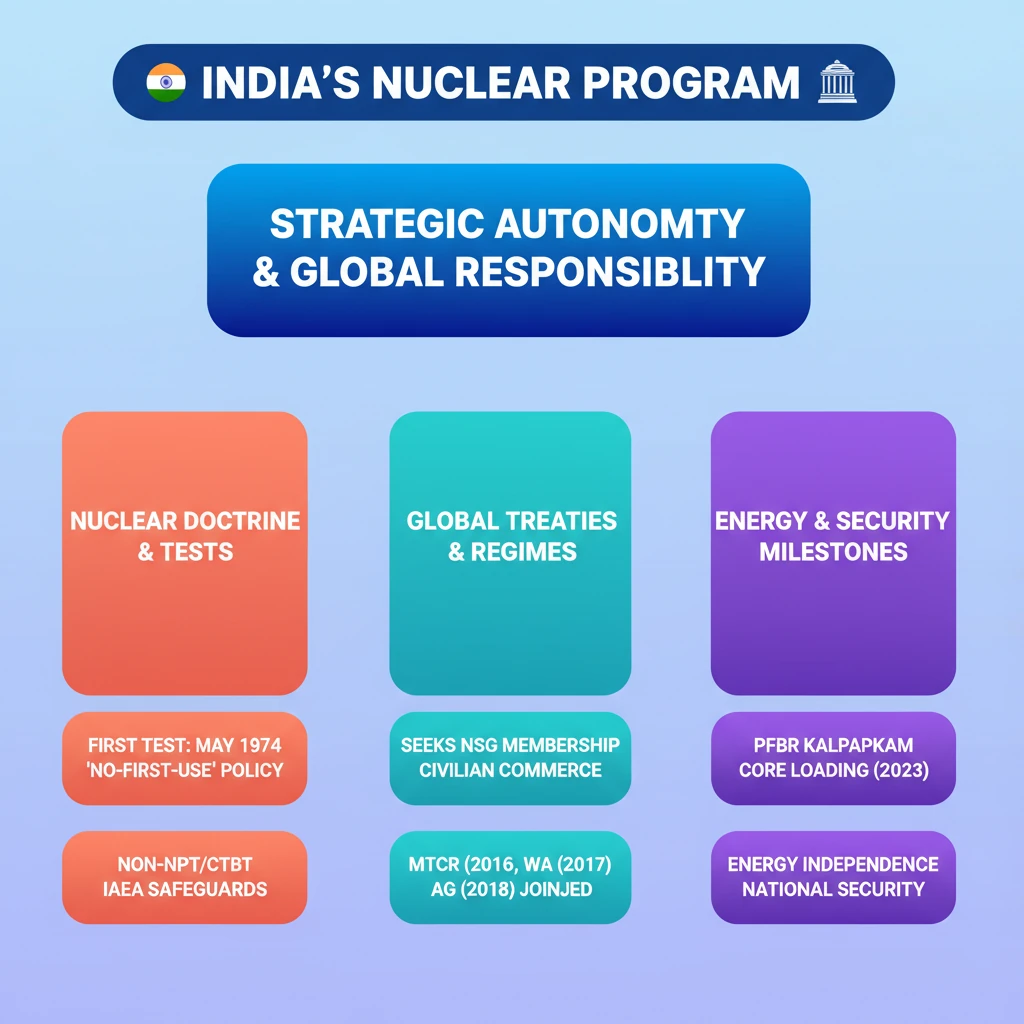
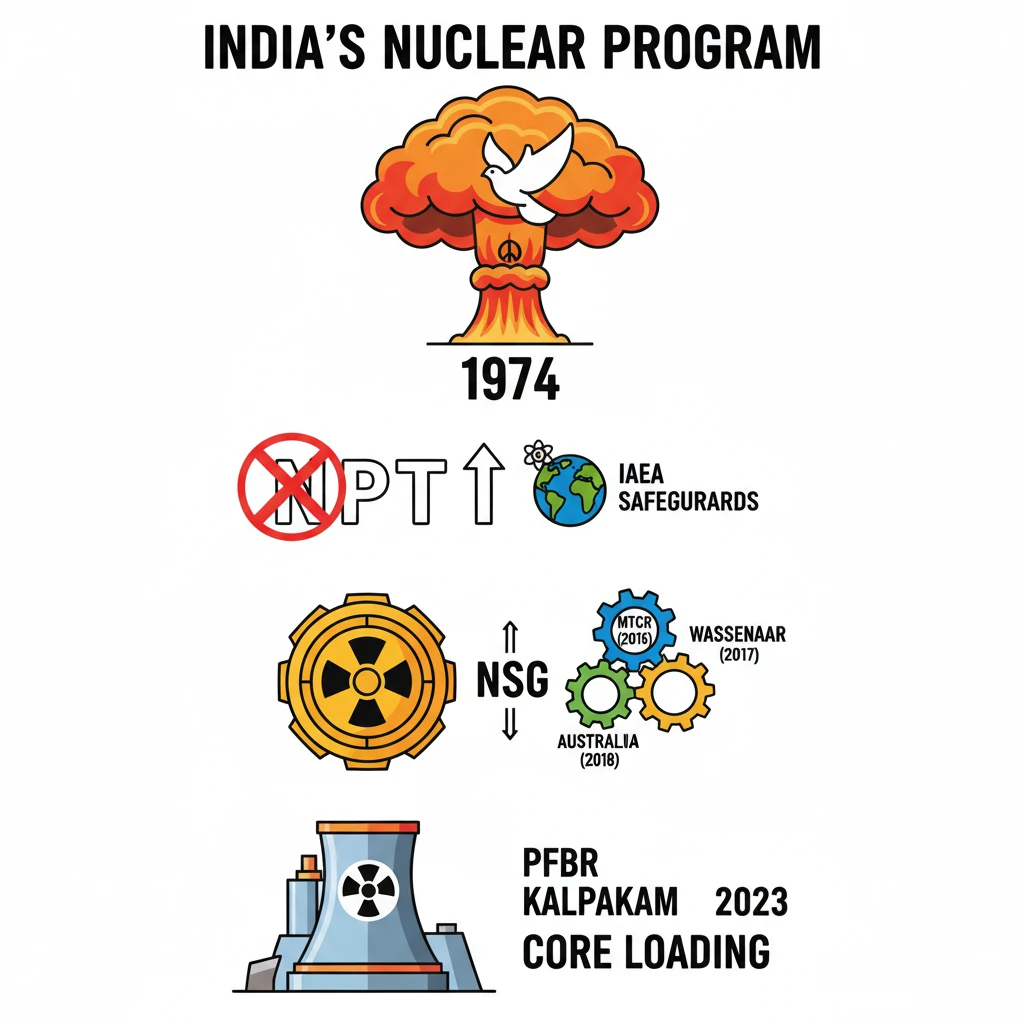
- •India tested its first nuclear device in May 1974 and maintains a 'no-first-use' nuclear doctrine.
- •India is not a signatory to the NPT or CTBT but has facility-specific safeguards with the IAEA.
- •India seeks NSG membership for civilian nuclear commerce and has joined MTCR (2016), Wassenaar Arrangement (2017), and Australia Group (2018).
- •Core loading of the Prototype Fast Breeder Reactor (PFBR) at Kalpakkam in 2023 is a major step in India's nuclear energy program.
- •India's nuclear program balances strategic autonomy, national security, and energy independence with responsible global conduct.
🧠 Memory Techniques
98% Verified Content
📚 Reference Sources
•Ministry of External Affairs (MEA) documents on India's nuclear doctrine
•International Atomic Energy Agency (IAEA) reports on safeguards
•Press Information Bureau (PIB) releases on PFBR