India’s Neighbourhood and Foreign Policy Initiatives - International Relations | UPSC Learning
Topics
0 topics • 0 completed
🔍
No topics match your search
India’s Neighbourhood and Foreign Policy Initiatives
Medium⏱️ 8 min read
international relations
📖 Introduction
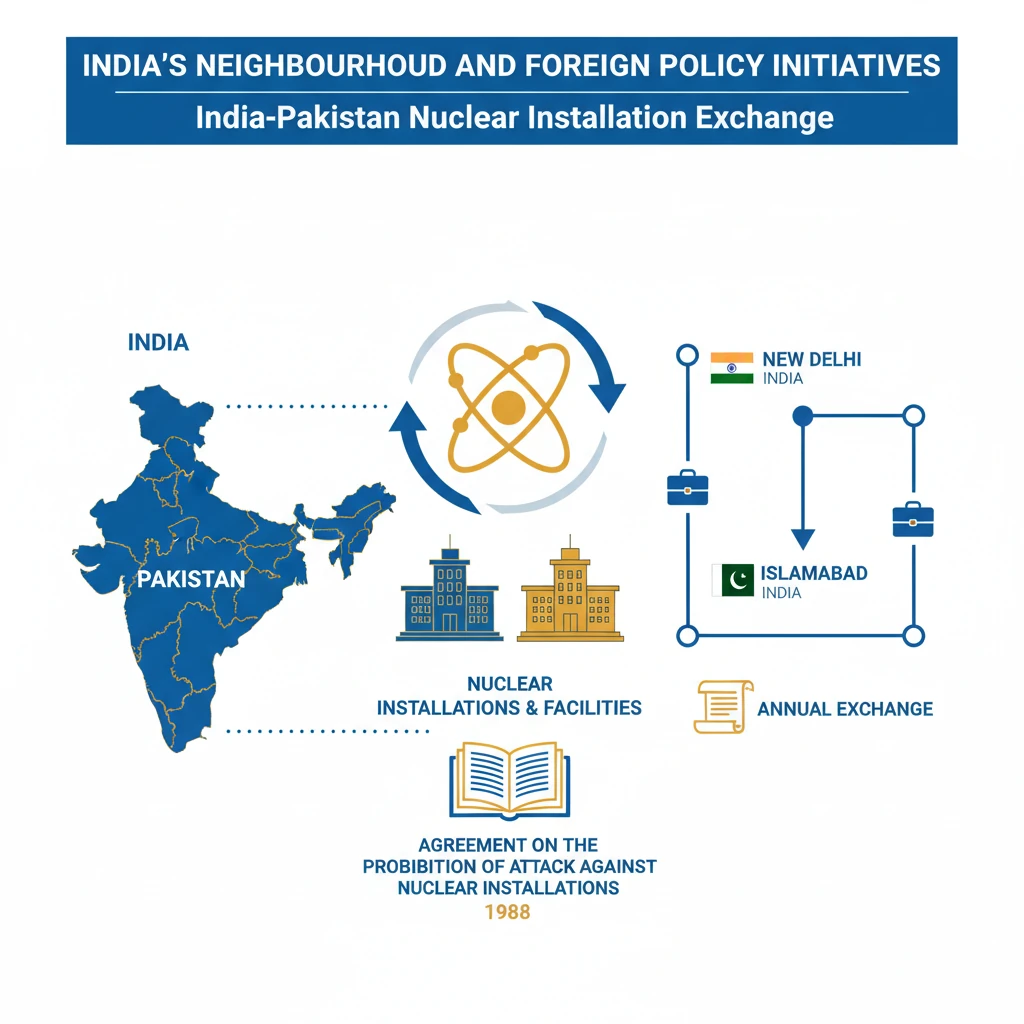
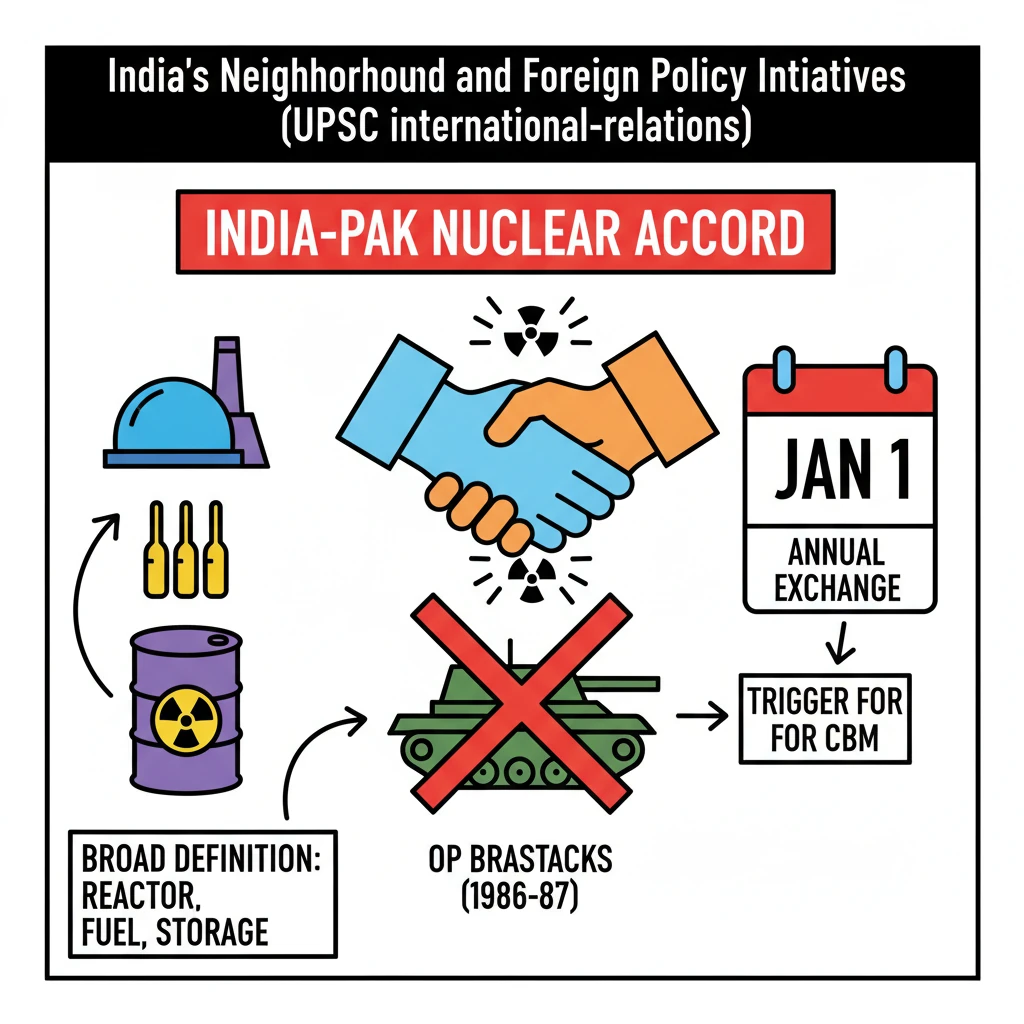
<h4>Introduction: India-Pakistan Nuclear Installation Exchange</h4><p>Recently, <strong>India</strong> and <strong>Pakistan</strong> conducted their annual exchange of lists detailing their respective <strong>nuclear installations and facilities</strong>. This crucial diplomatic exercise occurred simultaneously through diplomatic channels in <strong>New Delhi</strong> and <strong>Islamabad</strong>.</p><p>This exchange is a direct implementation of the <strong>Agreement on the Prohibition of Attack against Nuclear Installations and Facilities</strong>, a significant confidence-building measure between the two South Asian neighbors.</p><h4>The Agreement on Prohibition of Attack against Nuclear Installations and Facilities</h4><div class='info-box'><p><strong>Signed:</strong> <strong>31st December, 1988</strong> by then <strong>Pakistani Prime Minister Benazir Bhutto</strong> and <strong>Indian PM Rajiv Gandhi</strong>.</p><p><strong>Came into Force:</strong> <strong>27th January, 1991</strong>.</p><p><strong>Recent Exchange:</strong> The <strong>33rd consecutive exchange</strong> of such lists. The first exchange took place on <strong>01st January, 1992</strong>.</p></div><p>The agreement mandates both countries to inform each other about all nuclear installations and facilities covered under the treaty. This information is exchanged annually on the <strong>1st of January</strong>.</p><div class='key-point-box'><p><strong>Mandate:</strong> This annual exchange serves as a vital <strong>confidence-building security measure (CBM)</strong>, aiming to reduce mistrust and prevent miscalculation regarding nuclear assets.</p></div><h4>Background to the Agreement</h4><p>While various factors contributed, the immediate impetus for negotiating and signing this agreement was the heightened tension generated by the <strong>1986-87 Brasstacks exercise</strong> conducted by the <strong>Indian Army</strong>.</p><div class='info-box'><p><strong>Operation Brasstacks:</strong> A large-scale military exercise carried out by India in <strong>Rajasthan</strong>, close to the <strong>Pakistan border</strong>. This exercise significantly escalated fears of conflict.</p></div><h4>Definition of 'Nuclear Installation or Facility'</h4><p>The agreement broadly defines 'nuclear installation or facility' to include a wide range of sites and materials. This comprehensive definition ensures clarity and reduces ambiguity.</p><ul><li><strong>Nuclear power and research reactors:</strong> Facilities designed for energy generation or scientific study.</li><li><strong>Fuel fabrication:</strong> Sites involved in preparing nuclear fuel.</li><li><strong>Uranium enrichment:</strong> Processes to increase the concentration of fissile uranium isotopes.</li><li><strong>Isotope separation:</strong> Facilities for separating different isotopes.</li><li><strong>Reprocessing facilities:</strong> Plants that extract usable materials from spent nuclear fuel.</li><li><strong>Other installations:</strong> Any facility with fresh or irradiated nuclear fuel and materials in any form.</li><li><strong>Storage establishments:</strong> Sites storing significant quantities of radioactive materials.</li></ul><h4>Major Areas of Dispute Between India and Pakistan</h4><p>Despite confidence-building measures like the nuclear installations agreement, several long-standing disputes continue to strain India-Pakistan relations. These areas remain central to bilateral tensions.</p><h5>Kashmir Dispute</h5><p>The <strong>Kashmir dispute</strong> remains a primary flashpoint, characterized by ongoing military confrontations and political disagreements.</p><ul><li><strong>Line of Control (LoC) Violations:</strong> Frequent breaches of the ceasefire along the <strong>LoC</strong> lead to casualties and escalate tensions between the armed forces.</li><li><strong>Disagreements over Demilitarization:</strong> Calls for demilitarization on both sides of the <strong>LoC</strong> have largely gone unaddressed, impeding progress towards a peaceful resolution.</li></ul><h5>Terrorism</h5><p>Cross-border terrorism is a significant impediment to normalized relations, with India consistently raising concerns about Pakistan-backed militant activities.</p><ul><li><strong>Cross-border Infiltration:</strong> India frequently accuses Pakistan-backed militants of infiltrating across the <strong>LoC</strong> to conduct terrorist attacks within Indian territory.</li><li><strong>Designation of Terror Groups:</strong> Differences in how both countries designate militant groups as terrorist organizations create obstacles for effective counter-terrorism cooperation.</li><li><strong>Impact on Civilian Populations:</strong> Terrorist attacks result in innocent lives lost and exacerbate animosity, further widening the trust deficit between the two nations.</li></ul><h5>Water Sharing</h5><p>Disputes over shared river waters, particularly the <strong>Indus River System</strong>, pose another challenge, despite the existence of the <strong>Indus Water Treaty</strong>.</p><ul><li><strong>Construction of Dams:</strong> Disagreements arise over the construction of dams and hydroelectric projects on the <strong>Indus River</strong> and its tributaries, impacting water flow and usage rights for both countries.</li><li><strong>Implementation of Indus Water Treaty:</strong> Differences in interpreting and implementing specific clauses of the <strong>Indus Water Treaty</strong> persist, particularly concerning water allocation and dispute resolution mechanisms.</li></ul><h5>Trade and Economic Ties</h5><p>Economic relations between India and Pakistan have historically been limited and are often impacted by political developments.</p><ul><li><strong>Trade Barriers:</strong> Restrictive trade policies and high tariffs imposed by both nations significantly hinder cross-border trade and broader economic connectivity.</li></ul><div class='info-box'><p><strong>Recent Trade Halt:</strong> In <strong>August 2019</strong>, Pakistan halted trade with India in response to the constitutional amendments made regarding the <strong>Jammu and Kashmir region</strong>.</p></div><div class='exam-tip-box'><p><strong>UPSC Insight:</strong> Understanding the <strong>Agreement on the Prohibition of Attack against Nuclear Installations and Facilities</strong> is crucial for topics related to <strong>India-Pakistan relations</strong>, <strong>Confidence Building Measures (CBMs)</strong>, and <strong>nuclear diplomacy</strong> in <strong>GS Paper 2 (International Relations)</strong>. Be prepared to analyze its significance in the context of ongoing disputes.</p></div>
💡 Key Takeaways
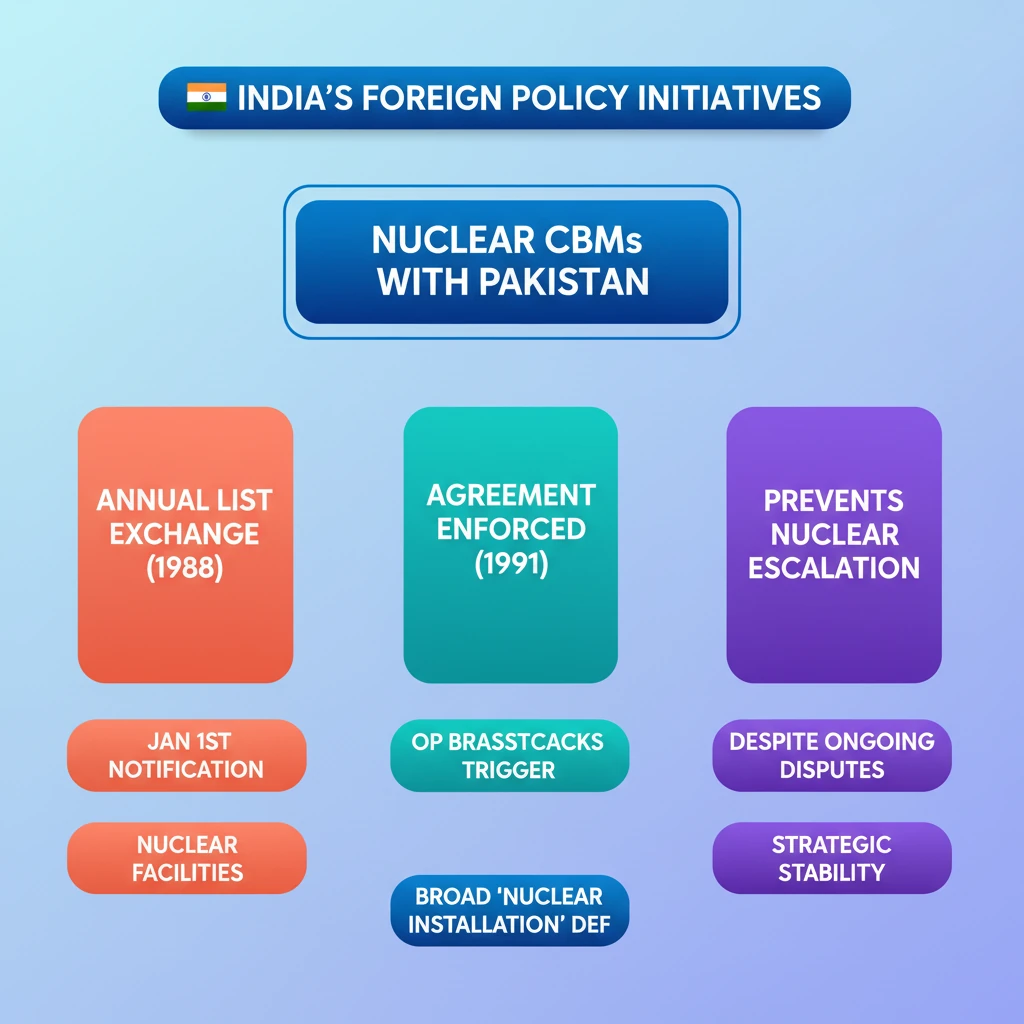
- •India and Pakistan annually exchange lists of nuclear installations under a 1988 agreement.
- •The agreement, in force since 1991, mandates informing each other about nuclear facilities on January 1st.
- •Operation Brasstacks (1986-87) was a key trigger for the negotiation of this confidence-building measure (CBM).
- •The agreement defines 'nuclear installation' broadly, covering reactors, fuel facilities, and radioactive material storage.
- •Despite ongoing disputes (Kashmir, terrorism, water, trade), this CBM remains a vital mechanism for strategic stability and preventing nuclear escalation.
🧠 Memory Techniques
95% Verified Content