What are the Other Development Partnerships of MEA? - International Relations | UPSC Learning
Topics
0 topics • 0 completed
🔍
No topics match your search

What are the Other Development Partnerships of MEA?
Medium⏱️ 8 min read
international relations
📖 Introduction
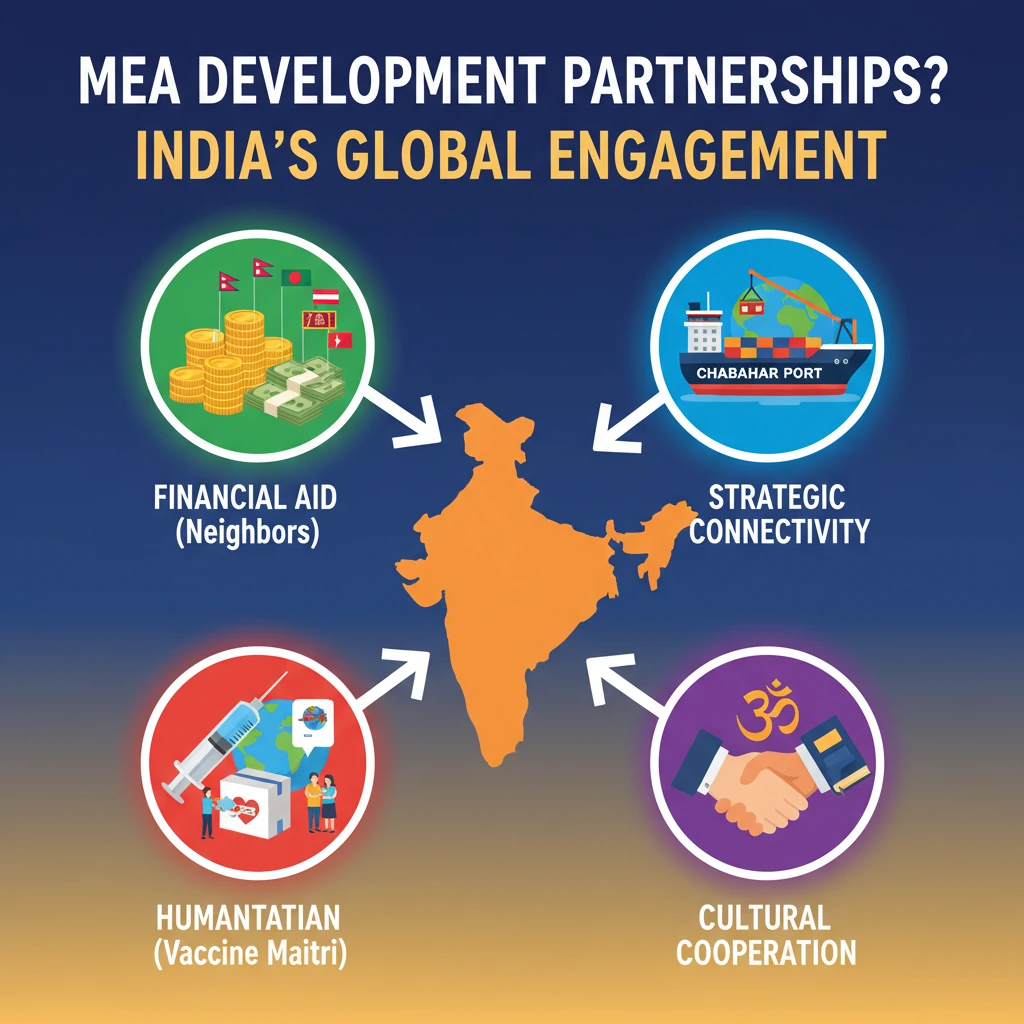
<h4>Understanding MEA's Development Partnerships</h4><p>The <strong>Ministry of External Affairs (MEA)</strong> plays a crucial role in extending <strong>development assistance</strong> to partner countries. These partnerships are a cornerstone of India's foreign policy, fostering goodwill, regional stability, and mutual growth.</p><div class='key-point-box'><p><strong>Key Objective:</strong> To strengthen bilateral relations, promote economic cooperation, and enhance India's soft power globally through tangible development projects and aid.</p></div><h4>Overview of Budgetary Allocations for Development Assistance</h4><p>India's commitment to its neighbors and other developing nations is reflected in its annual budgetary allocations for development aid. These funds support various projects, infrastructure development, and capacity building initiatives.</p><div class='info-box'><p><strong>Total Allocation (Latin America & Eurasia):</strong> <strong>Rs 1,883 crore</strong> has been allocated for development assistance to various countries in these regions.</p></div><h4>Country-Specific Development Aid Allocations</h4><p>The <strong>MEA's development partnerships</strong> include specific budgetary provisions for key strategic partners, reflecting India's "<strong>Neighborhood First Policy</strong>" and broader international commitments.</p><ul><li><p><strong>Maldives:</strong> Received <strong>Rs 600 crore</strong>, a decrease from the previous year's <strong>Rs 770 crore</strong>.</p></li><li><p><strong>Afghanistan:</strong> Allocated <strong>Rs 200 crore</strong>, underscoring India’s special relationship and continued support.</p></li><li><p><strong>Bangladesh:</strong> Provided <strong>Rs 120 crore</strong> in development aid.</p></li><li><p><strong>Nepal:</strong> Received a significant allocation of <strong>Rs 700 crore</strong>.</p></li><li><p><strong>Sri Lanka:</strong> Granted <strong>Rs 75 crore</strong> in development aid.</p></li><li><p><strong>Mauritius:</strong> Allocated <strong>Rs 170 crore</strong>.</p></li><li><p><strong>Myanmar:</strong> Pegged at <strong>Rs 250 crore</strong>.</p></li><li><p><strong>African Countries:</strong> A separate amount of <strong>Rs 200 crore</strong> has been set aside, emphasizing India's commitment to the African continent.</p></li></ul><h4>Strategic Connectivity Projects: Chabahar Port</h4><p>India's focus on enhancing regional connectivity is evident through its continued support for the <strong>Chabahar Port</strong> project in <strong>Iran</strong>. This port is vital for trade routes, especially for landlocked Afghanistan and Central Asian countries.</p><div class='info-box'><p><strong>Chabahar Port Allocation:</strong> Maintained at <strong>Rs 100 crore</strong>, highlighting India's sustained strategic interest in this crucial infrastructure.</p></div><h4>Humanitarian Assistance Initiatives</h4><p>Beyond financial aid, the <strong>MEA</strong> actively extends <strong>humanitarian assistance</strong> to partner countries during times of crisis. This includes responding to natural disasters, emergencies, and global health challenges.</p><ul><li><p><strong>Disaster Relief:</strong> India provides essential relief supplies, deploys medical teams, and offers financial assistance.</p></li><li><p><strong>Pandemic Response:</strong> During the <strong>Covid-19 pandemic</strong>, India supplied medicines, vaccines, and medical equipment to over <strong>150 countries</strong>, showcasing its role as a global responder.</p></li></ul><h4>Cultural and Heritage Cooperation</h4><p>The <strong>MEA</strong> also promotes <strong>cultural and heritage cooperation</strong>, strengthening people-to-people ties and preserving shared historical legacies. This aspect of development partnership enhances India's <strong>soft power</strong>.</p><div class='info-box'><p><strong>Completed Projects:</strong> Over <strong>50 cultural and heritage projects</strong> have been completed. Notable examples include the restoration of <strong>Ananda Temple</strong> and <strong>Shwedagon Pagoda</strong> in <strong>Myanmar</strong>, the <strong>Indian Gallery at Sacred Tooth Relic Temple</strong> in <strong>Kandy, Sri Lanka</strong>, and the construction of <strong>Dharamshala-Pashupatinath temple</strong> in <strong>Nepal</strong>.</p></div><p>Currently, approximately <strong>25 cultural and heritage projects</strong> are under implementation across various countries, demonstrating ongoing commitment.</p><div class='exam-tip-box'><p><strong>UPSC Insight:</strong> India's development partnerships are not just about financial aid but also encompass strategic connectivity, humanitarian outreach, and cultural diplomacy, reflecting a multi-faceted foreign policy approach. Be prepared to discuss these different dimensions in <strong>GS Paper 2 (International Relations)</strong>.</p></div>

💡 Key Takeaways
- •MEA's development partnerships are a cornerstone of India's foreign policy, encompassing financial aid, humanitarian assistance, and cultural cooperation.
- •Significant budgetary allocations are made to neighboring countries like Nepal, Maldives, Afghanistan, Bangladesh, Sri Lanka, Mauritius, and Myanmar.
- •Strategic projects like the Chabahar Port receive consistent funding, highlighting India's focus on regional connectivity.
- •India's humanitarian aid, exemplified by its COVID-19 response (Vaccine Maitri), showcases its role as a global first responder.
- •Cultural and heritage projects strengthen people-to-people ties and enhance India's soft power.
- •These partnerships are demand-driven and rooted in South-South Cooperation, aiming for mutual growth and regional stability.
🧠 Memory Techniques
95% Verified Content