Difference between ICC and ICJ - International Relations | UPSC Learning
Topics
0 topics • 0 completed
🔍
No topics match your search
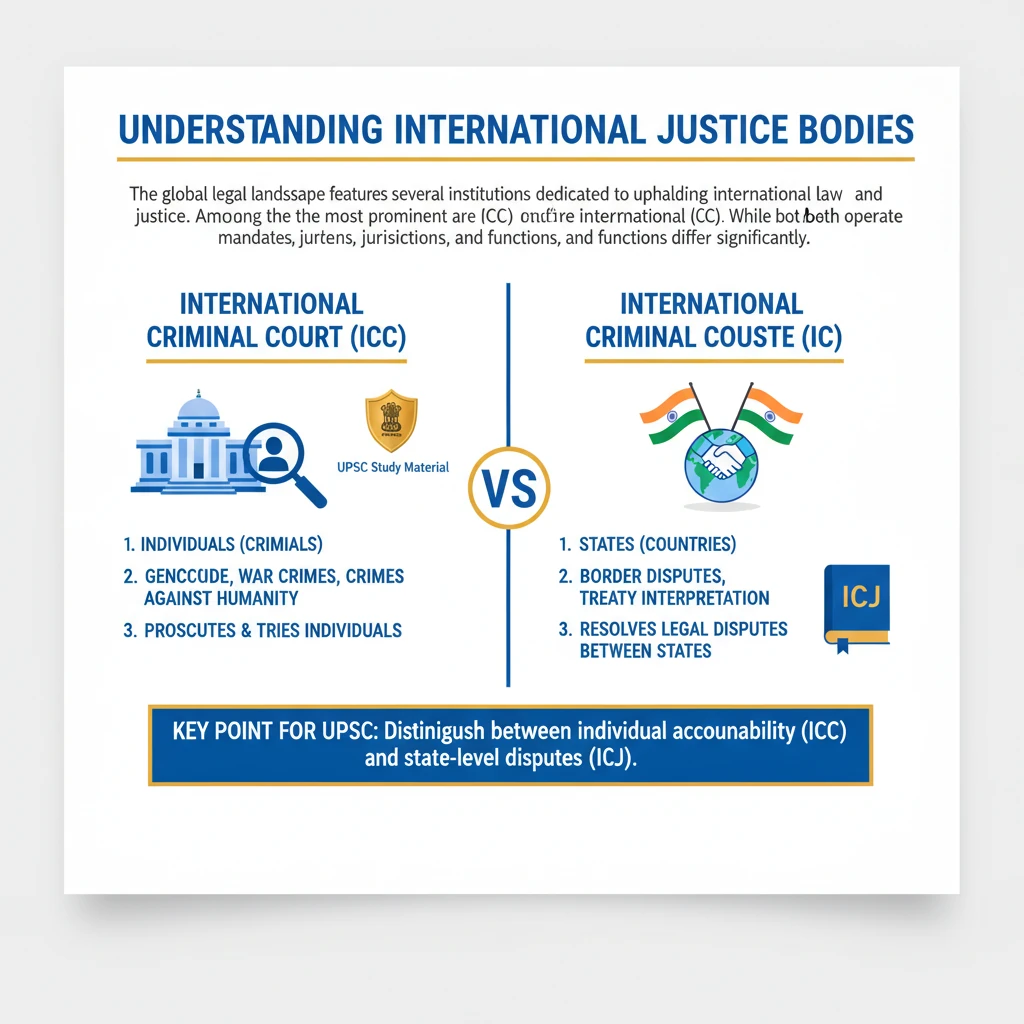
Difference between ICC and ICJ
Medium⏱️ 8 min read
international relations
📖 Introduction
<h4>Introduction to International Courts</h4><p>The global legal landscape features two prominent international judicial bodies: the <strong>International Court of Justice (ICJ)</strong> and the <strong>International Criminal Court (ICC)</strong>. While both are located in <strong>The Hague, the Netherlands</strong>, and deal with international law, their mandates, jurisdictions, and relationships with the <strong>United Nations</strong> are fundamentally distinct.</p><p>Understanding these differences is crucial for comprehending the architecture of international justice and accountability.</p><h4>International Court of Justice (ICJ)</h4><div class='info-box'><strong>Established:</strong> <strong>1945</strong><br><strong>UN Relationship:</strong> <strong>Highest judicial organ of the United Nations</strong><br><strong>Location:</strong> <strong>The Hague, the Netherlands</strong></div><p>The <strong>ICJ</strong> primarily resolves <strong>legal disputes between states</strong>. It also provides <strong>advisory opinions</strong> on legal questions referred to it by authorized <strong>UN</strong> organs and specialized agencies, clarifying complex international legal issues.</p><p>Its <strong>jurisdiction</strong> is limited to <strong>UN member-states</strong> that have consented to its authority. The <strong>ICJ</strong> does not prosecute individuals; its focus is solely on state-to-state matters.</p><div class='key-point-box'><strong>Enforcement:</strong> The <strong>ICJ</strong> possesses <strong>no direct enforcement power</strong>. It relies on the <strong>UN Security Council</strong> to uphold its judgments, where <strong>permanent members hold veto power</strong>, potentially hindering enforcement.</div><p>There is <strong>no appeal mechanism</strong> for <strong>ICJ</strong> judgments, making its decisions final and binding for the parties involved in a particular case.</p><h4>International Criminal Court (ICC)</h4><div class='info-box'><strong>Established:</strong> <strong>2002</strong><br><strong>UN Relationship:</strong> <strong>Not part of the United Nations system</strong><br><strong>Location:</strong> <strong>The Hague, the Netherlands</strong></div><p>The <strong>ICC</strong> was established by the <strong>Rome Statute</strong> to prosecute <strong>individuals</strong> for the most serious international crimes. These include <strong>genocide, crimes against humanity, war crimes, and the crime of aggression</strong>.</p><p>Its <strong>jurisdiction</strong> extends to individuals from states that are parties to the <strong>Rome Statute</strong>, or when a situation is referred by the <strong>UN Security Council</strong>, ensuring individual accountability.</p><div class='key-point-box'><strong>Enforcement:</strong> The <strong>ICC</strong> also lacks its own enforcement capabilities. It depends on the <strong>cooperation of member states</strong> to arrest suspects, gather evidence, and enforce sentences, which can be a significant challenge.</div><p>Unlike the <strong>ICJ</strong>, decisions of the <strong>ICC</strong> can be <strong>appealed</strong> within its own judicial structure, providing a mechanism for review of its judgments.</p><h4>Key Differentiators: A Comparative Overview</h4><table class='info-table'><tr><th>Feature</th><th>International Court of Justice (ICJ)</th><th>International Criminal Court (ICC)</th></tr><tr><td><strong>Established</strong></td><td><strong>1945</strong></td><td><strong>2002</strong></td></tr><tr><td><strong>UN Relationship</strong></td><td>Highest court of the <strong>UN</strong></td><td><strong>Not part of the UN</strong></td></tr><tr><td><strong>Jurisdiction</strong></td><td><strong>UN member-states</strong></td><td><strong>Individuals</strong></td></tr><tr><td><strong>Types of Cases</strong></td><td>Legal disputes between <strong>states</strong>, advisory opinions</td><td>Prosecutes <strong>individuals</strong> for serious international crimes (<strong>Rome Statute</strong>)</td></tr><tr><td><strong>Appeals</strong></td><td><strong>No</strong></td><td><strong>Yes</strong></td></tr><tr><td><strong>Enforcement</strong></td><td>Relies on <strong>UN Security Council</strong> (<strong>veto power</strong>)</td><td>Relies on <strong>member state cooperation</strong></td></tr></table><div class='exam-tip-box'>Understanding these distinctions is crucial for <strong>UPSC Mains GS-II International Relations</strong>. Questions often test the nuanced roles and limitations of international judicial bodies, requiring precise knowledge of their mandates.</div>
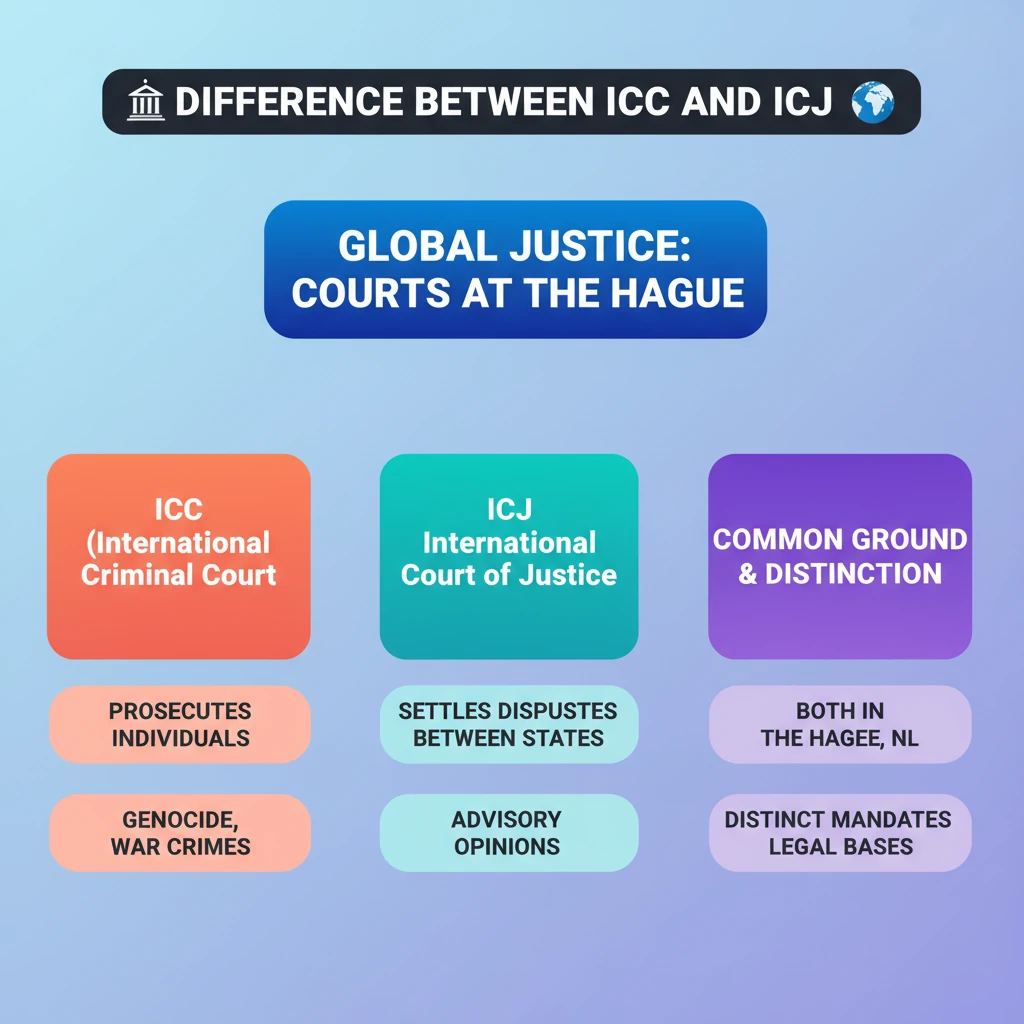
💡 Key Takeaways
- •ICJ resolves disputes between states; ICC prosecutes individuals for grave international crimes.
- •ICJ is a UN organ (established 1945); ICC is independent, established by the Rome Statute (entered into force 2002).
- •Both courts are located in The Hague, the Netherlands.
- •ICJ judgments are final with no appeal; ICC decisions can be appealed within its own structure.
- •Enforcement for both courts relies on external cooperation (UN Security Council for ICJ, member states for ICC).
🧠 Memory Techniques
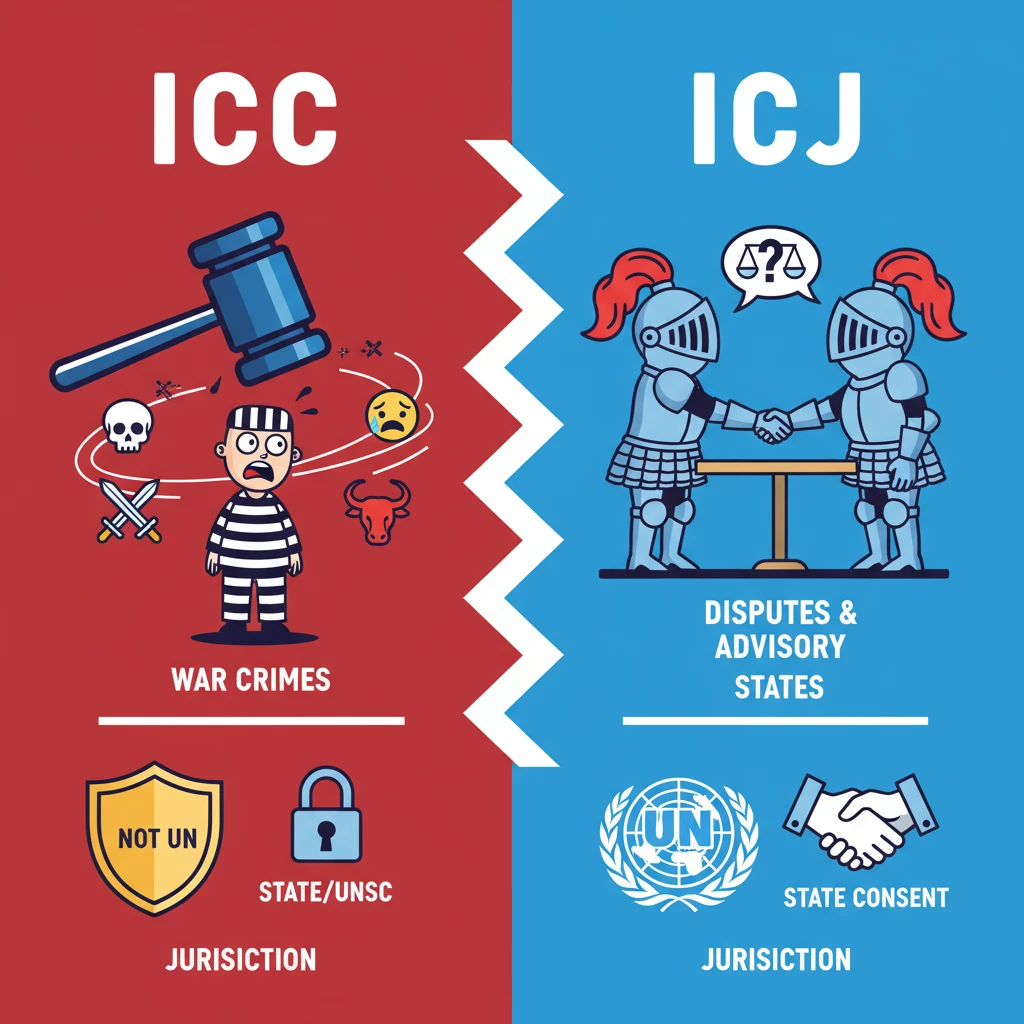
98% Verified Content