What are the Key Takeaways of Raisina Dialogue 2024? - International Relations | UPSC Learning
Topics
0 topics • 0 completed
🔍
No topics match your search
What are the Key Takeaways of Raisina Dialogue 2024?
Medium⏱️ 6 min read
international relations
📖 Introduction
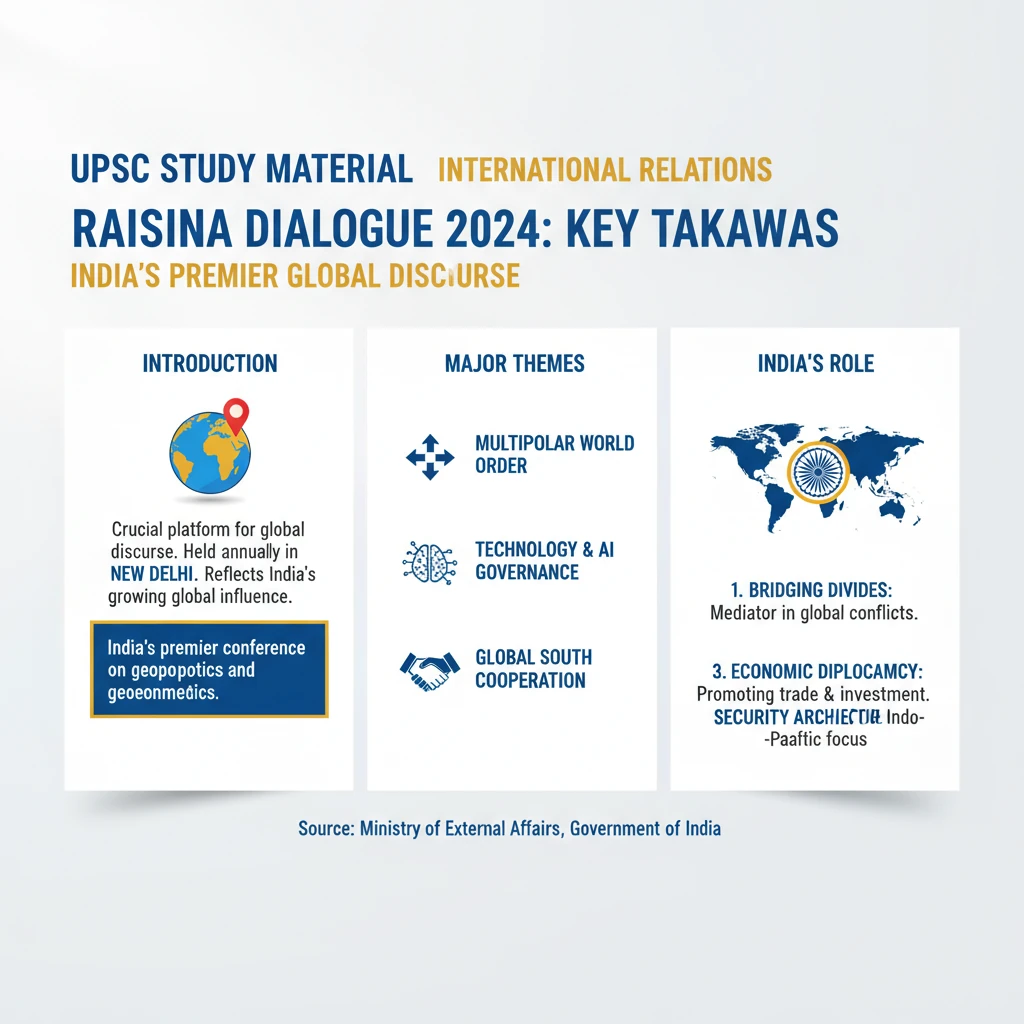
<h4>Introduction to Raisina Dialogue 2024</h4><p>The <strong>Raisina Dialogue 2024</strong> served as a crucial platform for global discourse, bringing together leaders, policymakers, and experts to discuss pressing geopolitical and geoeconomic issues. Held annually in <strong>New Delhi</strong>, it reflects India's growing influence in international relations.</p><div class='info-box'><p>The <strong>Raisina Dialogue</strong> is India's premier conference on geopolitics and geoeconomics, organized by the <strong>Observer Research Foundation (ORF)</strong> in partnership with the <strong>Ministry of External Affairs (MEA)</strong>.</p></div><h4>India's Role as a Bridging Power</h4><p>India's External Affairs Minister articulated India's position as a <strong>"bridging power"</strong>. This signifies the nation's intent to seek common ground and foster cooperation amidst global divisions.</p><p>This role is underpinned by a <strong>"multi-vector policy"</strong>, indicating India's strategy of engaging with multiple global partners without exclusive alignment, thereby positioning itself as a <strong>"vishwamitra"</strong> or a friend to the world.</p><div class='key-point-box'><p><strong>Key Concept:</strong> A <strong>"bridging power"</strong> aims to connect disparate blocs and facilitate dialogue, rather than aligning strictly with one side, promoting stability and multilateralism.</p></div><h4>Baltic-Nordic Forum Outreach</h4><p>A significant diplomatic achievement was the substantial presence of ministerial contingents from <strong>Central and Eastern Europe</strong>, specifically including all Ministers from the <strong>Baltic-Nordic Forum</strong>.</p><p>This outreach created new avenues for the Indian government to establish stronger <strong>trade agreements</strong> and <strong>investment ties</strong> with this economically competitive, yet often overlooked, part of Europe.</p><div class='info-box'><p>The <strong>Baltic-Nordic Forum</strong> comprises countries like <strong>Estonia, Latvia, Lithuania</strong> (Baltic States) and <strong>Denmark, Finland, Iceland, Norway, Sweden</strong> (Nordic Countries), known for innovation and strong economies.</p></div><h4>Focus on Global Conflicts</h4><p>A dominant theme of the dialogue was the discussion around ongoing <strong>global conflicts</strong>. The strong European presence naturally directed significant attention towards the <strong>Russian war in Ukraine</strong>.</p><p>European Ministers actively urged <strong>India</strong> to reassess its trade and ties with <strong>Russia</strong> and to advocate for <strong>Ukraine's sovereignty</strong>, particularly ahead of the second anniversary of the invasion.</p><p>They also extended an invitation for <strong>India</strong> to participate in a forthcoming <strong>"Peace Conference"</strong> in <strong>Switzerland</strong>, initiated at the request of <strong>Ukraine President Volodymyr Zelensky</strong>.</p><p>Discussions on military and naval strategy also concentrated on the imperative to manage an increasingly assertive <strong>China</strong>, including deliberations on <strong>"grey warfare"</strong> tactics.</p><div class='key-point-box'><p><strong>"Grey warfare"</strong> refers to aggressive actions below the threshold of conventional armed conflict, often involving cyberattacks, economic coercion, and propaganda.</p></div><div class='exam-tip-box'><p>UPSC aspirants should note India's delicate balancing act between its strategic partnership with Russia and its growing ties with Western nations, especially concerning the <strong>Ukraine conflict</strong> and <strong>China's assertiveness</strong>.</p></div><h4>Regional Security Concerns</h4><p>The conference also extensively addressed various <strong>regional security concerns</strong> across critical geopolitical zones. This included ongoing tensions in the <strong>Indo-Pacific</strong>, the volatile <strong>Middle East</strong>, and <strong>Eastern Europe</strong>.</p><p>Participants engaged in dialogues concerning effective <strong>conflict resolution strategies</strong>, fostering sustainable <strong>peace-building efforts</strong>, and managing complex <strong>regional rivalries</strong> to ensure stability.</p></div><h4>Technology and Innovation in Geopolitics</h4><p>A crucial underlying theme was the transformative influence of <strong>technology and innovation</strong> on the global geopolitical landscape and the future of <strong>global governance</strong>.</p><p>Discussions likely explored how advancements in areas like AI, cybersecurity, and space technology are reshaping power dynamics and international cooperation frameworks.</p>
💡 Key Takeaways
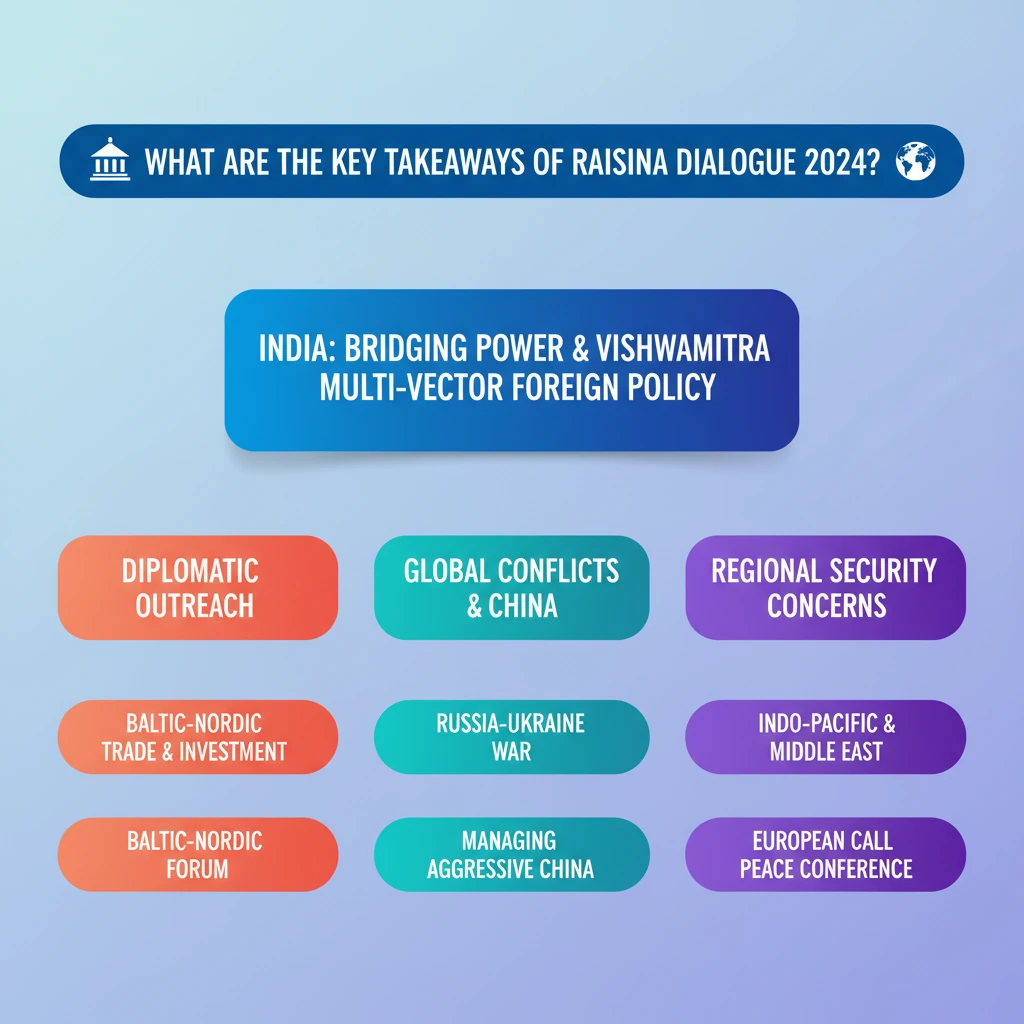
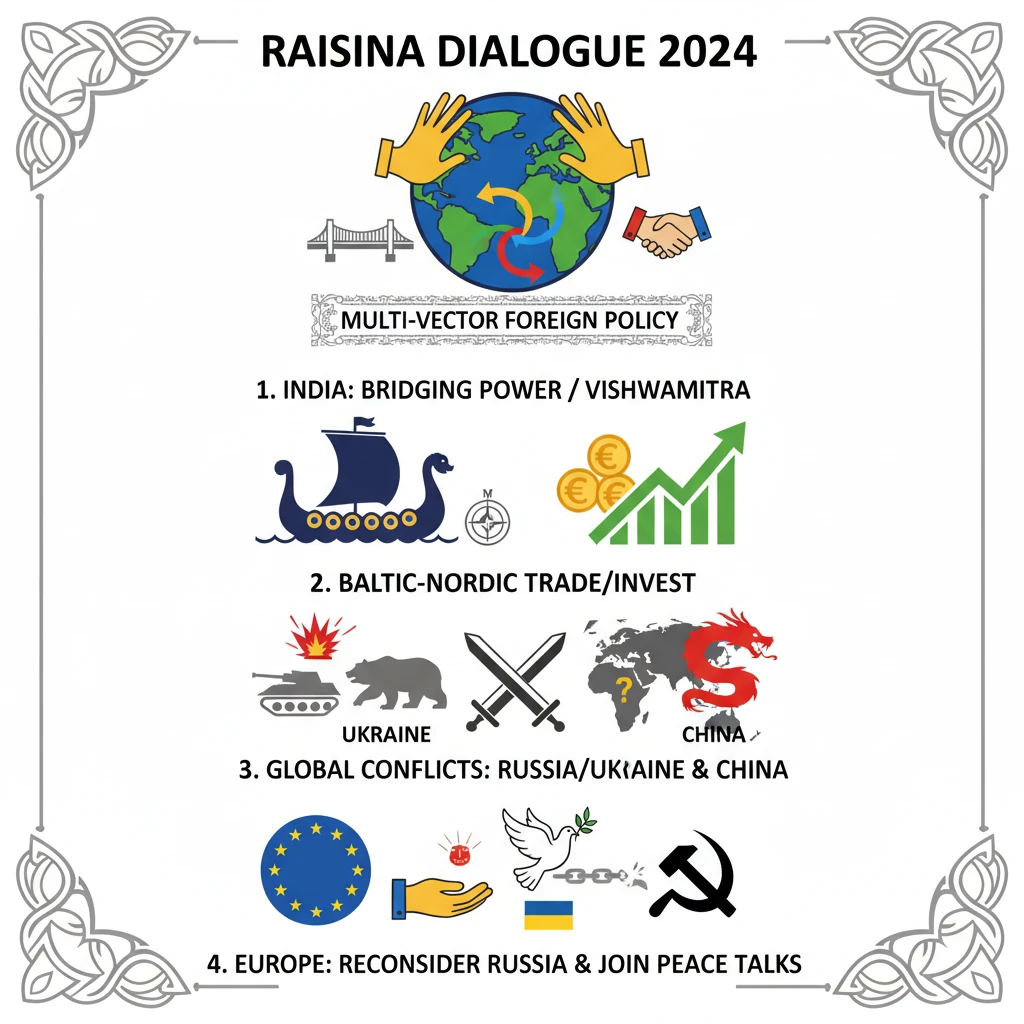
- •India positioned itself as a 'bridging power' and 'vishwamitra' through a 'multi-vector' foreign policy.
- •Significant diplomatic outreach to the Baltic-Nordic Forum aimed at strengthening trade and investment ties.
- •Discussions heavily focused on global conflicts, particularly the Russian war in Ukraine and managing an aggressive China.
- •European nations urged India to reconsider ties with Russia and join a Ukraine-requested 'Peace Conference'.
- •Regional security concerns across Indo-Pacific, Middle East, and Eastern Europe were extensively addressed.
- •Technology and innovation were recognized as key shapers of geopolitics and global governance.
🧠 Memory Techniques
95% Verified Content