How are the New Members Elected to the UNSC? - International Relations | UPSC Learning
Topics
0 topics • 0 completed
🔍
No topics match your search
How are the New Members Elected to the UNSC?
Medium⏱️ 6 min read
international relations
📖 Introduction
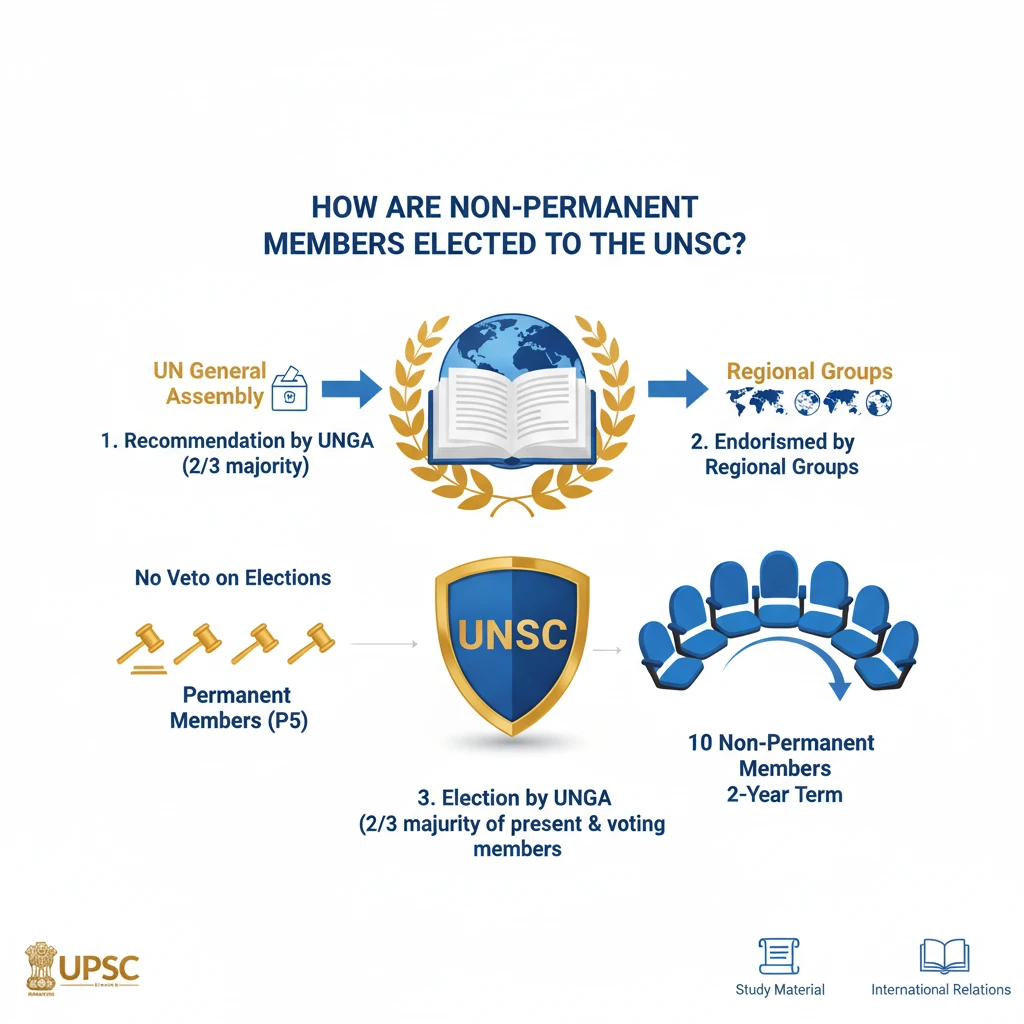
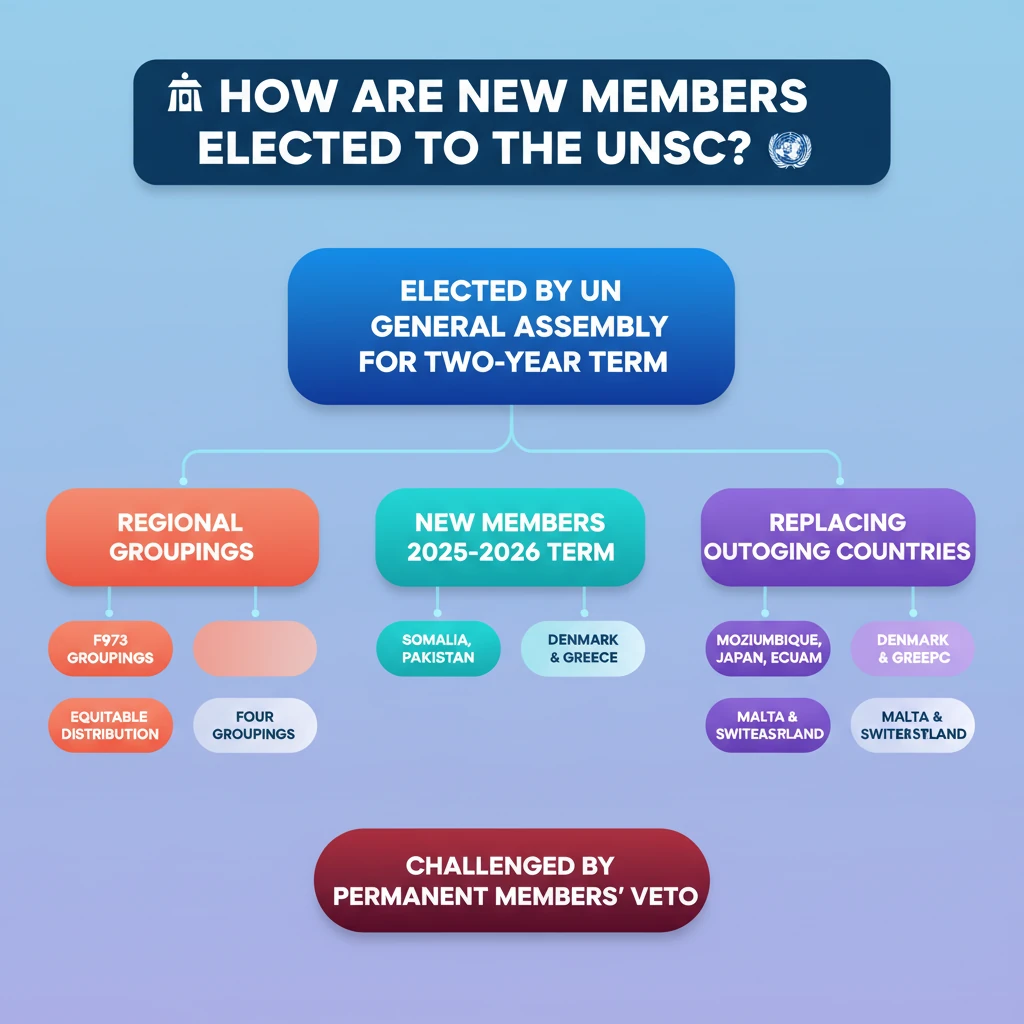
<h4>The UN Security Council: An Overview</h4><p>The <strong>United Nations Security Council (UNSC)</strong> holds a critical mandate in maintaining <strong>international peace and security</strong>. It is one of the six principal organs of the United Nations, tasked with addressing global threats and conflicts.</p><div class='key-point-box'><p>The <strong>UNSC</strong> is the only UN body with the authority to issue legally binding resolutions on member states, making its composition and election process highly significant.</p></div><h4>The Election Process for Non-Permanent Members</h4><p>The election of <strong>non-permanent members</strong> to the <strong>UNSC</strong> is a structured process involving <strong>regional groupings</strong>. These groups play a crucial role in nominating candidates for the available seats.</p><p>There are <strong>four main regional groups</strong> through which member states are nominated. This system ensures a degree of geographical representation within the Council.</p><h4>Regional Groupings and Recent Elections</h4><p>Each regional group typically agrees upon candidates to present to the <strong>UN General Assembly</strong>. These candidates are then elected for a <strong>two-year term</strong>, ensuring a rotation of representation.</p><div class='info-box'><p><strong>Newly Elected Non-Permanent Members (2025-2026 Term):</strong></p><ul><li><strong>African Group:</strong> <strong>Somalia</strong></li><li><strong>Asia-Pacific Group:</strong> <strong>Pakistan</strong></li><li><strong>Latin America and Caribbean Group:</strong> <strong>Panama</strong></li><li><strong>Western European and Others Group:</strong> <strong>Denmark</strong> and <strong>Greece</strong></li></ul></div><p>These newly elected members are set to replace countries whose terms are concluding. This rotation is fundamental to the Council's structure and function.</p><div class='info-box'><p><strong>Outgoing Non-Permanent Members:</strong></p><ul><li><strong>Mozambique</strong></li><li><strong>Japan</strong></li><li><strong>Ecuador</strong></li><li><strong>Malta</strong></li><li><strong>Switzerland</strong></li></ul></div><h4>Ensuring Regional Representation and Global Diversity</h4><p>The election process is specifically designed to ensure <strong>regional representation</strong> within the <strong>Security Council</strong>. This reflects the global geopolitical diversity and the varied interests of member states.</p><p>By having members from different regions, the UNSC aims to gather a broader perspective on international issues, potentially leading to more balanced and effective resolutions.</p><h4>Challenges to UNSC Effectiveness</h4><p>Despite its critical role, the effectiveness of the <strong>UN Security Council</strong> can be significantly hindered. A primary challenge is the <strong>veto power</strong> held by its <strong>five permanent members</strong>.</p><div class='exam-tip-box'><p>Understanding the <strong>veto power</strong> and its impact on UNSC decision-making is crucial for UPSC exams, particularly for questions on UN reforms and international relations dynamics.</p></div>
💡 Key Takeaways
- •UNSC non-permanent members are elected by the UN General Assembly for a two-year term.
- •The election process is guided by four regional groupings to ensure equitable geographical distribution.
- •Newly elected members for the 2025-2026 term include Somalia, Pakistan, Panama, Denmark, and Greece.
- •These new members replace outgoing countries like Mozambique, Japan, Ecuador, Malta, and Switzerland.
- •The UNSC's effectiveness is often challenged by the veto power of its five permanent members.
- •The election process underscores the ongoing debate and need for UN Security Council reforms.
🧠 Memory Techniques
98% Verified Content
📚 Reference Sources
•United Nations Official Website (for UNSC structure and election process)