What is the Significance of ASEAN for India and Japan? - International Relations | UPSC Learning
Topics
0 topics • 0 completed
🔍
No topics match your search

What is the Significance of ASEAN for India and Japan?
Medium⏱️ 6 min read
international relations
📖 Introduction
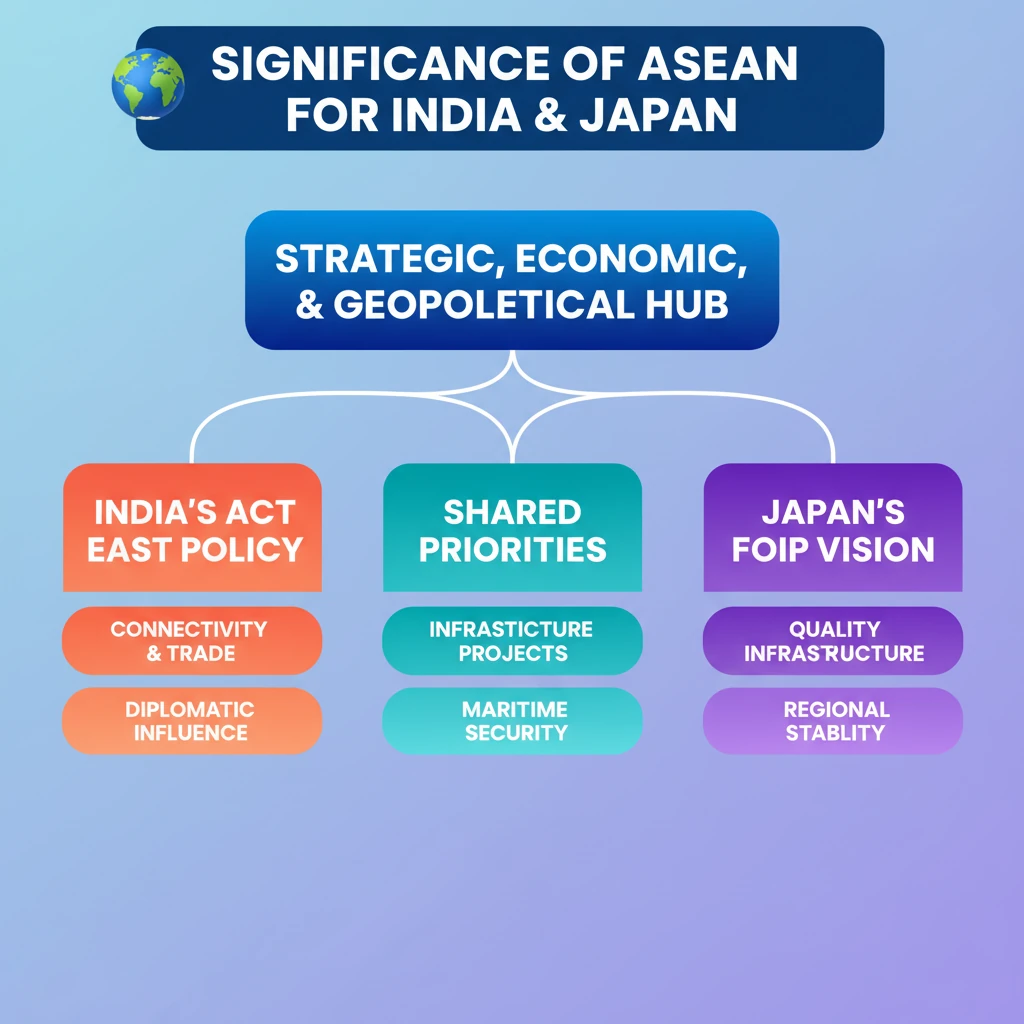
<h4>Introduction: ASEAN's Central Role</h4><p>The <strong>Association of Southeast Asian Nations (ASEAN)</strong> holds profound significance for both <strong>India</strong> and <strong>Japan</strong>. Its importance stems from its strategic, economic, and geopolitical position within the broader <strong>Indo-Pacific</strong> region.</p><div class='key-point-box'><p><strong>ASEAN</strong> acts as a crucial bridge, connecting South Asia with East Asia and serving as a hub for regional cooperation and stability.</p></div><h4>Significance for India: Pillar of Act East Policy</h4><p>For <strong>India</strong>, <strong>ASEAN</strong> is a vital component of its <strong>Act East Policy</strong>. This policy aims to strengthen India's engagement with Southeast Asian nations across various dimensions.</p><p>The relationship focuses on enhancing <strong>trade relations</strong>, improving <strong>regional connectivity</strong>, and boosting India's <strong>diplomatic influence</strong> in the dynamic <strong>Indo-Pacific</strong>.</p><p><strong>India</strong> actively participates in numerous <strong>infrastructure projects</strong> within <strong>ASEAN</strong> countries. These initiatives are designed to improve physical and digital linkages, facilitating greater economic integration.</p><p>Furthermore, <strong>economic agreements</strong> are regularly pursued to deepen commercial ties. A key objective is also to ensure <strong>maritime security</strong> in the critical sea lanes that traverse the <strong>ASEAN</strong> region, which are vital for global trade.</p><h4>Significance for Japan: Strategic Partner in Indo-Pacific</h4><p>For <strong>Japan</strong>, <strong>ASEAN</strong> is equally critical for its strategic vision of a <strong>Free and Open Indo-Pacific (FOIP)</strong>. Japan views <strong>ASEAN</strong> as a key partner in maintaining regional stability and economic prosperity.</p><p><strong>Japan</strong> has historically been a major investor and development partner for <strong>ASEAN</strong> nations. Its engagement often focuses on high-quality <strong>infrastructure development</strong> and strengthening supply chains.</p><p>Cooperation with <strong>ASEAN</strong> is essential for <strong>Japan's energy security</strong> and the protection of vital sea lanes. It also helps counter-balance other rising powers in the region, promoting a rules-based order.</p><div class='exam-tip-box'><p>Understanding the dual significance for both <strong>India</strong> and <strong>Japan</strong> allows for a more comprehensive analysis of <strong>Indo-Pacific geopolitics</strong> in <strong>UPSC Mains GS Paper 2</strong>.</p></div>
💡 Key Takeaways
- •ASEAN is strategically, economically, and geopolitically vital for both India and Japan.
- •For India, ASEAN is the core of its Act East Policy, focusing on connectivity, trade, and diplomatic influence.
- •For Japan, ASEAN is central to its Free and Open Indo-Pacific (FOIP) vision, emphasizing quality infrastructure and regional stability.
- •Both nations engage in infrastructure projects, economic agreements, and security cooperation with ASEAN.
- •Maritime security in critical sea lanes is a shared priority for India, Japan, and ASEAN.
🧠 Memory Techniques

95% Verified Content
📚 Reference Sources
•Ministry of External Affairs, Government of India (Act East Policy documents)
•ASEAN Official Website (Founding, objectives, member states)
•Japan Ministry of Foreign Affairs (FOIP strategy, ASEAN engagement)