19th NAM Summit and India-Uganda Relations - International Relations | UPSC Learning
Topics
0 topics • 0 completed
🔍
No topics match your search
19th NAM Summit and India-Uganda Relations
Medium⏱️ 8 min read
international relations
📖 Introduction
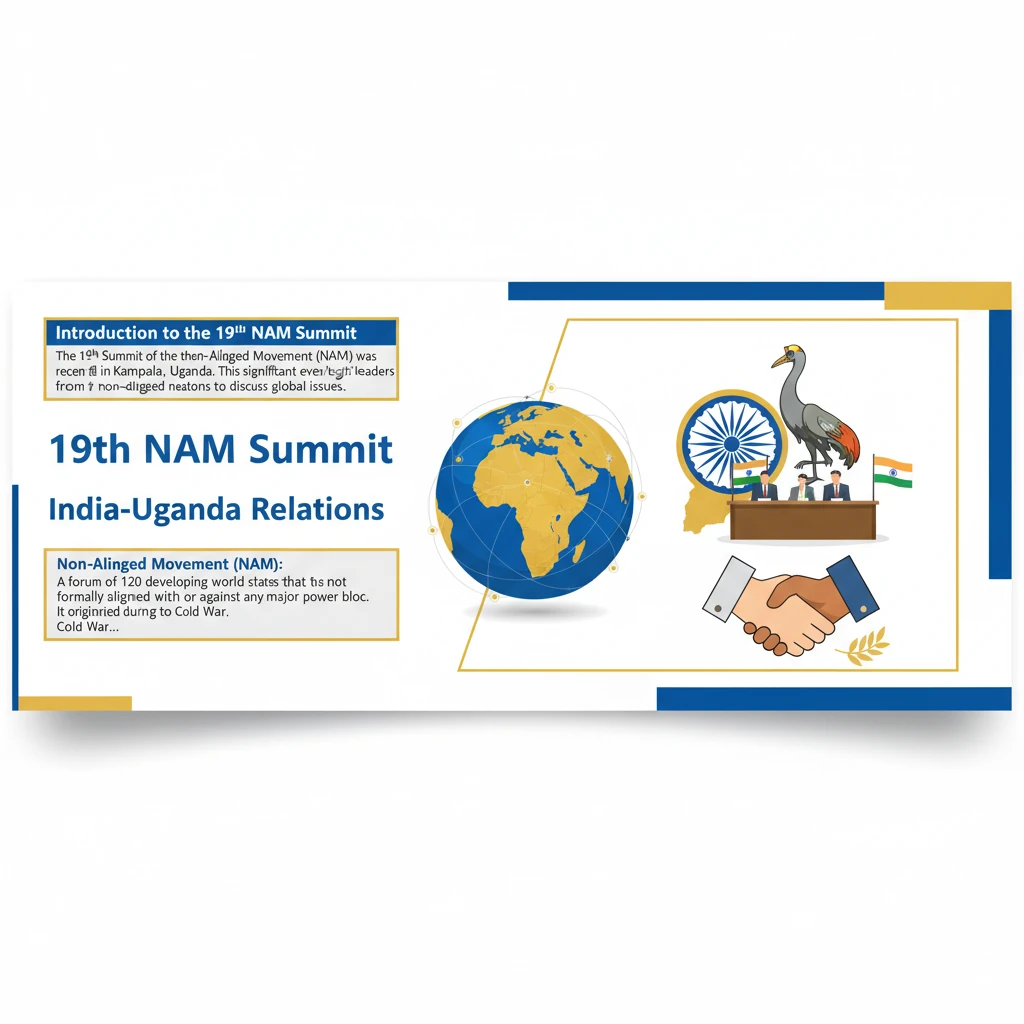
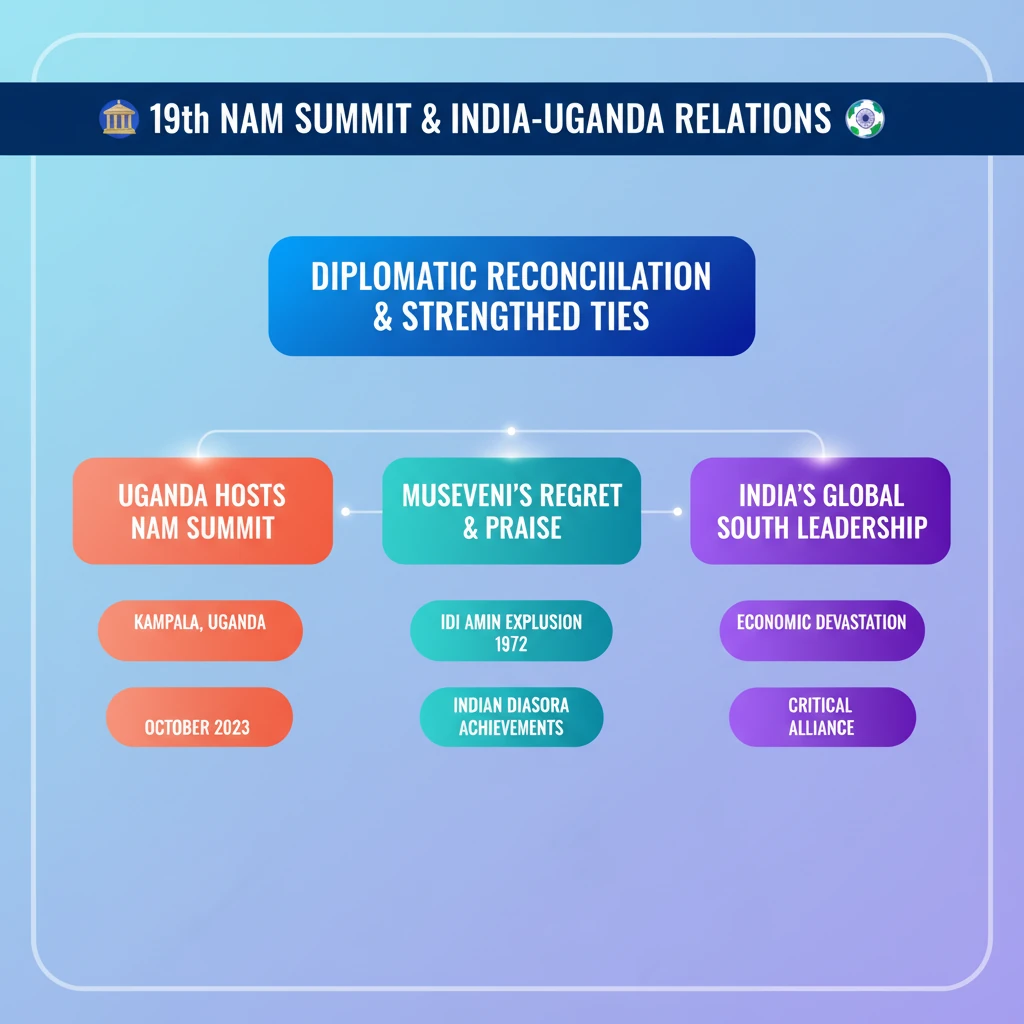
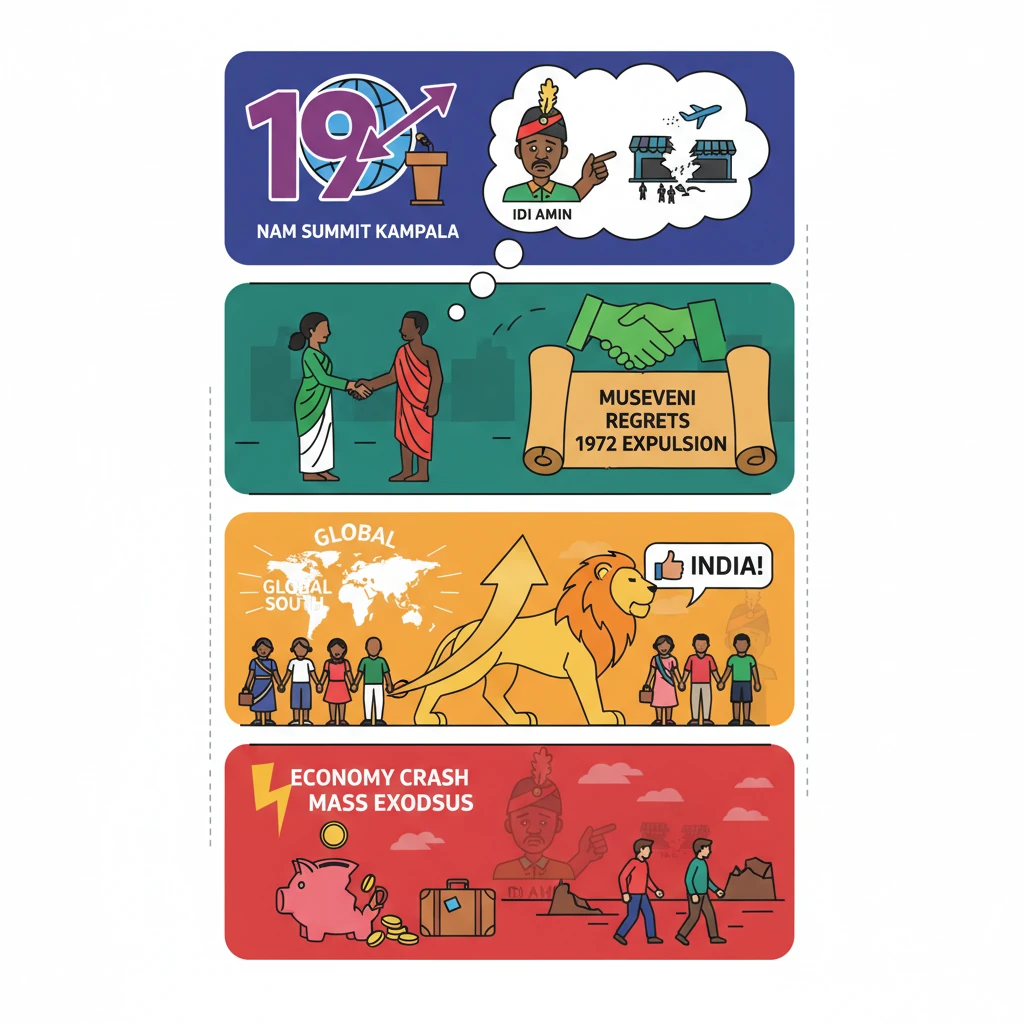
<h4>Context of the 19th NAM Summit</h4><p>The <strong>19th Summit</strong> of the <strong>Non-Aligned Movement (NAM)</strong> was recently held in <strong>Kampala, Uganda</strong>. This event brought significant attention to <strong>India-Uganda relations</strong>, particularly a historical incident.</p><p>During the summit, <strong>Ugandan President Yoweri Museveni</strong> expressed regret over the <strong>expulsion of Indians</strong> by former dictator <strong>Idi Amin</strong> in the <strong>1970s</strong>. He acknowledged the positive contributions of the <strong>Indian diaspora</strong> in Uganda and commended <strong>India's leadership</strong> in the <strong>Global South</strong>.</p><div class='info-box'><p><strong>Idi Amin's Expulsion Order:</strong> In <strong>August 1972</strong>, <strong>Idi Amin</strong>, then dictator of <strong>Uganda</strong>, ordered the expulsion of approximately <strong>80,000 Indians and other Asians</strong>. This drastic measure had a devastating impact on the <strong>Ugandan economy</strong>, as these communities were central to the country's commerce and industry.</p></div><h4>Key Outcomes of the 19th NAM Summit</h4><p>The <strong>19th NAM Summit</strong> was themed <strong>“Deepening Cooperation for Shared Global Affluence”</strong>. <strong>Uganda</strong> assumed the chairmanship of <strong>NAM</strong> from <strong>Azerbaijan</strong>, a role it will hold until <strong>2027</strong>.</p><p>A significant outcome was the adoption of the <strong>Kampala Declaration</strong>. This declaration strongly condemned <strong>Israeli military aggression</strong> and called for the immediate implementation of the <strong>UN Security Council resolution</strong>. The resolution aims to facilitate humanitarian aid into the besieged <strong>Gaza Strip</strong>.</p><p><strong>India's External Affairs Minister (EAM)</strong> led the Indian delegation. He advocated for a <strong>sustainable solution</strong> to the <strong>Gaza crisis</strong>, emphasizing the urgent need for <strong>humanitarian relief</strong>. The EAM also urged the international community to prevent the conflict's spread across the wider <strong>West Asia region</strong>.</p><h4>The Non-Aligned Movement: Foundation and Principles</h4><p>The <strong>Non-Aligned Movement</strong> was formally founded in <strong>September 1961</strong> at the <strong>First Summit Conference of Belgrade</strong>. This followed six years after the preparatory <strong>Bandung Conference</strong>.</p><div class='key-point-box'><p><strong>Founding Leaders:</strong> NAM was established under the visionary leadership of five key figures:</p><ul><li><strong>Josip Broz Tito</strong> of <strong>Yugoslavia</strong></li><li><strong>Gamal Abdel Nasser</strong> of <strong>Egypt</strong></li><li><strong>Jawaharlal Nehru</strong> of <strong>India</strong></li><li><strong>Kwame Nkrumah</strong> of <strong>Ghana</strong></li><li><strong>Sukarno</strong> of <strong>Indonesia</strong></li></ul></div><p>The movement emerged during the intense geopolitical climate of the <strong>Cold War</strong>. Its primary objective was to create an organization of states that would not formally align with either the <strong>United States</strong> or the <strong>Soviet Union</strong>. Instead, these states sought to maintain their <strong>independence</strong> and <strong>neutrality</strong> in global affairs.</p><p><strong>NAM</strong> operates without a permanent secretariat or a formal founding charter, act, or treaty. Its summits are typically held every <strong>three years</strong> to discuss and coordinate member states' positions on global issues.</p><h4>Evolution of India-Uganda Relations</h4><p><strong>India</strong> and <strong>Uganda</strong> share a deep historical relationship spanning over a century. The initial influx of <strong>Indians</strong> to <strong>Uganda</strong> began at the start of the <strong>20th century</strong>.</p><p><strong>India's freedom struggle</strong> served as a significant inspiration for early <strong>Ugandan activists</strong> in their fight against colonization. This shared history culminated in <strong>Uganda</strong> achieving its independence in <strong>1962</strong>.</p><p><strong>India</strong> officially established its diplomatic presence in <strong>Uganda</strong> in <strong>1965</strong>, solidifying the bilateral ties between the two nations.</p>
💡 Key Takeaways
- •The 19th NAM Summit in Kampala, Uganda, saw President Museveni regret Idi Amin's expulsion of Indians.
- •The summit adopted the Kampala Declaration, condemning Israeli aggression and calling for Gaza aid.
- •India's EAM advocated for a sustainable solution and humanitarian relief in Gaza.
- •NAM was founded in 1961 by leaders like Nehru, Tito, Nasser, Nkrumah, and Sukarno during the Cold War.
- •NAM aims for states to remain independent and neutral, without aligning with major power blocs.
- •India and Uganda share historical ties, with India's freedom struggle inspiring Uganda's independence.
🧠 Memory Techniques
95% Verified Content
📚 Reference Sources
•General knowledge on Non-Aligned Movement (NAM) and India-Uganda relations