Vijayanagara Empire: Cultural and Architectural Flourishing Under Krishna Deva Raya - History | UPSC Learning
Topics
0 topics • 0 completed
🔍
No topics match your search
Vijayanagara Empire: Cultural and Architectural Flourishing Under Krishna Deva Raya
Medium⏱️ 8 min read
history
📖 Introduction
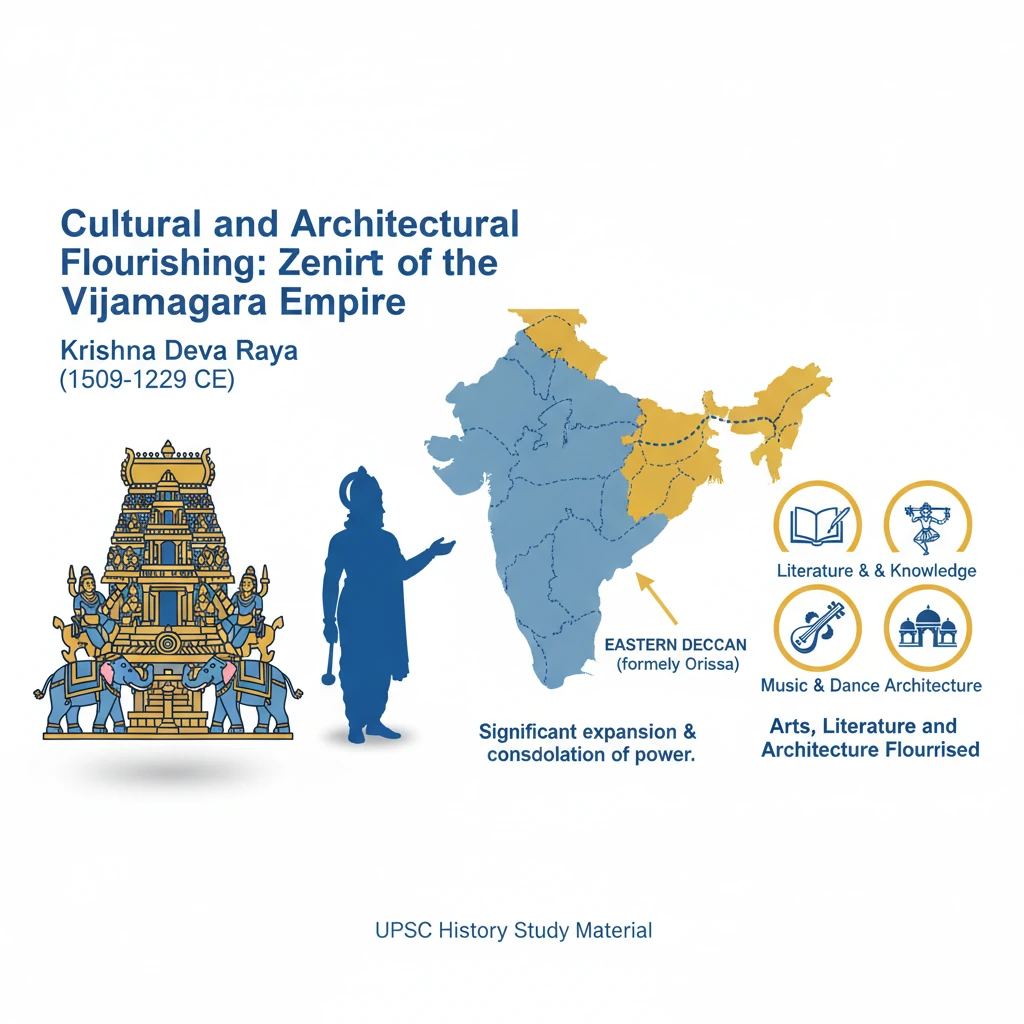
<h4>Zenith of the Vijayanagara Empire</h4><p>The <strong>Vijayanagara Empire</strong> is widely considered to have reached its peak during the reign of <strong>Krishna Deva Raya</strong>. His period marked a significant expansion and consolidation of the empire's power and influence.</p><p>Under his leadership, the empire extended its control over territories located to the <strong>east of the Deccan region</strong>. These areas had previously been under the dominion of <strong>Orissa</strong>, indicating a successful military and strategic expansion.</p><div class='key-point-box'><p><strong>Krishna Deva Raya's</strong> reign (<strong>1509-1529 CE</strong>) is often cited as the <strong>golden age</strong> of the Vijayanagara Empire, characterized by both military prowess and cultural achievements.</p></div><h4>Architectural Masterpieces of the Era</h4><p>Many of the most celebrated monuments of the <strong>Vijayanagara Empire</strong> were constructed during <strong>Krishna Deva Raya's</strong> rule. These structures stand as testaments to the empire's architectural grandeur and artistic skill.</p><p>Notable temples dating back to his time include the exquisite <strong>Hazara Rama Temple</strong>, the dedicated <strong>Krishna Temple</strong>, and the magnificent <strong>Vitthala Temple</strong>. Each showcases unique design elements and intricate craftsmanship.</p><div class='info-box'><p>The <strong>Vitthala Temple</strong> is particularly renowned for its <strong>musical pillars</strong> and the iconic <strong>Stone Chariot</strong>, a symbol of Hampi's architectural brilliance.</p></div><h4>Broader Imperial Patronage</h4><p>Beyond <strong>Krishna Deva Raya's</strong> specific contributions, <strong>Vijayanagara rulers</strong> in general were fervent patrons of temple construction. They actively encouraged the building of grand religious edifices across their domain.</p><p>Temples like the ancient <strong>Virupaksha Temple</strong> and the sprawling <strong>Vitthala Temple Complex</strong> exemplify this widespread patronage. These structures are celebrated for their elaborate carvings and breathtaking architectural designs, reflecting a distinct style.</p><div class='exam-tip-box'><p>For <strong>UPSC Mains GS1 (Art & Culture)</strong>, understanding the specific features of <strong>Vijayanagara architecture</strong>, such as the <strong>Kalyana Mandapa</strong> and <strong>gopurams</strong>, along with key examples, is crucial. Highlight the role of royal patronage.</p></div>
💡 Key Takeaways
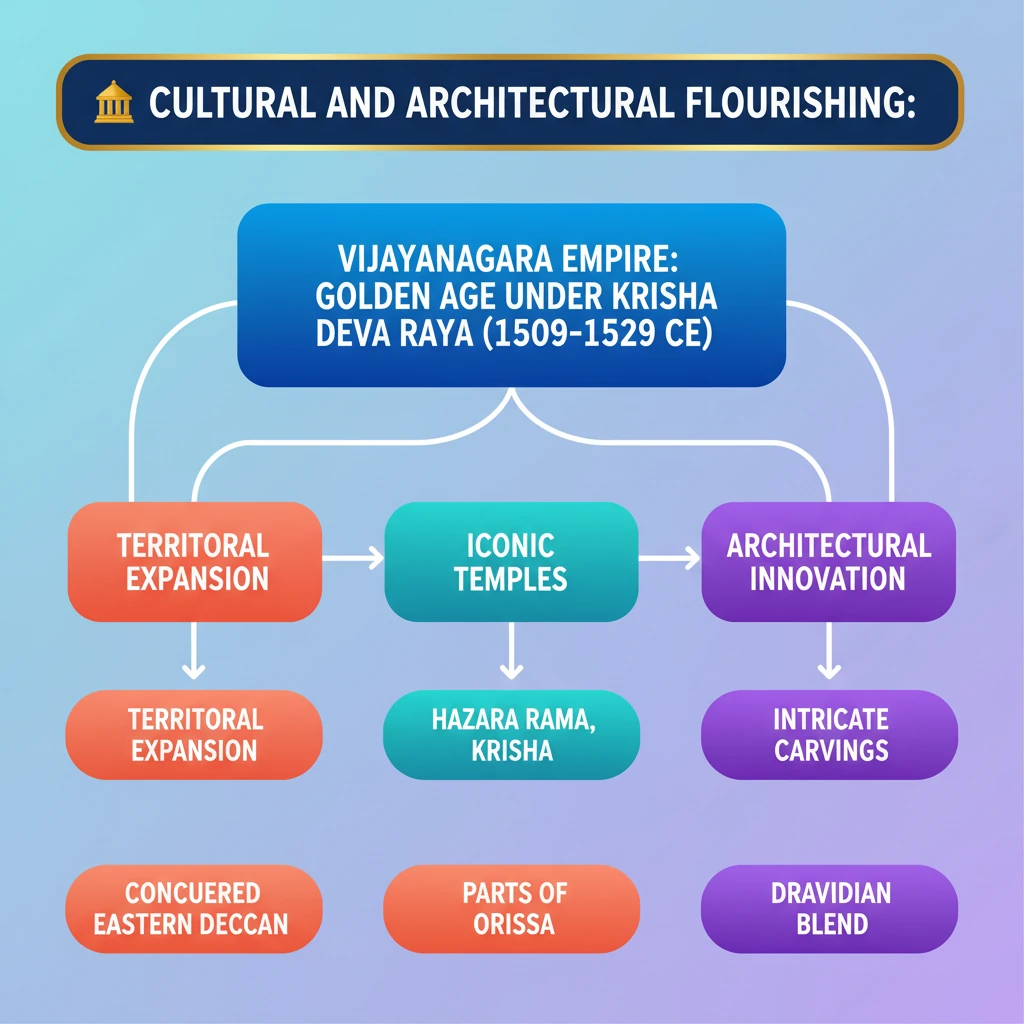
- •The Vijayanagara Empire reached its zenith under Krishna Deva Raya (1509-1529 CE).
- •Krishna Deva Raya conquered territories east of the Deccan, formerly part of Orissa.
- •Many iconic temples like Hazara Rama, Krishna, and Vitthala Temples date to his reign.
- •Vijayanagara rulers extensively promoted grand temple construction, exemplified by Virupaksha and Vitthala Temples.
- •Vijayanagara architecture is known for intricate carvings and stunning designs, a blend of Dravidian traditions and unique innovations.
🧠 Memory Techniques

98% Verified Content
📚 Reference Sources
•NCERT Class XI: An Introduction to Indian Art, Part I
•NCERT Class XII: Themes in Indian History, Part II
•Upinder Singh, A History of Ancient and Early Medieval India: From the Stone Age to the 12th Century (for broader context of South Indian history)