Hampi Stone Chariot: History, Significance, and Krishnadevaraya's Role - History | UPSC Learning
Topics
0 topics • 0 completed
🔍
No topics match your search
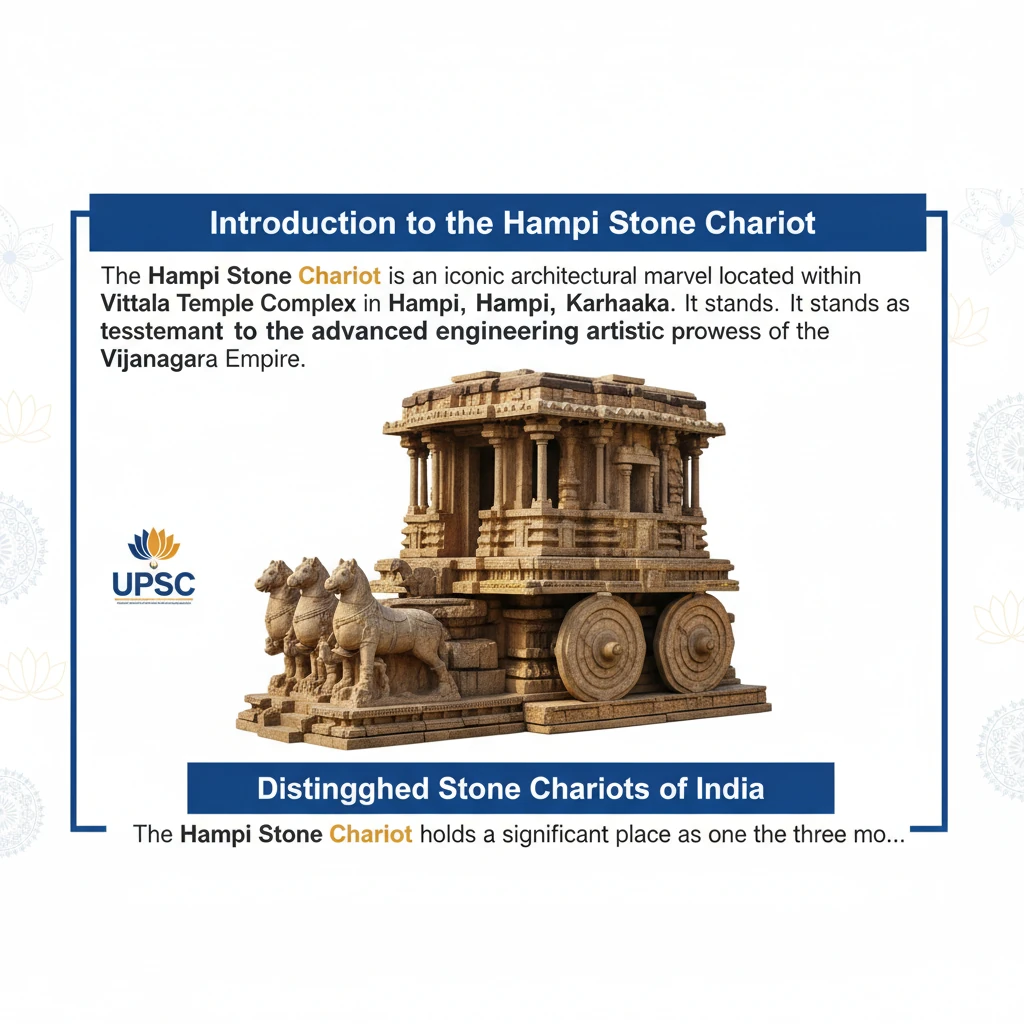
Hampi Stone Chariot: History, Significance, and Krishnadevaraya's Role
Medium⏱️ 7 min read
history
📖 Introduction
<h4>Introduction to the Hampi Stone Chariot</h4><p>The <strong>Hampi Stone Chariot</strong> is an iconic architectural marvel located within the <strong>Vittala Temple Complex</strong> in <strong>Hampi</strong>, <strong>Karnataka</strong>. It stands as a testament to the advanced engineering and artistic prowess of the <strong>Vijayanagara Empire</strong>.</p><h4>Distinguished Stone Chariots of India</h4><p>The <strong>Hampi Stone Chariot</strong> holds a significant place as one of the three most renowned <strong>stone chariots</strong> found across <strong>India</strong>. These structures are celebrated for their intricate carvings and architectural grandeur.</p><div class='info-box'><ul><li><strong>Hampi Stone Chariot</strong>: Located in <strong>Hampi</strong>, <strong>Karnataka</strong>.</li><li><strong>Konark Sun Temple Chariot</strong>: Situated in <strong>Konark</strong>, <strong>Odisha</strong>.</li><li><strong>Mahabalipuram Rathas</strong>: Found in <strong>Mahabalipuram</strong>, <strong>Tamil Nadu</strong>.</li></ul></div><h4>Construction and Patronage</h4><p>This magnificent chariot was constructed during the <strong>16th century</strong>, a period marking the zenith of the <strong>Vijayanagara Empire's</strong> power and cultural flourishing. Its creation was commissioned by a prominent ruler of the dynasty.</p><div class='info-box'><p><strong>Builder</strong>: <strong>King Krishnadevaraya</strong></p><p><strong>Dynasty</strong>: <strong>Vijayanagara Empire</strong></p><p><strong>Period</strong>: <strong>16th century</strong></p></div><h4>Religious Significance and Dedication</h4><p>Beyond its architectural brilliance, the <strong>Hampi Stone Chariot</strong> serves a profound religious purpose. It is essentially a shrine, embodying the spiritual beliefs of the era.</p><div class='key-point-box'><p>The chariot is dedicated to <strong>Garuda</strong>, the mythical bird and the official vehicle (<strong>vahana</strong>) of <strong>Lord Vishnu</strong>. This dedication underscores its role within the larger <strong>Vittala Temple</strong> complex, which is dedicated to <strong>Lord Vishnu</strong>.</p></div><div class='exam-tip-box'><p>For <strong>UPSC Prelims</strong>, remember the <strong>three famous stone chariots</strong> and their locations. For <strong>Mains</strong>, discuss the architectural significance and religious symbolism of such structures under <strong>Vijayanagara art and architecture</strong>.</p></div>
💡 Key Takeaways
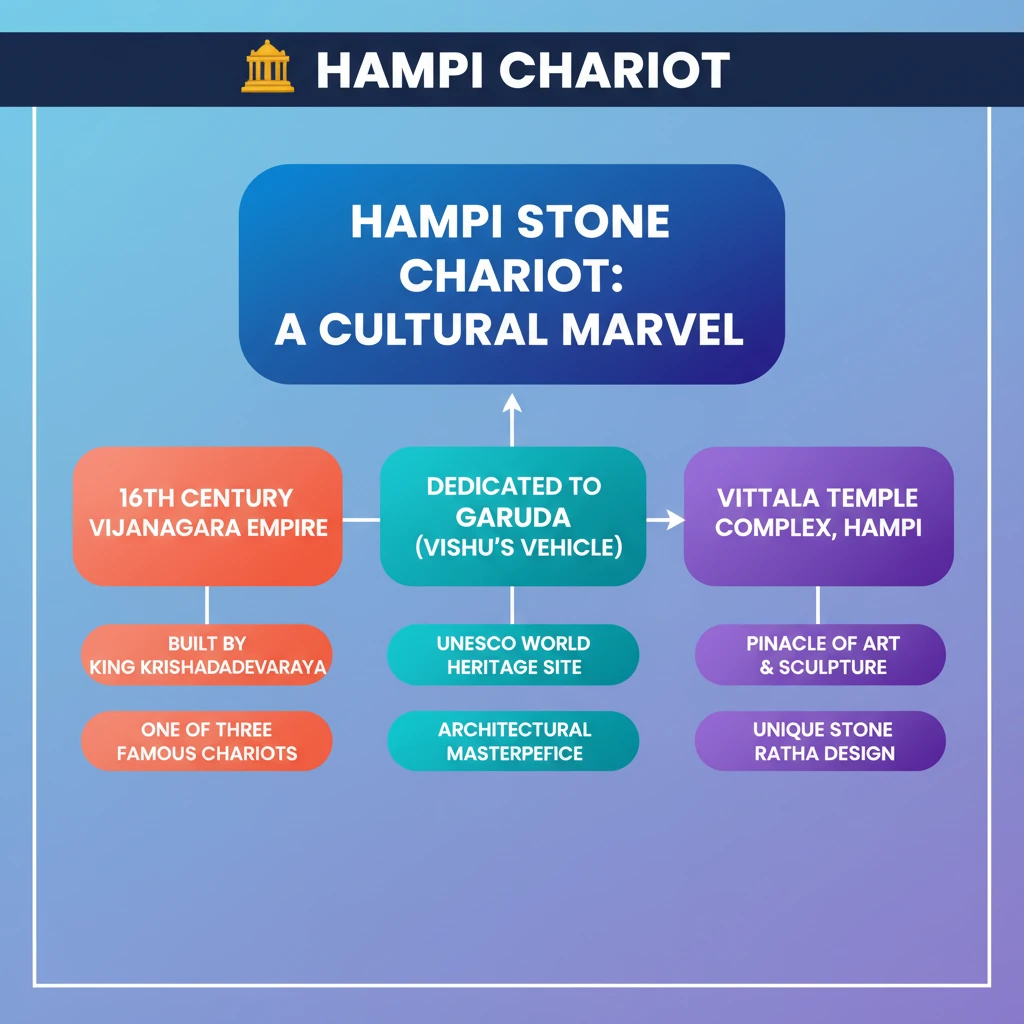
- •Hampi Chariot is one of three famous stone chariots in India (others: Konark, Mahabalipuram).
- •Built in the 16th century by King Krishnadevaraya of the Vijayanagara Empire.
- •It is a shrine dedicated to Garuda, the vehicle of Lord Vishnu.
- •Located within the Vittala Temple Complex, Hampi, a UNESCO World Heritage Site.
- •Represents the pinnacle of Vijayanagara architectural and sculptural art.
🧠 Memory Techniques
95% Verified Content
📚 Reference Sources
•NCERT Textbooks (Art & Culture)
•Archaeological Survey of India (ASI) official website
•UNESCO World Heritage Centre