What was Raja Rammohan Roy’s Role in Abolition of Sati? - History | UPSC Learning
Topics
0 topics • 0 completed
🔍
No topics match your search
What was Raja Rammohan Roy’s Role in Abolition of Sati?
Medium⏱️ 8 min read
history
📖 Introduction
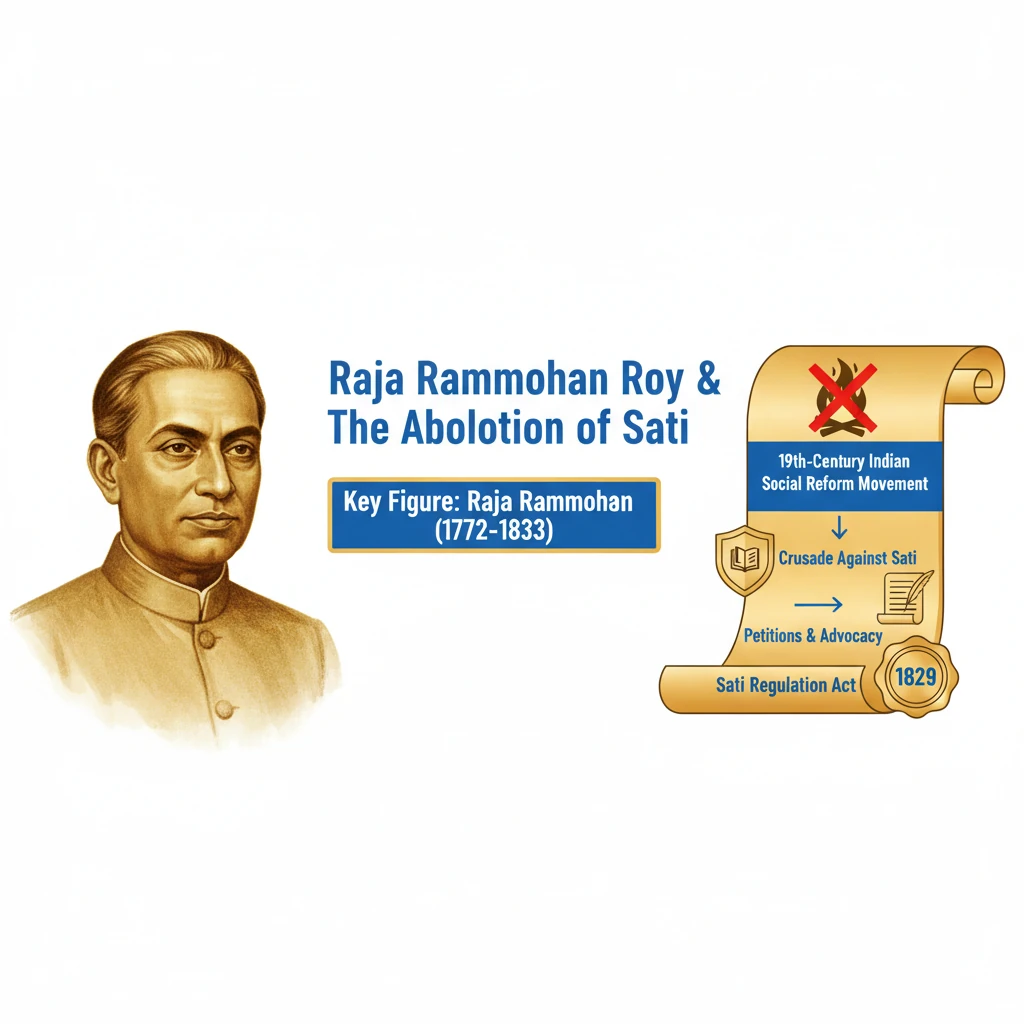
<h4>Introduction to Raja Rammohan Roy and Social Reform</h4><p><strong>Raja Rammohan Roy</strong> stands as a pivotal figure in the <strong>19th-century Indian social reform movement</strong>. He is widely recognized for his unwavering commitment to eradicating the abhorrent practice of <strong>Sati</strong>, a custom where a widow immolated herself on her husband's funeral pyre.</p><div class='key-point-box'><p><strong>Key Figure:</strong> <strong>Raja Rammohan Roy</strong> (1772-1833)</p><p><strong>Primary Focus:</strong> Abolition of <strong>Sati</strong></p><p><strong>Era:</strong> <strong>19th Century India</strong></p></div><h4>Launch of the Anti-Sati Campaign</h4><p><strong>Rammohan Roy</strong> initiated his vigorous campaign against <strong>Sati</strong> in <strong>1818</strong>. His activism was fundamentally driven by a deep conviction that the practice was not only morally reprehensible but also ethically unjustifiable.</p><p>He believed that <strong>Sati</strong> represented a profound violation of human dignity and societal values, compelling him to challenge deeply entrenched traditions.</p><h4>Strategies Employed in the Movement</h4><p><strong>Raja Rammohan Roy</strong> employed a multi-faceted approach to combat <strong>Sati</strong>, leveraging both scriptural interpretations and appeals to universal human values.</p><ul><li><strong>Use of Sacred Texts:</strong> He meticulously cited various <strong>Hindu sacred texts</strong> to demonstrate that no religious scripture actually sanctioned or mandated the burning alive of widows. This approach aimed to counter arguments from orthodox sections of society.</li><li><strong>Rationality and Humanity:</strong> Beyond scriptural arguments, <strong>Roy</strong> appealed to broader concepts of <strong>humanity</strong>, <strong>reason</strong>, and <strong>compassion</strong>. This allowed him to engage a wider audience, including both religious scholars and secular thinkers, in his crusade.</li><li><strong>Grassroots Activism:</strong> His efforts were not confined to intellectual debates. <strong>Rammohan Roy</strong> actively engaged in <strong>grassroots activism</strong>, visiting cremation grounds, organizing vigilance groups to prevent Sati, and filing counter-petitions to the government to advocate for its abolition.</li></ul><h4>Culmination: The Bengal Sati Regulation, 1829</h4><p>The relentless and tireless efforts of <strong>Raja Rammohan Roy</strong> ultimately bore fruit. His sustained campaign significantly influenced the colonial administration.</p><div class='info-box'><p><strong>Landmark Legislation:</strong> <strong>Bengal Sati Regulation, 1829</strong></p><p><strong>Date:</strong> <strong>December 4, 1829</strong></p><p><strong>Impact:</strong> Declared the practice of <strong>Sati</strong> a <strong>crime</strong> throughout the <strong>Bengal Presidency</strong>.</p></div><p>This landmark legislation marked a crucial victory for social reform in India, largely attributable to <strong>Roy's</strong> pioneering advocacy.</p>
💡 Key Takeaways
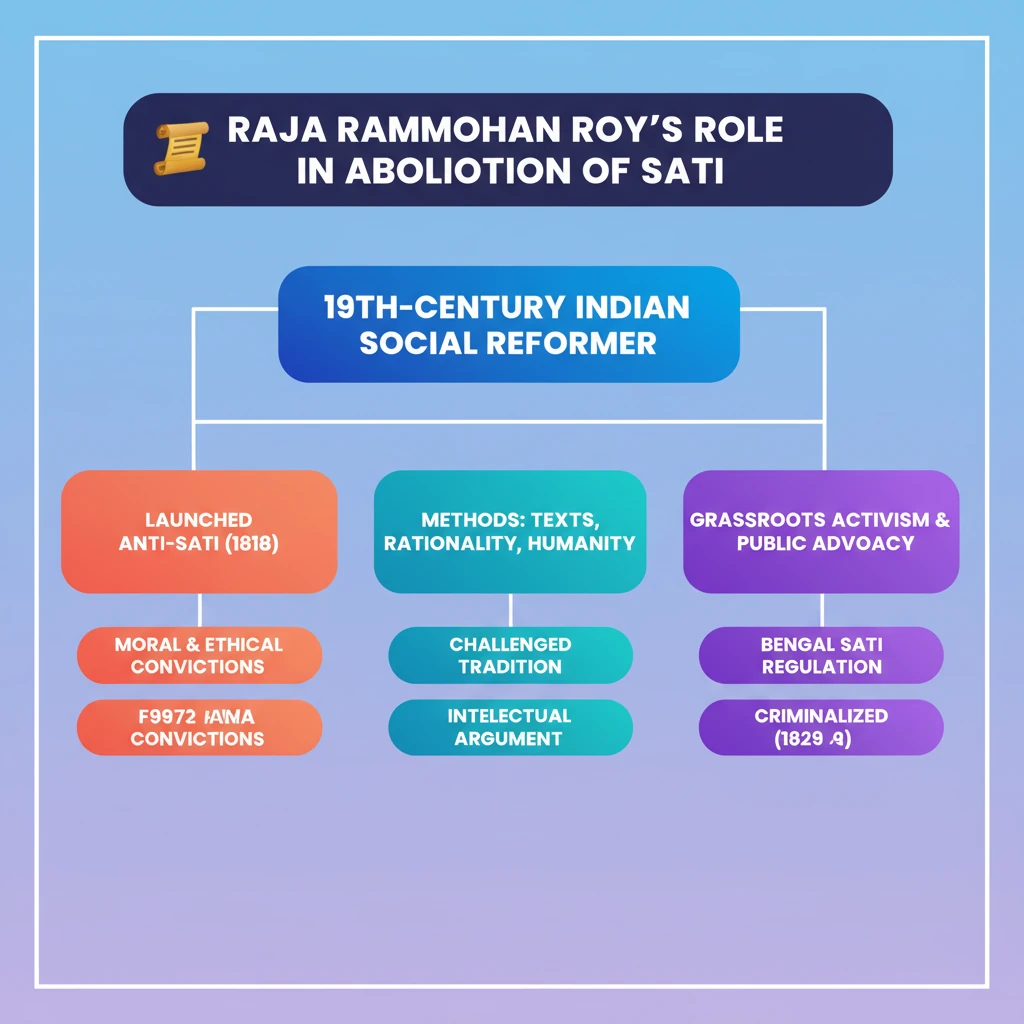
- •Raja Rammohan Roy was a key figure in the 19th-century Indian social reform movement.
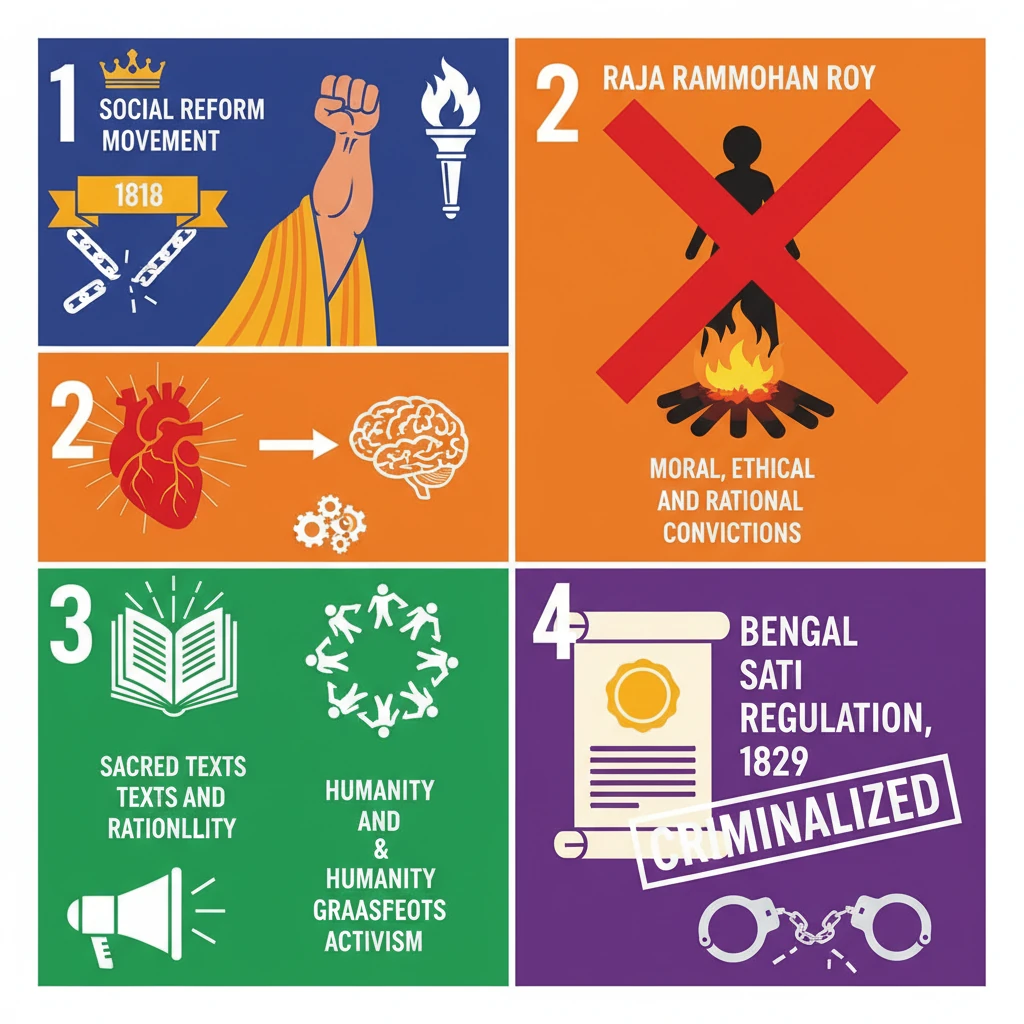
- •He launched his anti-Sati campaign in 1818, driven by moral and ethical convictions.
- •Roy used sacred texts, rationality, humanity, and grassroots activism to challenge Sati.
- •His tireless efforts led to the Bengal Sati Regulation, 1829, which criminalized the practice.
- •His work exemplifies the power of reform through intellectual argument, public advocacy, and direct action.
🧠 Memory Techniques
98% Verified Content
📚 Reference Sources
•NCERT Textbooks (History - Class VIII, XII)
•Standard Modern Indian History Texts (e.g., Bipan Chandra, Spectrum)