What is the History and Revival Efforts of Nalanda University? - History | UPSC Learning
Topics
0 topics • 0 completed
🔍
No topics match your search
What is the History and Revival Efforts of Nalanda University?
Medium⏱️ 5 min read
history
📖 Introduction
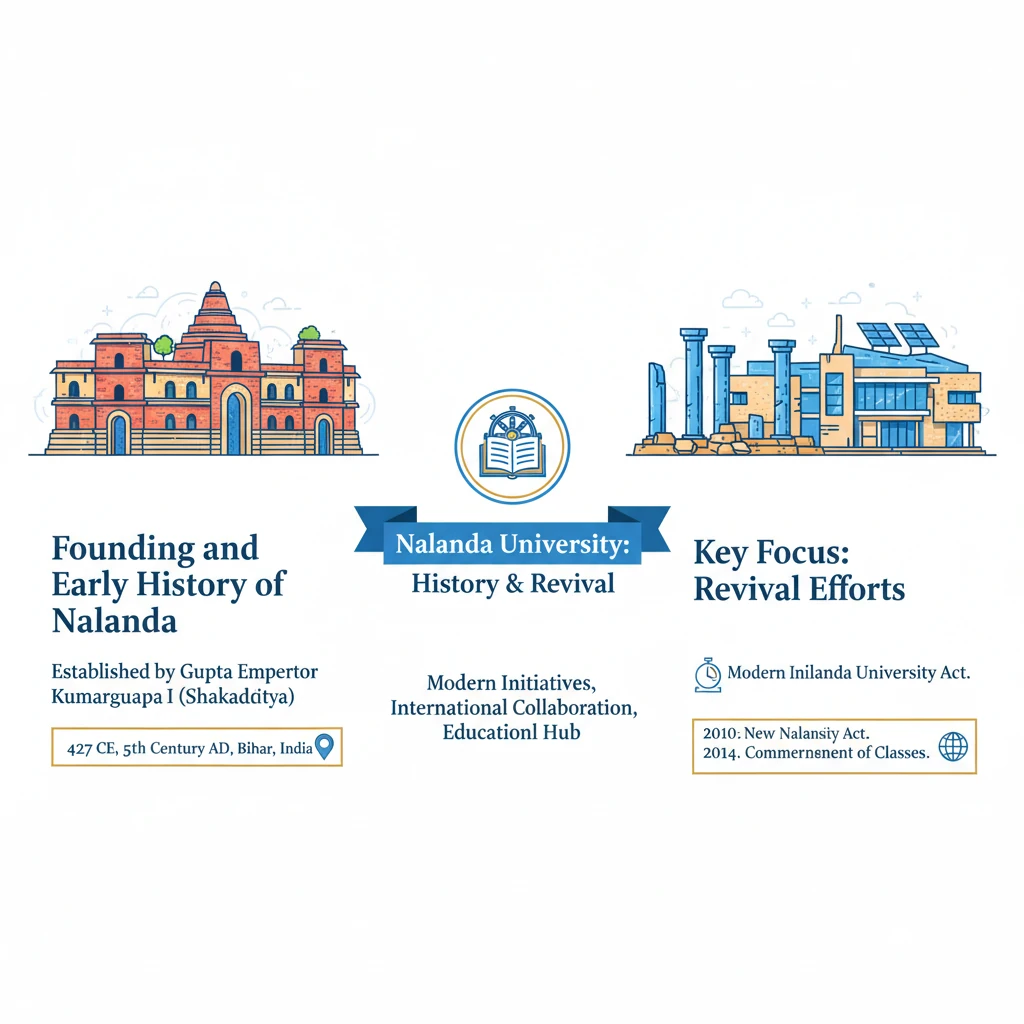
<h4>Founding and Early History of Nalanda</h4><p>The illustrious <strong>Nalanda University</strong> was established by <strong>Gupta Emperor Kumaragupta I</strong>, also known as <strong>Shakraditya</strong>, of the <strong>Gupta dynasty</strong>.</p><p>Its foundation dates back to <strong>427 CE</strong>, placing its origins in the early <strong>5th century AD</strong>. The university was situated in what is now modern <strong>Bihar, India</strong>.</p><div class='info-box'> <p><strong>Key Founding Details:</strong></p> <ul> <li><strong>Founder:</strong> Emperor <strong>Kumaragupta I (Shakraditya)</strong></li> <li><strong>Dynasty:</strong> <strong>Gupta Empire</strong></li> <li><strong>Founding Year:</strong> <strong>427 CE</strong> (early 5th century)</li> <li><strong>Location:</strong> Present-day <strong>Bihar</strong></li> <li><strong>Period of Flourishing:</strong> Approximately <strong>600 years</strong>, lasting until the <strong>12th century</strong>.</li> </ul></div><h4>Golden Age and Royal Patronage</h4><p>Nalanda's prominence significantly grew during the reigns of powerful monarchs. It achieved widespread popularity and influence under <strong>King Harshavardhana</strong> and the subsequent <strong>Pala monarchs</strong>.</p><p>These rulers provided substantial patronage, which allowed the university to expand its academic offerings and infrastructure, attracting scholars and students from across Asia.</p><h4>Visits by Chinese Pilgrims: Xuan Zang (Hiuen Tsang)</h4><p>During the reign of <strong>King Harshavardhana</strong> (<strong>606-647 AD</strong>), a renowned <strong>7th-century Chinese Buddhist monk</strong>, scholar, traveller, and translator named <strong>Xuan Zang</strong> visited Nalanda.</p><p>Also known as <strong>Hiuen Tsang</strong> and <strong>Moksadeva</strong>, he spent approximately <strong>five years</strong> studying at the university, immersing himself in its vast repository of knowledge.</p><p>Upon his return to China, <strong>Xuan Zang</strong> carried numerous <strong>Buddhist scriptures</strong> from Nalanda, which he subsequently dedicated his life to translating into <strong>Chinese</strong>, significantly enriching <strong>Chinese Buddhism</strong>.</p><div class='info-box'> <p><strong>Xuan Zang's Contribution:</strong></p> <ul> <li><strong>Visit Period:</strong> During <strong>Harshavardhana's reign</strong> (<strong>606-647 AD</strong>)</li> <li><strong>Duration of Study:</strong> Approximately <strong>5 years</strong> at Nalanda</li> <li><strong>Legacy:</strong> Carried back and translated numerous <strong>Buddhist scriptures</strong> into <strong>Chinese</strong></li> </ul></div><h4>Visits by Chinese Pilgrims: I-Tsing</h4><p>Another significant <strong>Chinese pilgrim</strong>, <strong>I-Tsing</strong>, visited <strong>Nalanda</strong> in <strong>670 AD</strong>. His accounts provide valuable insights into the university's scale and functioning during his time.</p><p><strong>I-Tsing</strong> documented that <strong>Nalanda</strong> was a massive educational complex, housing around <strong>2,000 students</strong>. Its operations were financially supported by revenues from <strong>200 villages</strong>, highlighting its extensive patronage and economic base.</p><div class='info-box'> <p><strong>I-Tsing's Observations (670 AD):</strong></p> <ul> <li><strong>Student Population:</strong> Approximately <strong>2,000 students</strong></li> <li><strong>Financial Support:</strong> Endowed with resources from <strong>200 villages</strong></li> </ul></div>
💡 Key Takeaways
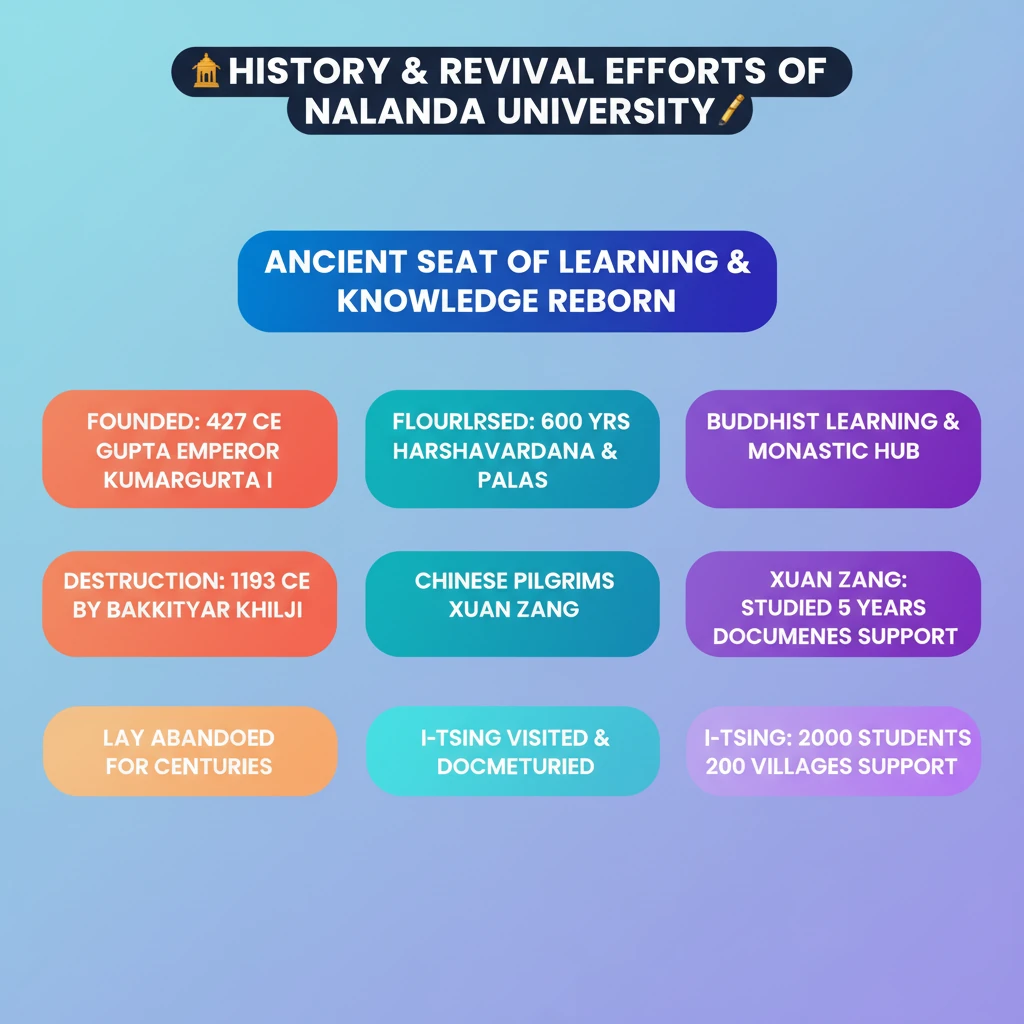
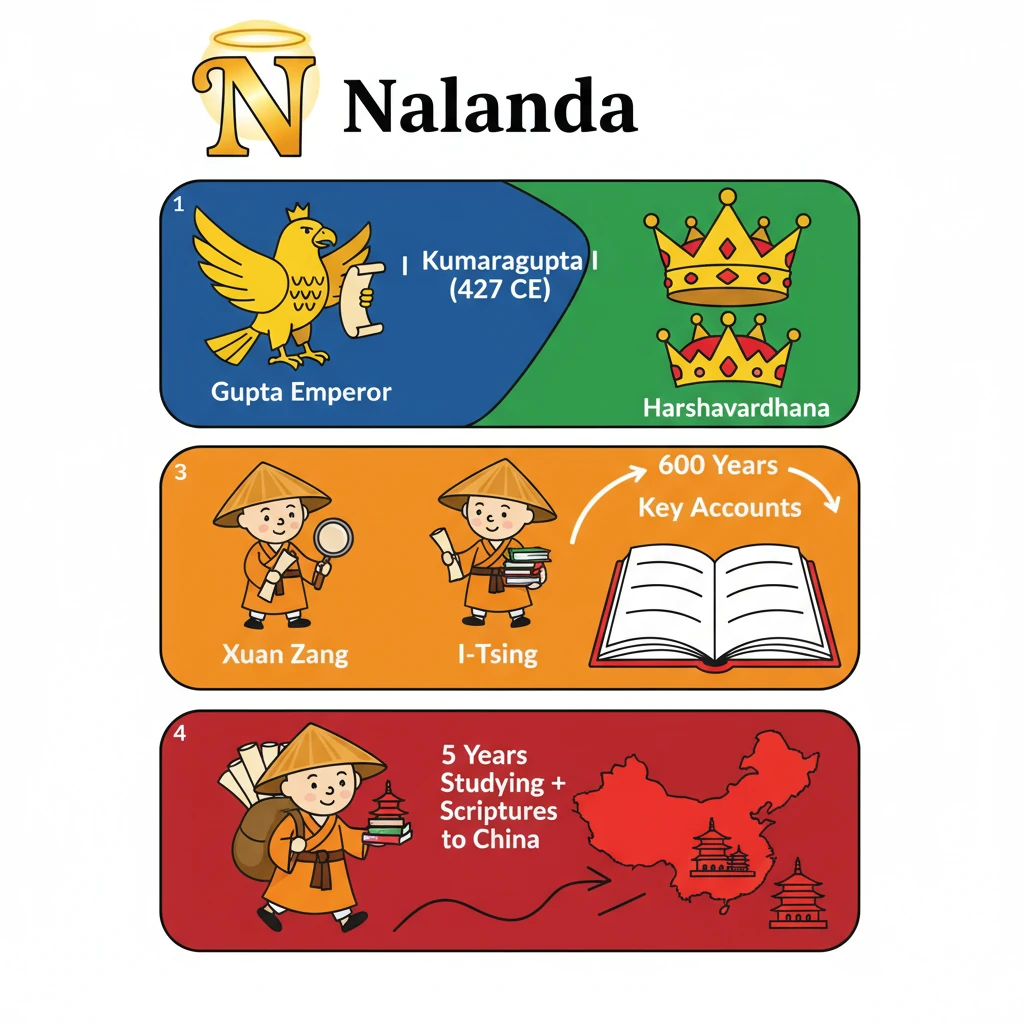
- •Nalanda University founded by Gupta Emperor Kumaragupta I in 427 CE.
- •Flourished for 600 years, prominent under Harshavardhana and Palas.
- •Visited by Chinese pilgrims Xuan Zang and I-Tsing, providing key historical accounts.
- •Xuan Zang studied for 5 years and took scriptures to China.
- •I-Tsing reported 2,000 students supported by 200 villages in 670 AD.
- •Represents a peak of ancient Indian education and international intellectual exchange.
🧠 Memory Techniques
95% Verified Content