Was QIM a Spontaneous Outburst, or an Organized Movement? - History | UPSC Learning
Topics
0 topics • 0 completed
🔍
No topics match your search
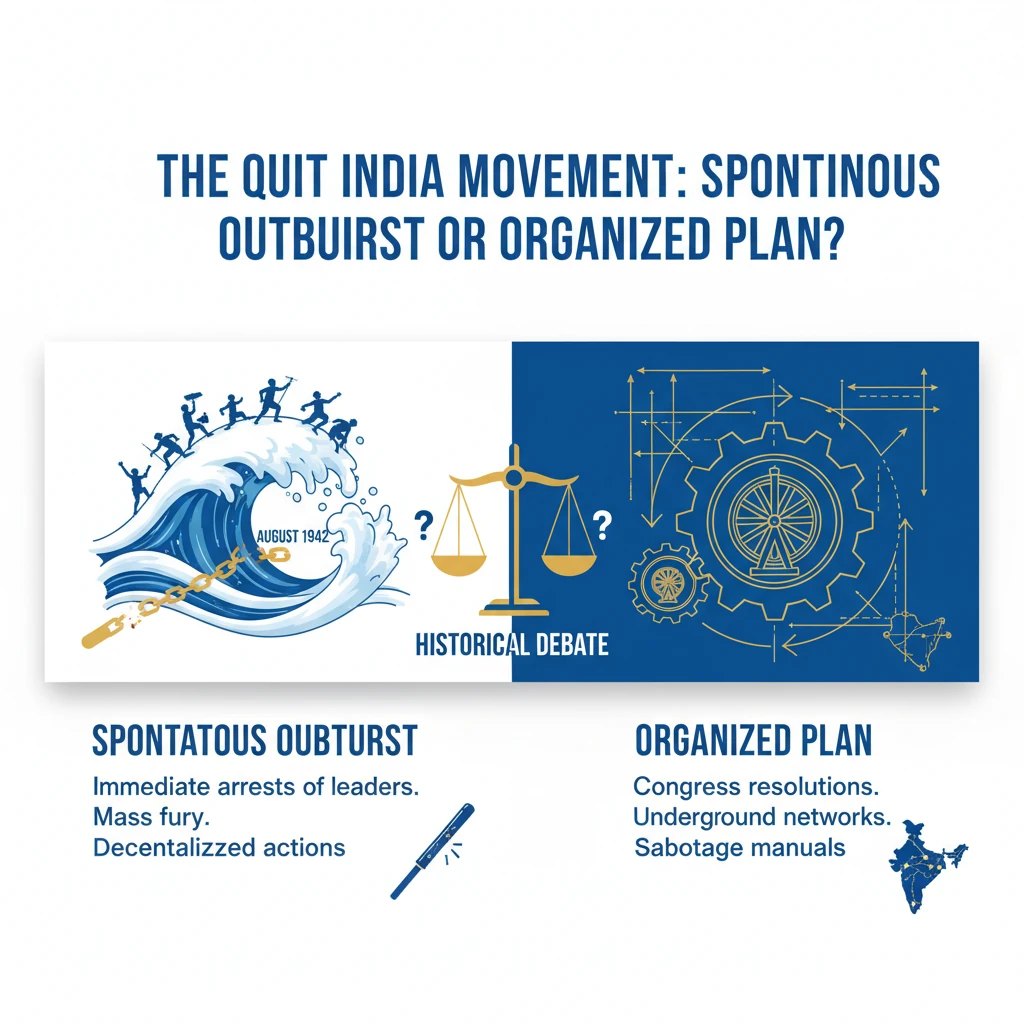
Was QIM a Spontaneous Outburst, or an Organized Movement?
Medium⏱️ 7 min read
history
📖 Introduction
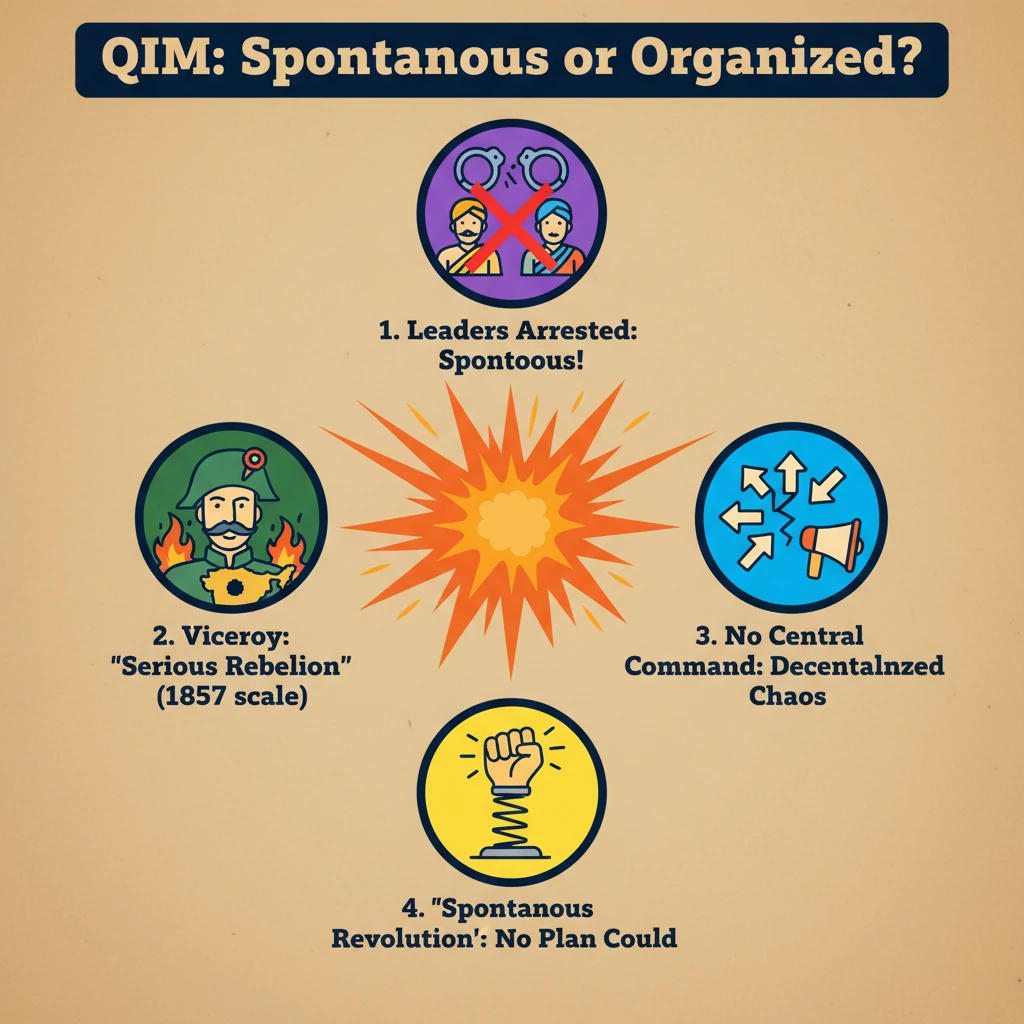
<h4>The Quit India Movement: Spontaneous Outburst or Organized Plan?</h4><p>The nature of the <strong>Quit India Movement (QIM)</strong>, launched in <strong>August 1942</strong>, has been a subject of historical debate. Historians often ponder whether it was a pre-planned, organized rebellion or a sudden, spontaneous reaction from the masses.</p><p>The immediate circumstances surrounding its launch provide strong arguments for its spontaneous character, especially given the rapid arrest of key leaders.</p><h4>Arguments for a Spontaneous Outburst</h4><p>One of the primary reasons for characterizing the <strong>QIM</strong> as a spontaneous outburst was the swift and decisive action taken by the British authorities. The entire <strong>upper echelon of the Congress leadership</strong> was incarcerated even before the movement could properly commence.</p><p>This pre-emptive arrest left the masses without central guidance or a preconceived plan. Consequently, the movement unfolded in a largely uncontrolled and uncoordinated manner across various regions of India.</p><div class='info-box'><p><strong>Viceroy Linlithgow's Assessment:</strong> The then <strong>Viceroy, Lord Linlithgow</strong>, famously described the <strong>Quit India Movement</strong> as 'by far the most serious rebellion since <strong>1857</strong>'. This highlights the unprecedented scale and intensity of the uprising.</p></div><div class='key-point-box'><p><strong>Characterization as a 'Spontaneous Revolution':</strong> Due to the absence of a central command and the immediate, widespread nature of the protests, the <strong>Quit India Movement</strong> is often termed a '<strong>spontaneous revolution</strong>'. It is argued that 'no preconceived plan could have produced such instantaneous and uniform results' across the subcontinent.</p></div><div class='exam-tip-box'><p>When analyzing the <strong>QIM</strong> for <strong>UPSC Mains (GS Paper I)</strong>, it's crucial to discuss its spontaneous elements. Focus on the immediate triggers and the nature of participation to substantiate its character as a mass uprising.</p></div>
💡 Key Takeaways
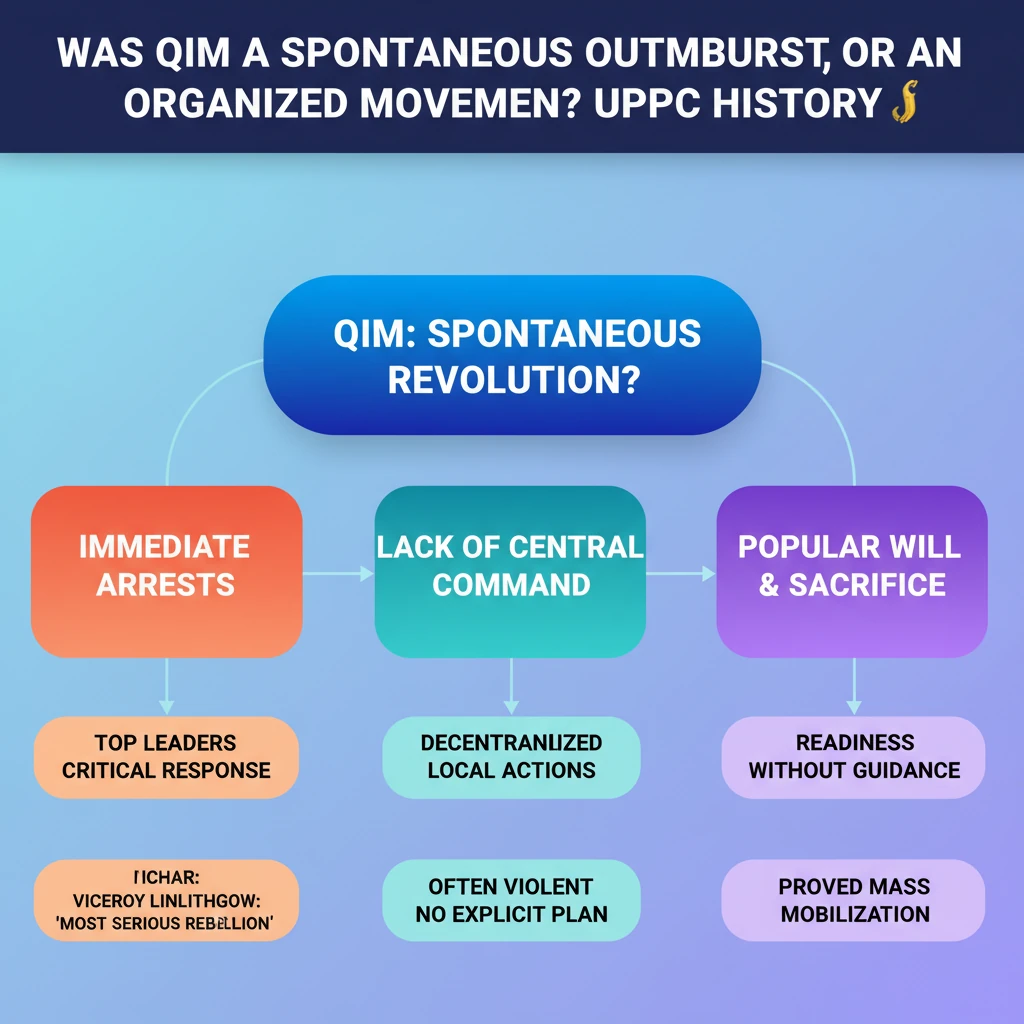
- •QIM was largely spontaneous due to the immediate arrest of top Congress leaders.
- •Viceroy Linlithgow called it 'the most serious rebellion since 1857'.
- •Lack of central command led to decentralized, often violent, local actions.
- •Characterized as a 'spontaneous revolution' because no plan could yield such immediate results.
- •Demonstrated immense popular will and readiness for sacrifice without explicit guidance.
🧠 Memory Techniques
95% Verified Content
📚 Reference Sources
•Bipan Chandra, India's Struggle for Independence
•Spectrum, A Brief History of Modern India